
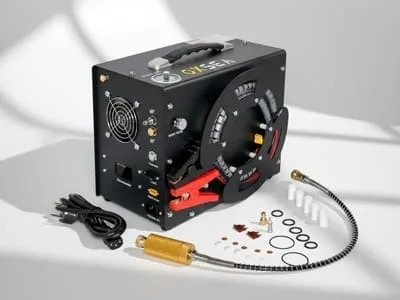
12 V / 220 V mini compressor
Refills 0.5 L and 1 L tanks from a battery or the mains
Last units
€549.99
Tip12 min read
Refill a mini scuba tank with a 12V compressor running off your boat battery: which battery to use, how many amp-hours per fill, the wiring, the air.
Yes, a 12V scuba compressor can refill a mini scuba tank on board, running straight off the boat's battery. With the OXSEA 12V/220V mini compressor, allow about 12 minutes for a 0.5 L tank and about 20 minutes for a 1 L tank. The battery handles it well on three conditions: you connect the compressor to the house battery and never to the engine's starting battery, you know how many amp-hours each refill takes, and you charge the battery back up to full right afterward.
Then there is the air. Whatever the compressor draws in on deck, you will be breathing under the hull. Where you set the unit down and whether the engine is running during the fill matter as much as the wiring.
A scuba tank is filled to 200 bar (about 2,900 psi). A tire or dinghy inflator works at a few bar, and a shop air compressor tops out at around ten (roughly 150 psi). Neither one comes close to the pressure required, and neither is built to supply air you breathe. You need a high-pressure compressor designed for the job, with its own filters.
The OXSEA mini compressor belongs in that category. It runs on 12 V from a battery or on 220 V from the mains. It fills all three tanks in the range, each with a working pressure of 200 bar: the OX500 and the OX500Plus (0.5 L) in about 12 minutes, the OX1000 (1 L) in about 20. With no full-size scuba tank on board, it is the only way to fill the OX1000, because the manual pump only works with 0.5 L tanks.
A 0.5 L tank gives you up to 8 minutes underwater, a 1 L tank about 15. Those times change with your breathing, your depth and how hard you are working. Clearing a propeller or scraping a hull often takes several dives, which means several refills in the same day. That is where the battery comes in.
| Where you are | Power source | What to watch |
|---|---|---|
| In a marina, next to a shore power pedestal | 220 V from the mains | Nothing comes out of the battery. Watch out for exhaust from neighboring boats. |
| At anchor | 12 V, house battery | The amp-hours you use. Engine off during the fill. |
| Ashore, next to the car | 12 V, vehicle battery | Engine off. One or two refills, then drive to recharge the battery. |
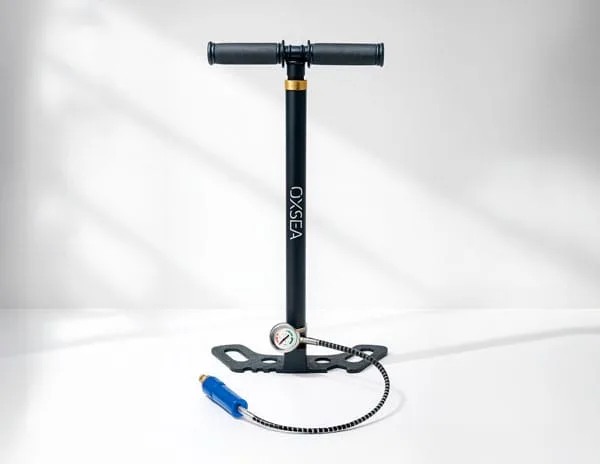
| On a boat with no battery | Manual pump, for 0.5 L tanks only | About 20 minutes of pumping per tank. |
Most recreational boats carry at least two batteries: one to crank the engine, and a house battery for everything else. The manufacturer Victron Energy spells it out in its book Energy Unlimited: Electricity on Board: the starting battery should feed the starter motor and nothing else. It is built to deliver a very high current for a few seconds. Its thin plates warp when it is discharged deeply and often, and the book places it among the batteries that are unsuited to repeated charge and discharge cycles.
So the compressor goes on the house battery. Does your boat have only one battery, the one that starts the engine? Then don't run it down at anchor. Fill your tanks in the marina or ashore before you head out, or keep a manual pump on board if you dive with a 0.5 L tank.
Two notes depending on the battery type. Among sealed lead-acid batteries, AGMs cope with high currents better than gel batteries, according to both Victron and INRS, France's occupational health and safety institute. With a lithium battery, look up the maximum discharge current in its manual and make sure it is higher than the compressor's draw.
The math fits on two lines. The current, in amps, is the compressor's power in watts divided by 12. The consumption, in amp-hours (Ah), is that current multiplied by the running time in hours: 12 minutes is 0.2 hours, 20 minutes is a third of an hour.
| Compressor current | 0.5 L refill (about 12 min) | 1 L refill (about 20 min) |
|---|---|---|
| 20 A | 4 Ah | 6.7 Ah |
| 30 A | 6 Ah | 10 Ah |
| 40 A | 8 Ah | 13.3 Ah |
These three rows are worked examples, not measurements. The figure that counts is the current printed on your unit's rating plate or in its manual. If you can't find it for an OXSEA mini compressor, ask us. Better still, if the boat has a battery monitor, note the amp-hours used during one refill: that gives you the real number for your own setup.
Next, compare that with the battery. Its capacity is rated for a slow discharge, often over 20 hours: a 100 Ah battery can deliver 5 amps for 20 hours, as INRS explains (in French). The harder you draw on it, the less it gives back. In Victron's tables, a 200 Ah semi-traction battery returns only about three quarters of its capacity when asked for 40 amps. And on a lead-acid house battery, the share you can really use is no more than half the rated capacity, again according to Victron.
A 100 Ah battery therefore leaves you 50 Ah at best, to share with the fridge, the instruments and the lights. In the 30 amp example, a 0.5 L refill uses 6 of them and a 1 L refill uses 10. Two or three refills over the day are no problem for a battery bank in good shape and fully charged. Eight 0.5 L refills back to back would eat up the entire usable reserve.
A voltmeter gives you a reference point, provided you read the battery voltage after it has rested for a few hours, with nothing charging it or drawing from it. While the compressor runs, the voltage sags and tells you nothing about the state of charge.
| Resting voltage (12 V lead-acid battery) | Battery state |
|---|---|
| 12.65 V or more | Full |
| 12.45 V | One quarter discharged |
| 12.24 V | Half discharged: stop there |
| 12.06 V | Three quarters discharged |
| 11.89 V | Empty |
These values come from Victron's book, which presents them as a general indication. One last habit, the one that makes a battery last: recharge it fully after the session. A lead-acid battery left discharged sulfates, and in the end the damage can't be undone. Victron recommends never leaving it more than 50% discharged and bringing it back to 100% on a regular basis.
At 12 V, a few hundred watts already add up to several dozen amps. Choose the cables and the protection to match.
The other hazard is less well known. A lead-acid battery gives off hydrogen, especially toward the end of a charge, and some of it lingers around the battery after charging has stopped. That is what the INRS fact sheet on charging lead-acid batteries, mentioned above, describes. In a closed locker, this gas mixed with air ignites from a single spark. A clamp brought close to a terminal is enough to make one.
Hence this sequence, to follow at every refill.
The whole procedure is filmed in the video “Use the 12 V / 220 V mini compressor” in the OXSEA School. Watch it before your first fill, not on the day a line gets wrapped around the prop.
The temptation makes sense: leave the engine running so the alternator backs up the battery while the compressor works. Don't do it. A running engine means exhaust, and exhaust contains carbon monoxide.
DAN (Divers Alert Network), the reference organization for diver safety, lists engine exhaust among the sources of breathing gas contamination, along with oil from an overheating compressor, cigarette smoke and paint fumes near the air intake. Carbon monoxide has no smell and no taste. Underwater, it impairs judgment and can make you pass out. A study published by INRS (in French), covering fifteen years of compressed air testing at the French Navy laboratory in Toulon, points to the same culprits: exhaust from machines with combustion engines, and lubricants broken down by heat.
The right sequence is simple. You fill with the engine and the generator off. You run the engine afterward, with the tank disconnected, to bring the battery back up. In a marina, look around you too: a neighbor's diesel warming up, a generator sitting on the dock, a car idling near the pier are all exhaust, just like yours.
Moisture counts as well. The same study calls it the least well controlled parameter in compressed air, because very dry air is hard to obtain by compressing the surrounding air directly. Too much moisture encourages corrosion inside a metal tank. On board, the air is damp and salty: keep the air intake out of the spray and keep the filters current. They are consumables, and the “Change the filters” video in the OXSEA School shows how to replace them.
If the air from a tank has an unusual smell or taste, don't use it. The opposite proves nothing, since carbon monoxide can't be smelled. Your protection is where you place the air intake.
Plugged into the dock pedestal, the same compressor runs on 220 V and asks nothing of the battery. It is the easiest way to leave with full tanks. Fill them the day before, check the gauges, then stow them wedged in, away from heat and knocks.
Do the very first fill and the first trial run in the marina as well. A new tank arrives empty, and you would rather get to know the gear at the dock than at anchor with a line in the prop. The guide on the mini scuba tank for boats covers choosing a model and stowing it on board.
Running the compressor at anchor through a 12 V to 230 V inverter gains you nothing. You put one more device, with its own losses, between the battery and the compressor. Use its 12 V connection.
Still deciding between a compressor, a pump and a transfer from a full-size tank? The guide on how to refill a mini scuba tank compares the three methods, with times and budgets.
Refilling is only half the job. Before any work under the boat, four rules are not open to debate.
Stay shallow and head up while there is still air showing on the gauge. The mini scuba tank safety guide goes through these points one by one.
Short answers to the questions this guide raises.
A single refill takes a few amp-hours, which a house battery in good condition supplies without trouble. The risk comes from refills done back to back, from a battery already drawn down by the fridge, or from a connection to the starting battery. Work out the consumption from your unit's current and don't go below half the capacity of a lead-acid battery.
With the OXSEA mini compressor, about 12 minutes for a 0.5 L tank (OX500, OX500Plus) and about 20 minutes for the 1 L OX1000. The time is the same on 220 V mains power.
No. Exhaust contains carbon monoxide, with no smell and no taste, and the compressor can draw it in and send it into the tank. Fill with the engine and the generator off, then start the engine afterward to recharge the battery.
Only if that socket's fuse can carry the compressor's current, which you can check on the fuse holder or in the boat's manual. If in doubt, connect the unit to the house battery with its original cable.
No. These devices work at a few bar, while a scuba tank is filled to 200 bar, and they are not designed to supply breathable air. You need a high-pressure compressor built for diving, with its filters.
Avoid drawing at anchor on the battery that has to restart the engine. Fill the tanks in the marina on 220 V, or ashore, before you cast off. For a 0.5 L tank, the manual pump stays the backup on board: about 20 minutes, with no power at all.
External documents this text relies on.
Prices include VAT; stock is live on each product page.
Refills 0.5 L and 1 L tanks from a battery or the mains
Last units
Guides that build on this one.
Guide5 min read
A mini scuba tank comparison of OXSEA's three models: refilling, time underwater, how you carry them and price, reviewed to help you find the one you need.
Guide9 min read
Mini scuba tank safety: where is the danger? Ascent, refilling, upkeep, transport, contraindications. The real risks and the precautions, with sources.
Guide9 min read
With or without a 12 V battery, which mini scuba tank for boats should you carry? Models, refill times, stowage on board and the safety rules to follow.

Each pack bundles the tank, its refill system and the accessories. Still unsure? Email us and we'll point you to the right one.