
Guide9 min read
Mini scuba tank for boats: getting equipped to work under the hull
With or without a 12 V battery, which mini scuba tank for boats should you carry? Models, refill times, stowage on board and the safety rules to follow.
- Written by
- The OXSEA team
- Published on
- Updated on
On this page
- Four reasons to go below the waterline
- First question: does your boat have a 12 V battery?
- Three tanks, two ways of carrying them
- From parcel to locker: first fill, trial run, stowage
- Before you get in: what is settled on deck
- Under the hull: managing your air and surfacing in time
- Frequently asked questions
Under a boat, holding your breath only gets you so far. The job often comes down to a string of short dives, during which you can barely see what you are doing. A mini scuba tank kept on board gives you a few minutes in the same spot, looking straight at whatever is stuck.
Which model to pick depends first on how your boat is equipped. Refilling on board comes next, then the precautions that keep an underwater job free of avoidable risk. The whole range is in the OXSEA mini scuba tank shop.
Four reasons to go below the waterline
A line fouls the propeller on the way back to harbour, or the keys go over the side at anchor: trouble of this kind rarely gives any warning.
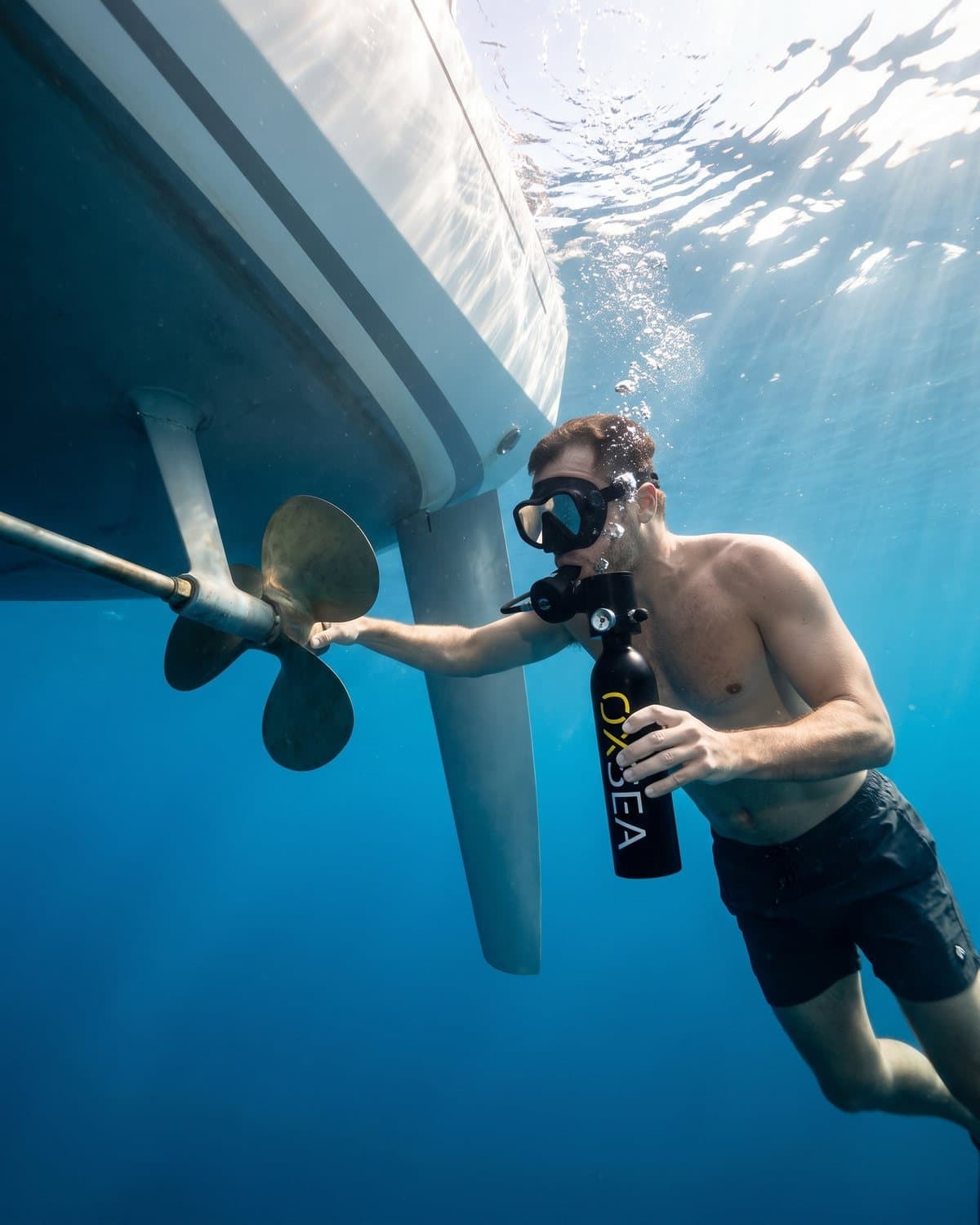
- A rope wound round the propeller. A pot line, a fender line, a shred of netting: once it has pulled tight on the shaft or on the drive leg, one breath-hold is seldom enough to slice through it. Breathing from the tank, you cut one turn, then the next, and finish by making sure nothing is left trailing.
- An anchor stuck on the bottom. In a shallow anchorage, the chain leads you down to it and you work it loose by hand. If the anchor is caught deeper than the zone near the surface where you can work, give up.
- Something gone overboard. Keys, a phone or a winch handle can often be recovered within minutes, provided the bottom is close and the water clear.
- A hull to inspect. You have touched bottom, you are getting ready for a passage or you want to know how the antifouling is holding up: a spell underwater shows you the hull, the keel, the rudder and the propeller. You can also judge whether the anode will see you through to the next haul-out.
First question: does your boat have a 12 V battery?
The answer settles how you refill, and how you refill settles which model you can take on board.
No battery: the manual pump
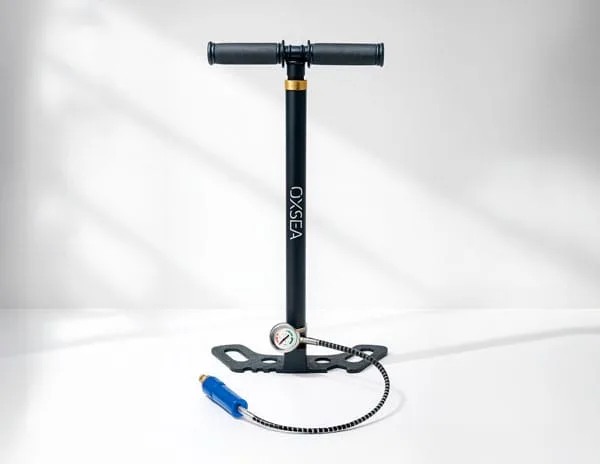
On a tender, a small sailing boat or a RIB that has no battery, you fill up with the OXSEA manual pump (€159.99). It needs no power and is quick to set up, on deck, on the quayside or ashore. Count on pumping for about 20 minutes to fill a 0.5 L model.
A 12 V battery: the mini compressor
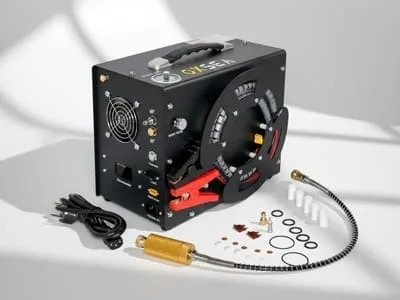
The OXSEA mini compressor sells for €549.99. It draws its power from the boat's 12 V battery or, in harbour, from 220 V shore power. Filling goes faster than with the pump: roughly 12 minutes for 0.5 L, roughly 20 minutes for 1 L. It is the right tool when one job follows another through the day.
Stand it outside, clear of the engine exhaust and of the exhaust from any generator. A study published by INRS, France's occupational health and safety institute, notes that carbon monoxide in compressed air can come, among other sources, from the exhaust of a machine with a combustion engine.
A full-size scuba tank on board: the transfer station
If you already sail with a full-size scuba tank, the transfer station (DIN or yoke fitting) draws enough air from it to fill any one of the three mini tanks. With an OX1000, the operation takes about 1 minute.
Three tanks, two ways of carrying them
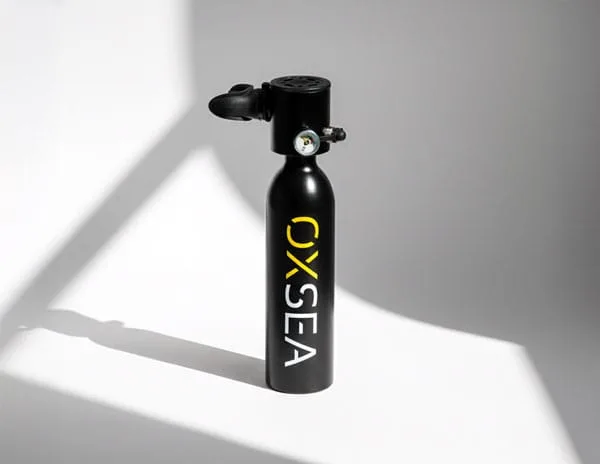
OX500, held in the mouth. The OX500 mini tank (€199.99) is the one we recommend, together with the manual pump, for a boat with no electricity. You hold it in your mouth by its silicone mouthpiece, a built-in gauge shows the air you have left, and it weighs under 1 kg once submerged. The pack that brings tank and pump together is priced at €359.99.
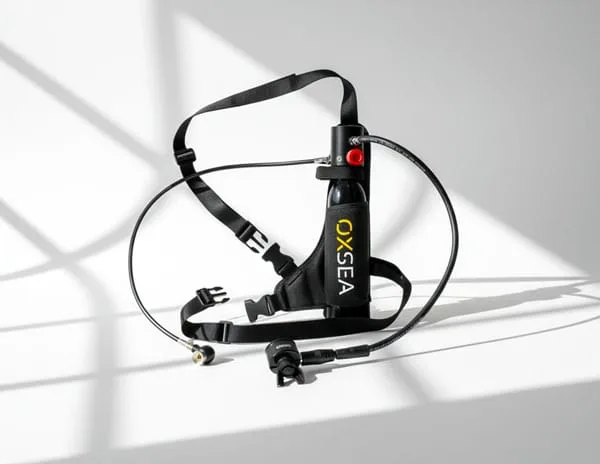
OX500Plus, in the mouth or on your back. The OX500Plus (€289.99) carries the same volume of air as the OX500: 0.5 L, which means up to 8 minutes. What it adds is the option of wearing it on your back, thanks to a harness and an external regulator. You then keep one hand for holding the propeller shaft and the other for cutting. It is supplied with an external pressure gauge.
OX1000, for staying down longer. With 1 L of air, the OX1000 (€299.99) offers about 15 minutes. It goes on your back, using a harness and an external regulator. A warning before you buy: the manual pump cannot fill it. It needs the mini compressor, or else a transfer station hooked up to a full-size scuba tank. Hence the OX1000 and mini compressor pack, listed at €849.99.
The OX500, OX500Plus and OX1000 comparison sets the three models side by side, one criterion at a time. The table below starts from your situation on board.
| Your situation | Refill method and time | Tank to take on board |
|---|---|---|
| Propeller caught in a net or a line, both hands busy | About 20 min by manual pump or about 12 min by 12 V mini compressor | OX500Plus, worn on your back |
| Boat with no battery: a quick look or an object to fish out | About 20 min by manual pump | OX500 |
| Full inspection of the hull and a check on the anode | About 20 min by 12 V mini compressor or about 1 min by transfer station | OX1000 |
| 12 V battery available, repeated jobs over the day | About 12 min by 12 V mini compressor | OX500 or OX500Plus |
| You already carry a full-size scuba tank | Transfer station, DIN or yoke | Any of the three tanks |
From parcel to locker: first fill, trial run, stowage
An OXSEA tank ships empty: when it is delivered, there is no air in it. So the first fill and the trial take place in harbour, not on the day you need the tank out at sea. The OXSEA School brings together the video tutorials that go through assembly and filling in detail.
After every use at sea, our product pages ask for a fresh-water rinse, then storage away from heat and knocks. On board, that means a cubby or a locker in which the tank is wedged in place (it must not roll as the boat heels), and never the deck in full sun.
Keep it where you can get at it, along with the mask and the knife. A propeller does not pick its moment to swallow a line, and digging under the sail bags wastes time.
Before you get in: what is settled on deck
Engine off, not just in neutral
Stop the engine before anyone enters the water and get the crew to agree: nobody restarts it before you have climbed back aboard. DAN Europe is an assistance network that specialises in diving. Before any engine is started, it asks you to make sure that no diver is under the boat or close by. Its magazine, Alert Diver, has described one accident: the engine was sitting in neutral when the divers got into the water, it was then put into gear and the propeller struck a diver. So neutral protects you from nothing. The engine has to be switched off.
Someone stays on board
Never dive alone. The reminder comes from the French ministry responsible for the sea, which advises diving with a buddy of the same level, each watching over the other. For work beneath the hull, have one more person stay on board. That person knows your plan and how long it should take, sees to it that the engine is left untouched and knows how to raise the alarm. At sea, the first way to reach the coastguard (the CROSS, in France) is by VHF, on channel 16. From the French coast, the CROSS also answers on 196, a free number that any phone can dial. Elsewhere in Europe, the emergency number is 112. Further afield, dial the local emergency number.
The Alpha flag signals a diver down
The Alpha flag, blue and white, is part of the International Code of Signals. The French ministry states that a dive support boat must fly it for as long as the diver remains in the water. Rule 27 of the International Regulations for Preventing Collisions at Sea also covers boats less than 12 metres long that take part in diving operations. Dive flag rules differ from one area to the next, so look up the ones in force on your stretch of water.
Training and a doctor's opinion
Diving has to be learned, the same ministry points out, and it directs people to a dive club where qualified instructors teach. It also recommends a visit to the doctor to confirm that there are no contraindications.
Under the hull: managing your air and surfacing in time
The quoted air times are upper limits, reached with calm breathing: 0.5 L gives up to 8 minutes, 1 L about 15 minutes. Effort, however, speeds up your breathing: haul on an anchor or cut through a rope that has pulled tight, and the supply shrinks faster.
So prepare everything you can before entering the water: the knife is secured to your wrist, the spot you are heading for has been picked out from on board, everyone knows their part. Read the gauge before the descent, then at regular intervals. Decide to come up while you still have air, not on the final breath.
A line that is jammed solid may call for two or three dives: if so, allow for the refill time between them.
Stay under your own boat
Your work is beneath your boat, not in the surrounding water. Before going down, check for current. If there is any, keep a hand on a line made fast to the boat. Divers carried off by the current sometimes drift and fail to make it back to shore, the French ministry reports.
Keep breathing all the way to the surface
The air in the tank is compressed: never hold your breath as you come up. According to DAN, a breath held during the ascent can cause a lung overexpansion injury, and a shallow swimming pool is no exception. Breathe normally and without a break, particularly as you near the surface.
Give up when it is too deep
Under a boat, everything happens at shallow depth, a short way from the surface. Stay there. If the cause of the trouble lies further down, drop the idea or hand the job to a professional.
Frequently asked questions
Short answers to the questions this guide raises.
Can a mini scuba tank be refilled on a boat that has no electricity?
Yes, for the 0.5 L models (OX500 and OX500Plus): the manual pump fills them in around 20 minutes. It is not suitable for the OX1000 (1 L), which needs the mini compressor or the transfer station fed from a full-size scuba tank.
How much working time can you expect under a boat?
The OX1000 lasts about 15 minutes, a 0.5 L model up to 8 minutes. The slightest effort shortens those times. Keep your eye on the gauge and surface before the tank has run empty.
On a boat, is an OX500 or an OX500Plus the better pick?
For a quick look, or to fish an object out, the OX500 held in the mouth is the simplest. For freeing a propeller, the OX500Plus has the edge: with the same air time, it can go on your back as well, leaving both your hands free.
Can a mini scuba tank be used without any training?
Training is recommended. For anyone who wants to learn, the French ministry responsible for the sea points to a dive club and its qualified instructors. Our video tutorials explain how to get to grips with the equipment and how to refill it, but they are no substitute for a supervised introduction.
Products mentioned in this guide
Prices include VAT; stock is live on each product page.
12 V / 220 V mini compressor
Refills 0.5 L and 1 L tanks from a battery or the mains
Last units
€549.99
Read next
Guides that build on this one.
Guide5 min read
Mini scuba tank comparison: OX500, OX500Plus or OX1000, which one should you get?
A mini scuba tank comparison of OXSEA's three models: refilling, time underwater, how you carry them and price, reviewed to help you find the one you need.
Tip8 min read
How to refill a mini scuba tank: time, budget and precautions
Refill a mini scuba tank with a manual pump, a mini compressor or from a full-size tank: fill times, budget for 20 refills, air quality, mistakes to avoid.
Guide9 min read
Mini scuba tank safety: where the danger lies and how to avoid it
Mini scuba tank safety: where is the danger? Ascent, refilling, upkeep, transport, contraindications. The real risks and the precautions, with sources.

Everything comes in the pack
Each pack bundles the tank, its refill system and the accessories. Still unsure? Email us and we'll point you to the right one.