

Tip17 min read
How to clean a boat propeller in the water, step by step
Clean a boat propeller in the water, step by step: barnacle removal, tools for bronze, stainless or aluminum props, prop coatings, US rules and safety.
- Written by
- The OXSEA team
- Published on
On this page
- How do you clean a boat propeller in the water, step by step?
- Why does a fouled propeller cost you speed and fuel?
- How do you clean a propeller out of the water?
- Bronze, stainless steel or aluminum: which tools for which propeller?
- Can you drive a boat with a damaged prop?
- Which antifouling actually works on a propeller?
- How often should you clean a boat propeller?
- Should you hire a prop cleaning service?
- Are you allowed to clean your propeller in the water in the US?
- Safety: what has to happen before anyone goes under the stern?
- How long can you stay under the propeller with a mini scuba tank?
- Frequently asked questions
To clean a boat propeller in the water, stop the engine, take the key out and leave someone aboard, then dive with hand tools only: a scraper held almost flat to lift the barnacles, blade by blade from the hub outward, and a green Scotch-Brite pad to finish. Leave every chemical on shore, keep metal tools off the blade edges and off any coated prop, and look at the anode without scraping it. Whatever will not come off by hand waits for a haul-out, where a brass wire brush, fine wet-dry sandpaper and a diluted descaler can do the rest.
Two neighboring jobs have their own guides: cleaning the hull in the water and clearing a rope from the propeller. What follows stays on the prop itself, from the first barnacle to the coating that slows down the next ones.
How do you clean a boat propeller in the water, step by step?
- Check that you are allowed to. Some marinas restrict in-water cleaning or reserve it for certified divers. The US rules are summed up further down.
- Make the boat safe. Engine off, key out of the ignition and handed to the person who stays aboard, main battery switch off, generator off, dive flag up. The safety section below explains each point.
- Gather the kit. A plastic scraper, a putty knife for bare metal, a green Scotch-Brite pad, gloves (barnacle edges cut), mask and fins, something to hold on to (a line run tight under the hull or a suction-cup handle), and enough air: a breath-hold for a quick wipe, a mini scuba tank for real scraping.
- First dive: look, do not touch. Check the blades, the hub, the shaft, the strut and the anode. Note what the prop is made of and whether it carries a coating, since that decides your tools. On an outboard or sterndrive, look for fishing line around the prop shaft.
- Scrape blade by blade, from the hub out. Scraper almost flat, light strokes, never against the edges. Hold the shaft or your line, not the blade you are working on. Run a gloved hand over the blade afterward: Tom Neale, technical editor at BoatUS Magazine, notes in Soundings that young barnacles feel like coarse sandpaper and are already wasting fuel at that stage.
- Finish with the pad. On a lightly fouled prop, Practical Sailor finds the green Scotch-Brite pad usually does the job on its own. On a coated prop, use only a soft cloth or a gloved hand.
- Clean the hub, the shaft and the strut. Barnacles there disturb the water flowing into the prop, as the next section explains.
- Look at the anode, do not scrape it bare. If it has lost about half its size, plan to replace it: our guide on when to change boat anodes shows how.
- Stop where hand tools stop. California's Coastal Commission, in its factsheet on in-water hull cleaning, asks for the boat to be hauled out when growth will not come off with hand tools or calls for metal scrapers, so that paint and debris can be captured. The same factsheet asks boaters to keep cleaning products out of the water and never to raise a visible plume of paint. Apply both limits to a painted or coated prop.
- Back aboard, test. Rinse the tools and the tank in fresh water. Before anyone restarts the engine, check that nobody is left in the water. Then run at your usual rpm and compare the speed with what you got before.
Splitting the work helps: one dive to look, one per blade face, one for the hub, shaft and strut. With a mini scuba tank, each of those dives fits within a single fill, as the last section shows.
Why does a fouled propeller cost you speed and fuel?
A propeller is a set of small wings. Roughen their surface and they lose grip on the water. Practical Sailor puts a number on it: a film of growth and scale about 0.04 inch (1 mm) thick can cut a propeller's efficiency by 12 to 15%. The magazine adds that on a folding prop, a few barnacles in the wrong place are enough to stop the blades from folding.
Boat tests point the same way. The figures below come from owners and editors who measured their own boats, plus one reference from commercial shipping.
| Source | Boat | What the fouling cost |
|---|---|---|
| Yachting Monthly, 2021 | Sadler 29 sailboat, fixed two-bladed bronze prop | 1.5 knots lost under engine at the end of a season. With a silicone prop coating the next season, the loss stayed under half a knot. |
| BoatUS Magazine, 2020 | Grand Banks 32, close to 8 tons, single 24-inch four-bladed prop | After cleaning and coating the prop: half a knot more at the same 1,800 rpm (8 knots before), less vibration, about 1 gallon (3.8 L) less fuel on an 80-mile run. |
| Practical Sailor | Bronze propellers | About 0.04 inch (1 mm) of growth and scale: 12 to 15% less efficiency. |
| IMO GreenVoyage2050 | Merchant ships | Polishing the propeller: 3 to 4% less fuel burned by the main engine. |
The shaft and the strut matter too. Writing for Cruising World, the marine systems specialist Steve D'Antonio explains that barnacles on a shaft stir up enough turbulence to disturb the water flowing into the prop, which costs efficiency and brings noise and vibration. On a diesel, fouled running gear can also lead to fuel overload: black smoke, local overheating and soot. The German magazine YACHT adds that an imbalance, whether from a damaged blade or from shell growth, can seriously damage shafts, bearings and gears.
A simple habit catches barnacles on a boat prop early. With a clean prop, on a calm day, note your speed at a fixed rpm, the way the BoatUS editor knew his boat made 8 knots at 1,800 rpm. When the same rpm gives you less speed, look at the prop before blaming the engine.
How do you clean a propeller out of the water?
When the boat is hauled out, sitting on its trailer, or when the outboard is tilted all the way up, you can work in comfort and use stronger means. Before touching the prop, take the key out and turn off the power at the main switch: Practical Sailor gives that warning for any work on a propeller.
- Wash it while it is still wet. In its propeller care guide, YACHT advises hosing or pressure washing the prop as soon as the boat comes out: the more growth comes off wet, the easier the rest of the job.
- Scrape, then brush. A scraper for the hard growth, then a stiff brush for the soft growth that is left.
- Attack the shell bases gently. The calcified rings barnacles leave behind need a wire brush, preferably brass because it leaves no rust marks, or wet-dry sandpaper in 80 grit or finer. The aim, YACHT insists, is to remove the growth, not to sand the blade. Clean the hub as well.
- Use a descaler for what resists. In the nooks of a folding prop, Practical Sailor recommends Barnacle Buster. The concentrate is diluted between 20:1 and 5:1, starting with the weakest mix. Pour the acid into the water, never the other way around, and wear goggles and gloves. In the magazine's tests on brass and copper, only muriatic acid (hydrochloric acid) did measurable harm, after a long soak.
- Regrease a folding or feathering prop. Acid washes out the grease. Follow the maker's manual: some props need full disassembly every year, others only cleaning.
- Look after the anode. Practical Sailor's tip: a few passes of a wire brush reactivate it. Replace it before it has lost half its size.
- On an outboard or sterndrive, take the prop off now and then. Yamaha recommends checking for fishing line wrapped around the prop shaft, greasing the shaft with marine grease, fitting a new cotter pin and tightening the nut to the specified torque. While it is off, look for bends, nicks or cracks: according to Yamaha, they cost performance and can cause damaging vibration.
Bronze, stainless steel or aluminum: which tools for which propeller?
The metal decides what you can use. A look at the prop, or at your boat's paperwork, tells you which one you have.
| Propeller | To clean it | Out of the water only | To avoid |
|---|---|---|---|
| Bronze or brass, bare metal | Scraper, brass wire brush, wet-dry sandpaper 80 grit or finer, Scotch-Brite pad | Barnacle Buster type descaler, diluted | Long soaks in muriatic acid. Copper bottom paint: Practical Sailor notes that the bronze strips it of its biocide. |
| Stainless steel, bare metal | Scraper, brass wire brush, Scotch-Brite pad | For leftover stains, Yamaha's tips for most props: a rough-cast wheel cleaner left no more than 30 seconds, then a rinse and paste wax | Steel wire brushes, which can leave rust marks |
| Aluminum, painted | Plastic scraper and soft pad: the goal is to lift the growth, not the paint | Only products whose label allows aluminum | Copper antifouling. BoatUS rules it out on aluminum outboards and outdrives, Practical Sailor on aluminum props. |
| Any prop with a slick coating | Soft cloth, sponge, gloved hand | Fresh water rinse | Scrapers, pads and sandpaper. Propspeed and Prop One, for instance, have to be stripped back to bare metal before they can be recoated, according to Practical Sailor. |
Whatever the metal, keep the tools off the blade edges. A nick is not a cosmetic detail: Yamaha counts it among the defects that rob performance.
Can you drive a boat with a damaged prop?
Only as far as you need to, at low rpm, and only while the vibration stays mild. If it grows, stop and call for a tow. Yamaha says bends, nicks and cracks rob performance and can cause damaging vibration, and advises having the prop examined and repaired by a dealer. YACHT points out that an imbalance can seriously damage shafts, bearings and gears. On an outboard, Yamaha adds a check worth doing after any incident: anything wrapped around the prop shaft can cut into its seals and let water into the gearcase, and lower unit oil that looks milky means water has got in, a case for a pressure test of the seals at the dealer.
Fouling and damage often go together. Once the prop is clean, look closely at the edges: a nick hidden under barnacles shows up only after scraping.
Which antifouling actually works on a propeller?
A prop is hard to protect. YACHT gives an example: the tip of a 14-inch prop turning behind a 2:1 gearbox, at 2,000 engine rpm, moves through the water at about 42 mph (67 km/h). And according to Cruising World, most conventional antifouling paints barely stick, if at all, to an untreated metal prop. Yachting Monthly sorts the options into three families: bare polished metal, slippery silicone coatings and biocidal prop paints. Two simpler routes exist alongside them.
- Slick foul-release coatings (Propspeed, Prop One, Prop Defender, Hempel Silic One). They contain no biocide and rely on a surface organisms cannot grip. Results from the field: the BoatUS editor found his prop practically clean after a year of Propspeed, a product he received free of charge for the test, which he put at $400 for a year of protection; the brand's representative quoted 12 to 18 months between applications. Yachting Monthly held its speed loss under half a knot for six months with Prop Defender, although coral worm still took hold. YACHT reports a 2020 Dutch study, run on test panels, in which Silic One did well in moving salt water but did little in still salt water.
- Biocidal prop paints such as Velox Plus. Velox relies on zinc pyrithione, according to Yachting Monthly. In Practical Sailor's trials, Velox and Prop One both held about 21 months on a catamaran in Sydney, Australia, while on Chesapeake Bay the same two showed signs of failure in under six months. Same products, different water.
- Epoxy primer and hard bottom paint. Cruising World describes the method: abrade the metal, degrease, apply an epoxy primer as a tie coat, then a hard antifouling rather than an ablative one, keeping strictly to the time windows between coats. Practical Sailor adds one condition: avoid copper-based paints.
- Spray zinc. Pettit Barnacle Barrier gave Practical Sailor a year of protection on Chesapeake Bay, enough for a boat hauled every year. Some readers reported weaker results.
- Grease or polish. In low-fouling water, YACHT describes a yearly cleaning followed by a polish, or a coat of propeller grease, as often enough. In the Dutch study, plain milking grease kept test panels clean in fresh water.
Three rules hold whatever you pick. Preparation decides the result: for Propspeed, BoatUS describes removing every old coating and all fouling, sanding with 80 grit and wiping down with solvent. No coating ever goes on the anode: BoatUS is categorical on that point. And a biocidal product must be allowed where you keep the boat; in California, for example, copper hull paints are regulated as pesticides by the state's Department of Pesticide Regulation, as the Coastal Commission factsheet points out.
How often should you clean a boat propeller?
There is no universal schedule. Practical Sailor recommends inspecting the prop several times per season and removing barnacles while they are still soft, before they anchor themselves; for a folding prop, it considers maintenance at least once a year a must. The California factsheet gives the opposite safeguard: inspect regularly and clean only when the growth calls for it. Two signals tell you it is time:
- speed at your reference rpm drops, or the engine reaches that rpm with more effort;
- a gloved hand on the blade feels the coarse sandpaper Tom Neale describes.
If you clean every few weeks, the job takes minutes and needs nothing harsher than a pad. If you wait for a crust, it becomes a haul-out job.
Should you hire a prop cleaning service?
A hull cleaning diver makes sense when the prop is heavily fouled, when the water is murky or cold, when nobody aboard is comfortable going under the stern, or when the marina only allows certified cleaners. In Marina del Rey, Los Angeles County publishes the list of divers certified under its ordinance. Wherever you are, a few questions sort out a service:
- Do they follow best management practices for in-water cleaning, such as those developed by the California Professional Divers Association that the Coastal Commission factsheet refers to?
- Do they know how to clean a coated prop without damaging the coating?
- Will they report on the anode, the shaft and the edges of the blades, with photos?
Are you allowed to clean your propeller in the water in the US?
It depends on where the boat sits, and rules are mostly local. California offers the clearest examples.
- Marina del Rey. Since a 2018 ordinance, Los Angeles County requires everyone who cleans a hull in the water in this harbor, commercial divers and private owners alike, to follow best management practices and hold a BMP certification. Cleaning that leaves a visible paint plume is banned, anyone doing the work needs a Commercial Service ID from the Harbor Master, and the first two violations carry a fine of up to $250.
- The rest of the California coast. The Coastal Commission factsheet on hull cleaning is guidance, not a requirement, and site rules can go further. Its practices: clean by hand with cloth, plastic scrapers or soft scrubbers, never with wet sandpaper, no visible plume of paint, and no cleaning for 90 days on a freshly painted hull.
Before you go under your own stern, ask the marina office whether in-water cleaning is allowed at the slip, whether it must be done by a certified diver, and whether running gear is treated like the hull.
Safety: what has to happen before anyone goes under the stern?
- Engine off, key out, main switch off. BoatUS starts every propeller job with the engine stopped and the key out of the ignition, and Practical Sailor says the warning counts three times over when the boat is in the water.
- The prop is dangerous even when stopped. The Divers Alert Network (DAN) tells swimmers to stay clear of a propeller at all times, since an immobile prop can still injure, and asks the skipper to check that nobody is near or under the boat before starting up.
- Generator off as well. The US Coast Guard tells boaters to keep everyone away from engine and generator exhaust outlets and never to go under a swim platform where exhaust exits unless the area has been ventilated. Carbon monoxide collects exactly where you will be working.
- Fly the right flag. Under the federal navigation rules (Rule 27), a small vessel engaged in diving operations shows a rigid replica of the blue and white Alpha flag at least 3.3 feet (1 m) high, visible all around. States add their own rules for the red diver-down flag with a white diagonal stripe. In California, the state's ABCs of Boating recognizes that flag without making it compulsory. Rules differ from one state to the next: check your state's boating handbook.
- Never alone. BoatUS is explicit about it. Someone stays aboard, holds the key and knows how to call for help.
- Keep breathing all the way up. If you work on compressed air, never hold your breath while rising. DAN's Alert Diver magazine reports that even a 5-foot (1.5 m) ascent with a held breath can cause an arterial gas embolism.
How long can you stay under the propeller with a mini scuba tank?
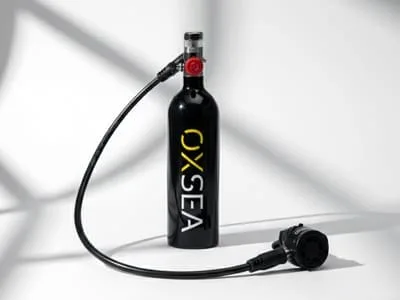
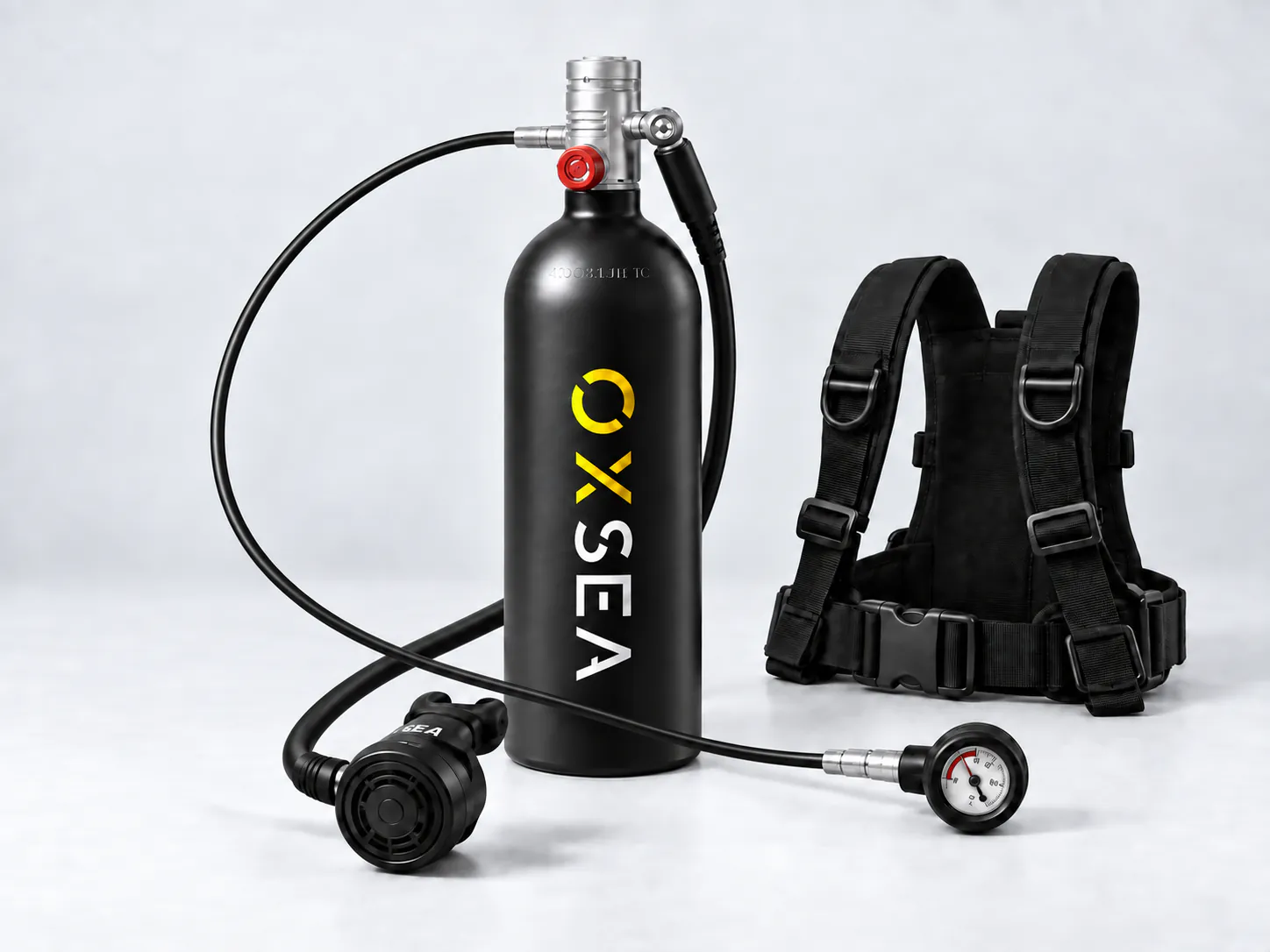
On a breath-hold, much of each dive goes into getting down and back up. With a mini scuba tank, you stay face to face with the prop and finish a blade before surfacing. The OXSEA range has four tanks.
- OX500: 17 fl oz (0.5 L) of air at about 2,900 PSI (200 bar), up to 8 minutes, held in the mouth.
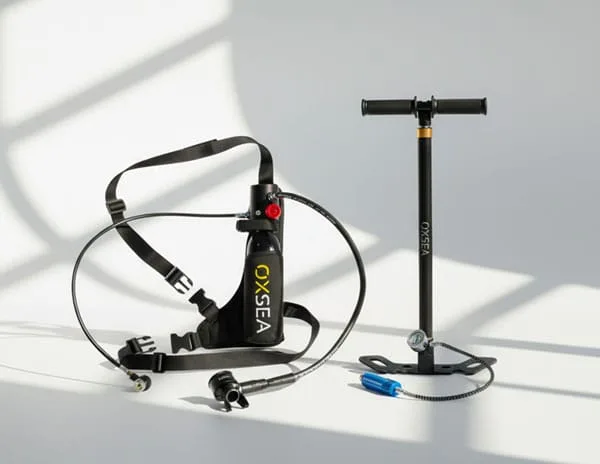
- OX500Plus: the same air, but it can also be worn on the back with a harness and an external regulator. One hand holds the shaft, the other works the scraper.
- OX1000: 34 fl oz (1 L) at about 2,900 PSI (200 bar), about 15 minutes, worn on the back.
- OX2000: 78 fl oz (2.3 L), 20 to 25 minutes, worn on the back, for the long jobs a large yacht propeller can call for. It is refilled from the mains with the Power Compressor 220 V, which the product page lists for 110 V or 220 V outlets.
These times are maximums, reached breathing calmly near the surface. Scraping is real effort and shortens them: watch the gauge and come up with air to spare. Time your first working dive and you know your real pace.
Between dives, refilling sets the rhythm: about 20 minutes with the manual pump for a 0.5 L tank (the pump does not fit the OX1000), about 12 minutes for 0.5 L and 20 minutes for 1 L with the mini compressor running on the boat's 12 V battery. The OX500Plus and manual pump pack needs no power at all, and the OX1000 and mini compressor pack suits longer sessions. Our guides to the 12V compressor on board and to mini scuba tank safety cover the rest.
Frequently asked questions
Short answers to the questions this guide raises.
How do you get barnacles off a boat prop?
Scrape them off with a scraper held almost flat, blade by blade from the hub outward, then go over the blade with a green Scotch-Brite pad. Out of the water, a brass wire brush or 80 grit or finer wet-dry sandpaper removes the shell bases, and a diluted descaler such as Barnacle Buster handles the nooks. In the water, use hand tools only.
Can you clean a propeller without taking it off the boat?
Yes. In the water, a scraper and a pad are enough for most fouling, with the engine off, the key out and someone aboard. Taking the prop off is still useful now and then on an outboard, to check for fishing line on the shaft and to grease it, as Yamaha recommends.
Can you drive a boat with a damaged prop?
Only at low rpm, as far as you need to, and only while the vibration stays mild. Yamaha warns that bends, nicks and cracks can cause damaging vibration and recommends having the prop examined. On an outboard, check the lower unit oil afterward: milky oil means water has reached the gearcase.
What should you never use on a boat propeller?
A long soak in muriatic acid, which did measurable harm in Practical Sailor's tests. Copper antifouling on an aluminum prop or outdrive, which BoatUS rules out. Scrapers, pads or sandpaper on a slick coating. And any paint on the anode.
Can you put bottom paint on a propeller?
Not ordinary copper bottom paint on its own: it barely sticks to bare metal, and on bronze the copper biocide is wasted. The methods that work use an epoxy primer and a hard antifouling, a dedicated prop coating, or spray zinc, with careful preparation in every case.
How often should you clean a boat propeller?
Whenever growth appears, ideally while the barnacles are still soft. Practical Sailor recommends several inspections per season. A drop in speed at your usual rpm is the most reliable signal.
Is a prop cleaning service worth it?
Yes when the fouling is heavy, the water is murky or cold, nobody aboard is comfortable under the stern, or the marina only allows certified cleaners. Ask whether the diver follows in-water cleaning best practices and reports on the anode and the blade edges.
How long does a mini scuba tank last for propeller cleaning?
Up to 8 minutes with an OX500 or OX500Plus (0.5 L), about 15 minutes with an OX1000 (1 L), 20 to 25 minutes with an OX2000 (2.3 L), breathing calmly near the surface. Scraping speeds up your breathing, so expect less, and plan one dive per blade face.
Sources
External documents this text relies on.
- notes in Soundings (soundingsonline.com)
- Practical Sailor (practical-sailor.com)
- factsheet on in-water hull cleaning (documents.coastal.ca.gov)
- Yachting Monthly (yachtingmonthly.com)
- BoatUS Magazine (boatus.com)
- IMO GreenVoyage2050 (greenvoyage2050.imo.org)
- Cruising World (cruisingworld.com)
- YACHT (yacht.de)
- propeller care guide (yacht.de)
- Yamaha (yamahaoutboards.com)
- BoatUS (boatus.com)
- Yamaha (yamahaoutboards.com)
- Practical Sailor's trials (practical-sailor.com)
- the same two showed signs of failure (practical-sailor.com)
- Los Angeles County (beaches.lacounty.gov)
- BoatUS (boatus.com)
- Divers Alert Network (DAN) (dan.org)
- US Coast Guard (uscgboating.org)
- federal navigation rules (navcen.uscg.gov)
- ABCs of Boating (dbw.parks.ca.gov)
- Alert Diver (dan.org)
Products mentioned in this guide
Prices include VAT; stock is live on each product page.
Read next
Guides that build on this one.
Guide6 min read
Mini scuba tank comparison: OX500, OX500Plus, OX1000 or OX2000, which one should you get?
A mini scuba tank comparison of OXSEA's four models: refilling, time underwater, how you carry them and price, reviewed to help you find the one you need.
Guide9 min read
Mini scuba tank safety: where the danger lies and how to avoid it
Mini scuba tank safety: where is the danger? Ascent, refilling, upkeep, transport, contraindications. The real risks and the precautions, with sources.
Guide9 min read
Mini scuba tank for boats: getting equipped to work under the hull
With or without a 12 V battery, which mini scuba tank for boats should you carry? Models, refill times, stowage on board and the safety rules to follow.

Everything comes in the pack
Each pack bundles the tank, its refill system and the accessories. Still unsure? Email us and we'll point you to the right one.