
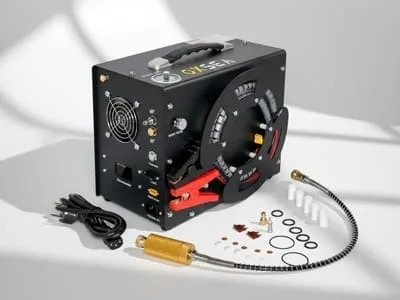
12 V / 220 V mini compressor
Refills 0.5 L and 1 L tanks from a battery or the mains
Last units
€549.99
Guide9 min read
Mini scuba tank safety: where is the danger? Ascent, refilling, upkeep, transport, contraindications. The real risks and the precautions, with sources.
At 200 bar, the compressed air in a mini scuba tank comes with a few rules. The most serious risk, though, is not the tank itself. It comes down to two things you do: how you breathe once you are underwater, and how you go about refilling. This guide goes through both and cites its sources. The models themselves are in our mini scuba tank shop.
Below the surface, every breath you take in is at the pressure of the depth you are at. When you head back up, that pressure falls and the air expands. So long as you keep breathing normally, the surplus escapes on its own. With your breath held, it stays trapped, stretches the lungs and ends up injuring them. This is a lung overexpansion injury, also known as pulmonary barotrauma. Air bubbles can then pass into the bloodstream: that is a gas embolism.
Staying near the surface does not keep you safe. The Divers Alert Network (DAN), an international body dedicated to the safety of divers, reports that a lung overexpansion injury can occur in a swimming pool. DAN also says that ascending roughly 1.5 metres with your breath held may be all it takes to set off a gas embolism. Proportionally, pressure changes most in the last few metres: air held in at 3.4 metres takes up a third more volume by the time you surface.
Coming up with full lungs is the freediver's habit. On compressed air, that habit turns dangerous. In 2019, the journal Diving and Hyperbaric Medicine published an account of a fatal accident, written by a hyperbaric physician and a diving safety specialist. A 26-year-old freediver had taken air from the regulator of a friend on scuba, at around 10 metres, and then ascended.
The two authors' conclusion: by breathing compressed air at depth, a freediver is exposed to the same risk as a scuba diver, lung overexpansion injury and gas embolism, if they do not exhale enough during the ascent. They point out that a gas embolism has been known to occur from a depth of only one metre.
The warning sign is chest pain after a session underwater, including pain that shows up several hours later. When that happens, call the emergency services: in France the SAMU on 15, across Europe the emergency number 112, elsewhere your local emergency number. DAN recounts what happened to an experienced diver who had not gone as deep as 5 metres. The pain began that same evening, and the diver was referred to the emergency department.
Breathing compressed air underwater brings the same mechanisms into play as a scuba dive. The French underwater sports federation, the FFESSM (Fédération française d'études et de sports sous-marins), publishes a list of contraindications to that activity, given as a guide. It covers certain heart conditions, certain lung conditions (asthma and a history of pneumothorax among them), certain ear conditions, some neurological diseases such as epilepsy, as well as pregnancy. Some of these are permanent, and the rest are weighed up case by case. DAN points out that obstructed airways can lead to a lung overexpansion injury even in someone who is breathing normally.
If you have the slightest doubt, get medical advice before using the tank at all, preferably from a doctor who practises diving medicine or from a sports physician.
The same list mentions alcohol, cannabis and medicines that can alter behaviour: after taking any of them, stay out of the water. Minors may only use the tank with a trained, responsible adult who stays at their side and actively supervises them.
No qualification is required to buy a mini tank, but training is still recommended. During an introductory dive at a club, an instructor shows you how to keep your breathing calm underwater and how to surface without holding your breath.
Our tanks are made from 6061 aluminium for a 200 bar working pressure, and go through leak and reliability tests. They come in two sizes: 0.5 litres for the OX500 and OX500Plus, 1 litre for the OX1000. Their other differences are set out in our OX500, OX500Plus and OX1000 comparison.
During filling, you read the pressure on the gauge (built in on the OX500, external and included with the OX500Plus). The safety disc is a protective component: a video tutorial shows how to replace it.
Stop at 200 bar, eyes on the gauge, even when you are using a transfer station connected to a full-size scuba tank: working pressure is never to be exceeded. According to DAN, over 90% of cylinder ruptures occur at the filling stage. Filled time after time close to its test pressure (higher than working pressure), or above it, a tank eventually deforms. After that, it can no longer hold even its working pressure.
The air you compress is the air you will breathe. DAN lists what can contaminate it. Carbon monoxide comes from exhaust fumes, or from the oil in an overheating compressor. Lubricants add hydrocarbons. Then come dust and moisture, and moisture encourages corrosion as well. And carbon monoxide has neither taste nor smell.
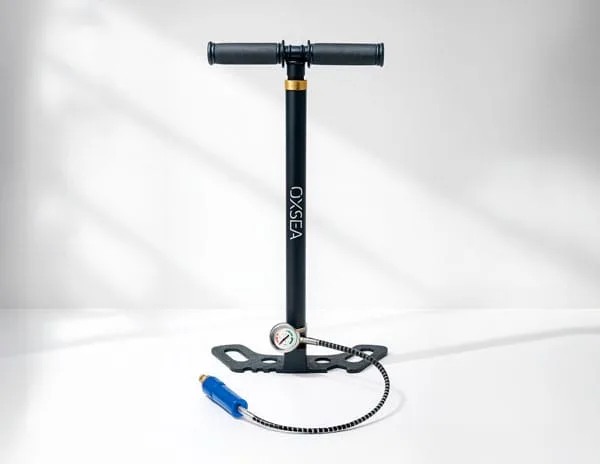
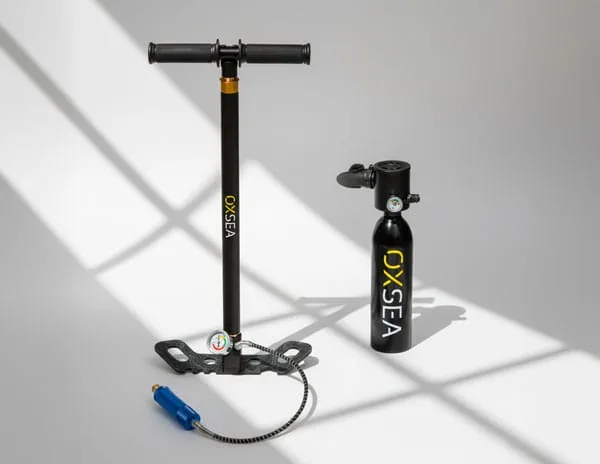
Both our 12V mini compressor and our manual pump have filters (the pump is for 0.5 litre tanks only). Filters are consumables and need changing regularly.
Corrosion or visible damage: according to DAN, the tank must no longer be used. The OXSEA School videos show how to replace the regulator seal, the safety disc or the filters, and how to look for a leak. Need a check or a repair? Write to us: our contact details are at the bottom of every page.
In France, an order (arrêté) of 20 November 2017 governs the in-service monitoring of pressure equipment. It imposes regular checks on scuba cylinders. First, a periodic inspection, at least once a year (Article 15). Next, a requalification (the periodic retest), at intervals of no more than two years, or six years when the annual inspection has actually been carried out to the prescribed specification (Article 18). For transportable vessels, an external check is added before each fill.
That order, however, covers only the equipment defined in Article R. 557-14-1 of the French Environmental Code. For group 2 gases, which include air, the article applies to vessels whose maximum allowable pressure multiplied by volume exceeds 200 bar-litres. It excludes those of 1 litre or less, as long as the maximum allowable pressure does not go beyond 1000 bar. Our tanks have a capacity of 0.5 litres or 1 litre and a working pressure of 200 bar. On our reading of the texts, this compulsory monitoring therefore does not apply to them. Rules differ in other countries, so check those in force in yours and wherever you get your tank filled.
All the same, we advise a periodic check carried out by a professional, at a frequency that matches how much you use the tank, and your own inspection at every refill.
| Type of check (French rules) | OXSEA mini tank (1 litre or less) | Standard scuba tank |
|---|---|---|
| External examination before filling | No obligation, but do it at every refill | Compulsory (Article 15) |
| Periodic inspection | No obligation under the order | At least once a year (Article 15) |
| Requalification | No obligation, periodic professional check advised | Every 2 years, or every 6 years if the inspection is annual (Article 18) |
DAN Europe states that no transport document and no label is required of a private individual who takes air cylinders along for personal use. Lay the tank down and wedge it between two bags so that it cannot roll. Protect the valve as well: DAN notes that injuries often occur when it has been damaged. Then there is heat, which you should avoid. In summer, a car boot can reach as much as 94 °C in some regions. The pressure inside rises as the temperature does, and the structure of aluminium can be altered if it stays above 60 °C for a long time.
IATA rules bar dangerous goods from passengers' baggage, listed exceptions aside. DAN Europe gives the threshold: once it holds 2 bar or more at 20 °C, a cylinder of compressed air falls into that category. So a full one never goes on board, whether in the hold or in the cabin. If it is empty, the decision rests with the airline, and some do refuse scuba cylinders: ask yours before booking and keep the written reply.
On the day of the flight, empty the tank entirely, declare it at check-in and present it with its valve head open or disconnected. Some airlines also require the valve head to be removed. Once you have arrived, you can refill without electricity using the pack that combines the OX500 and the manual pump.
Short answers to the questions this guide raises.
Yes, and one above all: lung overexpansion injury. It threatens anyone who comes up holding their breath, including at very shallow depth. The rules: breathe continuously, ascend slowly, stay near the surface and never refill above 200 bar.
In France, on our reading of the texts, no: the order of 20 November 2017 sets up compulsory monitoring, but the French Environmental Code (Article R. 557-14-1) exempts air vessels of 1 litre or less whose maximum allowable pressure stays within 1000 bar. Rules differ in other countries, so check locally. We still advise periodic checks by a professional, and a visual inspection at each refill.
Full, never. Empty, it depends on the airline: you need its agreement before booking. At the airport, the tank is declared at check-in, with its valve head open or disconnected.
Three precautions: refill outdoors, keep the air intake clear of any exhaust and use filters in good condition. If the air has an unusual taste or smell, do not dive. Carbon monoxide, however, cannot be detected by smell. So your first protection is where you put the air intake.
Prices include VAT; stock is live on each product page.
Refills 0.5 L and 1 L tanks from a battery or the mains
Last units
Guides that build on this one.
Tip8 min read
Mini scuba tank air time: up to 8 min from 0.5 L, about 15 min from 1 L, close to the surface. Two methods for estimating the time you will really have.
Tip3 min read
Fresh-water rinsing, seals, safety disc, refill filters, winter storage: the habits that keep an OXSEA mini tank in working order, and when to call after-sales.
Guide5 min read
A mini scuba tank comparison of OXSEA's three models: refilling, time underwater, how you carry them and price, reviewed to help you find the one you need.

Each pack bundles the tank, its refill system and the accessories. Still unsure? Email us and we'll point you to the right one.