
Tip10 min read
First time scuba diving with a mini tank: how deep, how long, what gear
First time scuba diving with a mini tank: how deep to go, how many minutes of air you get, what gear to bring, and the habits that prevent accidents.
- Written by
- The OXSEA team
- Published on
On this page
For your first time scuba diving with a mini tank, pick calm, shallow water where you can stand, and keep someone close by whose job is to watch you. The session will be short: a 0.5 L tank gives up to 8 minutes of air, a 1 L tank about 15 minutes, and those times drop as soon as you go deeper, work hard or get cold. One rule comes before all the others: keep breathing at all times, and never hold your breath on the way up.
Most of what follows also applies to a first dive on a full-size scuba tank: choosing the spot, checking your health, equalizing your ears, arranging for someone to watch you. Only the air time and refill figures are specific to OXSEA tanks.
How deep should you go on your first dive?
Less deep than you imagine. What makes a first descent tricky is not the number of meters, it is the pressure. At the surface it is 1 bar (about 14.5 PSI). At 10 meters (33 feet) it doubles. And the sharpest change happens close to the surface, a point DAN's Alert Diver magazine makes in a piece on shallow-water accidents. DAN, the Divers Alert Network, is an international organization devoted to diver safety.
Two consequences follow, starting at the very first meter. Your ears feel the pressure before you even have the sense of having gone down. And your lungs cannot cope with a held breath. According to the same article, rising about 1.5 meters (5 feet) while holding your breath can be enough to cause a gas embolism, and this kind of accident can happen even in a swimming pool.
French dive clubs work with a benchmark. France's sports code, the Code du sport, places the introductory dive (the "baptême") in the 0 to 6 meter zone (0 to 20 feet), with one instructor for a single diver (Annex III-16a). That framework assumes a qualified instructor within arm's reach. With just a buddy and a mini tank, stay well shallower.
The right starting depth is water you can stand up in. You can straighten up at any moment and get your head out without swimming. One caveat: shooting up to standing with full lungs from the bottom of water you can stand in comes very close to the scenario DAN describes. Breathe out as you stand. The next meters come from one session to the next, once equalizing your ears and slow breathing have become automatic. Our mini scuba tank safety guide explains these mechanisms in detail.
Before you get in the water: health, location, supervision
According to figures from France's regional sea rescue coordination centers (CROSS), cited by the French ministry in charge of the sea, a quarter of fatal accidents linked to recreational boating involve divers, on scuba or freediving. The ministry's underwater leisure fact sheet (Loisirs sous-marins) fits on two pages. The three checks below are based on it.
Your health
The ministry advises seeing a doctor to rule out any contraindication. The indicative list from the FFESSM, France's national diving federation, mentions in particular asthma, a history of pneumothorax (collapsed lung), a perforated eardrum or ear tubes, epilepsy and pregnancy. It also lists alcohol, cannabis and current infections as temporary contraindications. These are cases to assess with a doctor, not a diagnosis to make on your own.
A blocked nose is reason enough to put the outing off. Your ears will then struggle to equalize, and DAN advises against forcing them. It also recommends avoiding tobacco and alcohol, which irritate the lining of the nose and throat and encourage mucus.
The spot
The ministry's sheet asks you to find out about currents, tides, wind, weather and the type of seabed. It also asks you to identify prohibited or dangerous areas: channels, fishing nets, routes used by other people on the water. Last, it mentions divers carried off by the current who could not make it back to shore.
For a first time, look for clear water with no waves, a sandy bottom without sharp rocks, an easy way in and out, away from boats. A pool where this is allowed, or a sheltered cove on a calm day, suits the purpose well.
Someone watching you
"The unit is the pair," the ministry writes. Never dive alone. For a first time, keep someone at the surface with a mask and snorkel who has eyes on you the whole time and knows how to raise the alarm. Tell a friend or relative where you are going and when you expect to be back, as the same sheet advises.
Make yourself visible. The ministry recommends a buoy and a flag for all underwater activities. In France, a boat must fly the blue-and-white Alpha flag as long as anyone is in the water. If you dive near the stern, shut the engine off and pull the key: a propeller put in gear by mistake causes serious injuries.
Gear for your first session
| Item | What it does | Check beforehand |
|---|---|---|
| Tank | Supplies the air | Filled to 200 bar (about 2,900 PSI) the day before, airflow adjusted |
| Dive mask | Lets you see and equalize your ears | It covers your nose and you can pinch it through the skirt |
| Fins | Move you along with little effort | Tried on beforehand, neither too tight nor too loose |
| Wetsuit or rash guard | Keeps you warm, protects your skin | Suited to the water temperature |
| Waterproof watch | Tracks your time underwater | Entry time noted |
| Buoy and flag | Make you visible to boats | Easy to see from the surface |
As for the tank, a 0.5 L volume is enough to learn on. You hold the OX500 in your mouth by its silicone mouthpiece. The OX500Plus has the same volume and can be held in the mouth or worn on your back, with an external regulator. The 1 L OX1000 is worn on your back. All three are filled to 200 bar.
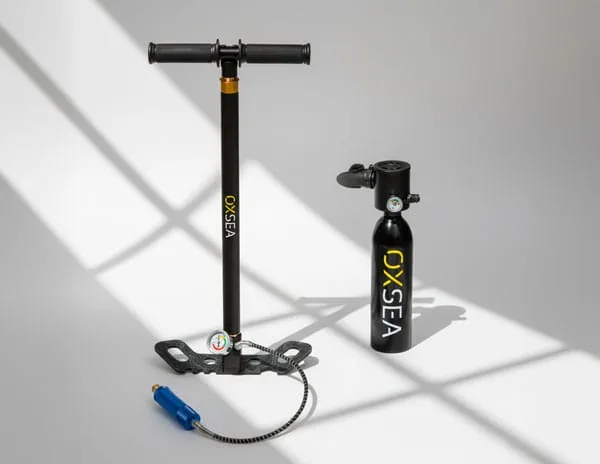
To get started without electricity, the OX500 pack + manual pump gives you the tank and the means to fill it: about 20 minutes of pumping for a 0.5 L tank. The 12 V / 220 V mini compressor fills a 0.5 L tank in about 12 minutes and the OX1000 in about 20 minutes. The manual pump, on the other hand, does not work with the OX1000. Our guide on how to choose a mini scuba tank compares the models.
Coming from snorkeling? The OXAIR full-face mask fits the OX500Plus and the OX1000, never the OX500. It keeps a snorkel for the surface and connects to the tank through a dedicated fitting. With it, just as with a standard mask, make sure you can equalize your ears before your first descent.
Your first session, step by step
- The day before, on land. Fill the tank and set the airflow by following the "Adjust the airflow" video in the OXSEA School. Take two or three breaths from the mouthpiece out of the water to get a feel for it.
- On site. Go over the plan with the person watching you. Agree on three hand signals: I'm OK, something is wrong, I'm coming up. Note the time.
- At the surface, face in the water. Breathe from the tank for one minute without going down. Breathe in slowly, breathe out fully. The sound of the bubbles and the slight resistance of the regulator feel odd at first, then you stop noticing them.
- Equalize before you set off. DAN's equalizing tips recommend doing it once while still at the surface. The most common method: pinch your nose and blow gently, with your lips sealed around the mouthpiece.
- Go down feet first. Slowly, along a line, a ladder or a gentle slope. DAN explains that equalizing takes far more effort head down. Equalize often, before you feel any discomfort. If an ear won't clear, come up a little and try again. Never force it.
- At the bottom. Stay calm, breathe slowly, glance at your buddy regularly. Leave coral and seagrass alone. If water gets into your mask, keep the mouthpiece in, keep breathing and come up without rushing.
- The ascent. Head up well before the air runs out, at a slow pace, breathing normally. Never hold your breath, not even for the last meter or when you stand up.
- Back at the surface. Give the agreed signal, take out the mouthpiece, get your breath back. Wait until you feel rested before going down again.
How long does a first dive last?
| Tank | Volume | Air available at best | Refill |
|---|---|---|---|
| OX500, OX500Plus | 0.5 L at 200 bar | Up to 8 minutes | Manual pump, about 20 minutes. Mini compressor, about 12 minutes. |
| OX1000 | 1 L at 200 bar | About 15 minutes | Mini compressor, about 20 minutes. Not with the manual pump. |
Treat these times as ceilings. You reach them near the surface, breathing calmly. Every meter of depth makes you use air faster, and so do effort and cold. On a first try, people also tend to breathe faster than they realize. Before you get in, set yourself a time to head back up that sits well below the maximum, half of it for example, and keep the rest in reserve. Our guide to mini scuba tank air time walks through the calculation depth by depth.
Two or three short descents with a break at the surface in between beat one long one: you check in with your buddy after each. Between outings, you refill the tank. The guide on how to refill a mini scuba tank compares the pump, the compressor and transferring air from a full-size tank.
What a mini tank won't teach you
Breathing from a mini tank takes a few minutes to get the hang of. Everything else takes practice, and the French ministry says so plainly: diving, on a breath hold or on a tank, is something you learn, ideally at a club with qualified instructors.
An entry-level course such as the FFESSM's Level 1 works on equipment, technical skills like clearing your mask or handling your regulator, underwater communication and group safety. The federation suggests around five open-water dives and asks for a medical certificate stating that you have no contraindication. Once trained, a diver can go down to 20 meters (66 feet) under supervision.
Those reflexes come in handy two meters (6.5 feet) under a hull too: keeping calm when water gets into your mask, controlling your ascent, keeping track of your air, helping a buddy in trouble. A try-out session at a club, before your first attempt with friends, lets you pick them up under an instructor's eye.
Common first-timer mistakes
- Holding your breath as you come up or stand up. It is the freediver's habit, and a dangerous one on compressed air.
- Taking a gulp of air at the bottom, then coming up on a held breath. Compressed air kept in the lungs expands on the way up. The safety guide tells the story of a fatal case published in a medical journal.
- Going in without a spotter, or with someone on the beach who is busy with something else.
- Aiming for the tank's maximum time instead of surfacing with air to spare.
- Diving with a stuffy nose, after a drink or in rough seas. Any one of these is reason enough to wait for another day.
Frequently asked questions
Short answers to the questions this guide raises.
How deep should you go on a first dive with a mini tank?
To where you can still stand, so you can straighten up at any moment while breathing out. In French clubs, the Code du sport places the introductory dive in the 0 to 6 meter zone (0 to 20 feet), with one instructor per diver. Without an instructor, stay well shallower and add depth gradually from one session to the next.
How long does a first scuba dive last?
A few minutes. A 0.5 L mini tank gives up to 8 minutes and a 1 L tank about 15 minutes, near the surface and breathing calmly. Beginners often use more air: head up at around half that time.
Can you do your first dive alone?
No. France's ministry for the sea reminds divers that in diving, the unit is the pair. For a first time, keep someone at the surface who can see you at all times and knows how to call for help.
Do you need a medical certificate for a first dive?
To train at a club in France, yes: the FFESSM requires a certificate of no contraindication for Level 1. For a private try, the ministry recommends seeing a doctor, especially if you have asthma, a history of lung problems or ear trouble.
Can you fly after a first dive?
DAN recommends waiting at least 12 hours after a single no-decompression dive, and 18 hours after repetitive dives over several days (DAN guidelines). To take the tank itself on a plane, read our guide on flying with a mini scuba tank.
Can you spearfish with a mini tank?
Not in France. The French ministry's sheet points out that fishing with scuba gear, meaning with tanks, is prohibited there. Spearfishing in France is done on a breath hold.
Sources
External documents this text relies on.
Products mentioned in this guide
Prices include VAT; stock is live on each product page.
Read next
Guides that build on this one.
Guide5 min read
Mini scuba tank comparison: OX500, OX500Plus or OX1000, which one should you get?
A mini scuba tank comparison of OXSEA's three models: refilling, time underwater, how you carry them and price, reviewed to help you find the one you need.
Guide9 min read
Mini scuba tank safety: where the danger lies and how to avoid it
Mini scuba tank safety: where is the danger? Ascent, refilling, upkeep, transport, contraindications. The real risks and the precautions, with sources.
Guide9 min read
Mini scuba tank for boats: getting equipped to work under the hull
With or without a 12 V battery, which mini scuba tank for boats should you carry? Models, refill times, stowage on board and the safety rules to follow.

Everything comes in the pack
Each pack bundles the tank, its refill system and the accessories. Still unsure? Email us and we'll point you to the right one.