
Tip9 min read
Snorkel mask with air tank: how it works and which one to choose
Snorkel mask with air tank: the snorkel at the surface, tank air below, full face mask or mouthpiece, refilling, ear equalizing, fogging and safety rules.
- Written by
- The OXSEA team
- Published on
On this page
A snorkel mask with an air tank is a mask connected to a small supply of compressed air that you take underwater with you. At the surface you breathe through a snorkel, as you would when snorkeling. When you dive down, air from the tank takes over. There are two ways to set it up: a full face mask that covers your whole face and connects to the tank, or a standard mask worn with the tank's mouthpiece or regulator in your mouth. At OXSEA, the OXAIR full face mask fits all four tanks, from the OX500 to the OX2000. The tank decides your time underwater: up to 8 minutes with 0.5 L, about 15 minutes with 1 L, and 20 to 25 minutes with the 2.3 L OX2000, depending on your breathing, depth and effort.
What a snorkel mask with an air tank actually is
A snorkel mask on its own lets you breathe through a tube while your face stays at the surface. As soon as you go under, the snorkel stops giving you air and you are free diving on a single breath.
Adding a tank gives you air to breathe below the surface. Whether you call it a snorkel mask or a scuba mask with an air tank, this is not the full scuba kit you would use at a dive center, with a cylinder that usually holds 10 to 15 liters. It is a mini tank of 0.5 to 2.3 liters (200 bar, about 2,900 psi, for the OX500, OX500Plus and OX1000), made for staying close to the surface: looking at the bottom, stretching out a snorkeling trip, checking a propeller. Our guide explains how a mini scuba tank works and walks through the four models.
You will also come across the phrase “snorkel mask with oxygen tank”. It is misleading: the tank holds compressed air, with its 21% oxygen, not pure oxygen. The Divers Alert Network (DAN), the international organization devoted to diver safety, explains that once the gas a diver breathes contains more than 21% oxygen, oxygen toxicity becomes possible, and that it is unpredictable.
How it works: snorkel at the surface, tank air below
While you float face down at the surface, you breathe through the snorkel and the tank stays full. Underwater, you breathe air from the tank: through the mask's fitting with a full face mask, or through the mouthpiece or regulator in your mouth with a standard mask.
The regulator brings the high-pressure air in the tank down to a pressure you can breathe, which is the pressure of the water around you. The deeper you go, the more air each breath draws from the tank. That is why the air times above apply near the surface, breathing calmly. Effort and cold shorten them too.
The pressure gauge tells you how much air is left, and so when to head up. It is built into the OX500, external and included with the OX500Plus, and external and optional on the OX1000 and OX2000.
Full face mask or standard mask with a mouthpiece
With a standard scuba mask, which covers your eyes and nose, the air comes in through your mouth. The OX500 is held in your mouth by its silicone mouthpiece. The OX500Plus has the same 0.5 L volume and can be held in your mouth or worn on your back with a harness and an external regulator. The OX1000 (1 L) and OX2000 (2.3 L) are worn on your back, which leaves your hands free. The OX500 packs, OX500Plus packs and OX1000 packs pair each tank with its refill system.
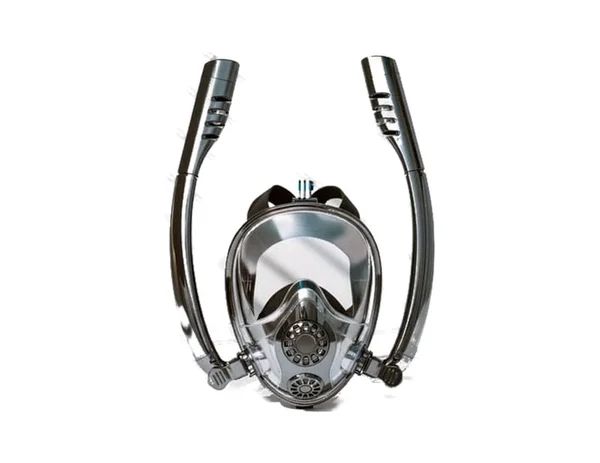
The OXAIR full face mask works differently. A single lens covers your eyes, nose and mouth, with a wide field of view. At the surface you breathe naturally through the snorkel. Underwater, the tank's air takes over through a dedicated fitting, via a mouthpiece or regulator depending on your setup. It comes in one size with adjustable straps, and it fits all four OXSEA tanks. It is not sold on its own: you add it to a pack, as an option on the pack page.
| Point of comparison | Full face snorkel mask with air tank (OXAIR) | Standard mask and the tank's mouthpiece |
|---|---|---|
| What the mask covers | Eyes, nose and mouth, under a single lens | Eyes and nose; your mouth stays free for the mouthpiece |
| At the surface | Through the mask's snorkel | Through a separate snorkel, or from the tank |
| Underwater | Through the mask's fitting, connected to the tank | Through the OX500 mouthpiece or the regulator (OX500Plus, OX1000, OX2000) |
| Equalizing your ears | Hands-free moves only: swallowing, pushing your jaw forward | Every method, pinching your nose through the skirt |
| Check before you buy | That your ears clear without pinching your nose | That the mask seals well and the mouthpiece suits you |
Nothing stops you from owning both: the OXAIR for snorkeling, a standard mask for the days your ears need a pinched nose.
Before you buy: what to check
A refillable tank, and a way to refill it
An air supply you cannot refill is good for one dive. So work out where you will fill the tank, and with what. A refillable mini scuba tank from OXSEA can be filled in three ways, depending on the model.
- Manual pump: about 20 minutes for 0.5 L, no electricity needed. For the OX500 and OX500Plus only.
- 12 V / 220 V compressor: about 12 minutes for 0.5 L, 20 minutes for 1 L, longer for the OX2000. It runs off a boat or car battery, or a 220 V socket.
- DIN or yoke transfer station: about a minute from a filled scuba cylinder, for 0.5 L or 1 L.
That last option assumes you have a cylinder at hand. At a dive center, renting or filling a cylinder usually requires a diving certification. Without one, the pump or the compressor lets you refill at home or on board.
Mask and tank compatibility
A mask and a tank from different brands will not necessarily connect, so check the fitting before you order. The OXAIR is compatible with all four OXSEA tanks. The “Connect the OXAIR mask” video in the OXSEA School shows how to hook it up.
Fit on your face
A mask that does not seal lets water in. The OXAIR comes in one size with adjustable straps, so try it on before you get in the water. The skirt should rest on your skin all the way around your face, with no hair caught under it, and a beard can also let water through. For a standard mask, place it on your face without the strap and breathe in gently through your nose. If it stays put on its own, the shape suits you.
Fogging
Fog forms when the humid air inside the mask meets a lens cooled by the water. Rinse the mask before you put it on, keep your fingers off the inside of the lens, and leave it in the shade until you get in. A defogger made for dive masks also helps, if the mask's instructions allow it. After the session, rinse with fresh water and let it dry in the shade, as the OXAIR product page recommends.
Your ears
This is the point people forget with a full face mask. As soon as you go down, the water presses on your eardrums and you need to equalize. Under the lens of a full face mask, your fingers cannot reach your nose, which leaves the hands-free moves, such as swallowing or pushing your jaw forward. Try it where you can stand. If your ears only clear when you pinch your nose, keep the OXAIR for the surface and go down with a standard mask. Our guide on how to equalize your ears when scuba diving covers each method.
Your first time with a mask and a tank
- On land, the day before. Fill the tank, connect the mask, adjust the straps.
- Where you can stand. Breathe through the snorkel for a few minutes, face in the water.
- Just below the surface. Check that the tank's air flows smoothly. Breathe in slowly, breathe out fully.
- Equalize before you go down. Do it again often, before you feel any discomfort. If an ear will not clear, go up a little and never force it.
- Feet first. Go down slowly, along a gentle slope, a ladder or a line.
- Head up early. Start up well before the air runs out, breathing normally.
Our guide to your first time scuba diving with a mini tank covers choosing the spot, your health and who keeps watch.
Safety rules, with or without a full face mask
Whichever mask you wear, you breathe compressed air underwater. The rules are those of scuba diving.
- Never hold your breath on the way up. The air in your lungs expands as the pressure drops. According to DAN's Alert Diver magazine, an ascent of about 1.5 meters (5 feet) with your breath held can be enough to cause an arterial gas embolism.
- Never take a breath from the tank at the bottom and then come up holding it. The trapped air expands in the same way.
- Stay shallow. A mini tank is meant for use close to the surface.
- Never dive alone. In diving, the basic unit is the pair, as France's ministry for the sea (in French) puts it. Keep someone at the surface who can see you and raise the alarm.
- Head up while the gauge still shows air.
- If the mask floods, come up without rushing, breathing out gently.
The mini scuba tank safety guide goes over these rules, along with medical contraindications and refilling precautions.
Frequently asked questions
Short answers to the questions this guide raises.
Can you breathe underwater with just a snorkel mask?
No. A snorkel only gives you air while its top end stays above the water. Below the surface you need a supply of compressed air, connected to the mask or held in your mouth.
Does a snorkel mask with an air tank run on oxygen?
No. The tank holds compressed air with 21% oxygen, not pure oxygen. According to DAN, breathing a gas richer in oxygen than air while diving exposes you to oxygen toxicity.
Does the OXAIR mask fit every OXSEA tank?
Yes: the OX500, OX500Plus, OX1000 and OX2000. You add it to a pack, as an option on the pack page.
How long can you stay underwater with a mini tank?
Up to 8 minutes with 0.5 L, about 15 minutes with 1 L, and 20 to 25 minutes with the 2.3 L OX2000, depending on your breathing, depth and effort. Time spent breathing through the snorkel at the surface takes nothing from the tank.
Do you need a scuba certification?
No certification is required to buy one, and OXSEA tanks can be used without diver training, close to the surface. Training is still worth it: an introductory dive at a dive center teaches you to breathe calmly underwater and to come up without holding your breath.
Can you equalize your ears with a full face mask?
Yes, if hands-free moves work for you, since your nose stays under the lens. Check it where you can stand. If they do not, keep the full face mask for the surface and go down with a standard mask.
Sources
External documents this text relies on.
Tanks mentioned in this guide
Each tank has its own page; its packs include the refill system.
| Tank | Capacity | Air time | How you wear it | Refill | OXAIR mask | Packs |
|---|---|---|---|---|---|---|
| OX500 mini scuba tank | 0.5 L | up to 8 min | in the mouth | Manual pump, Compressor 12 V / 220 V, or from a dive cylinder | yes | OX500 packsLowest price: OX500 Pack + Manual pump |
| OX500Plus mini scuba tank | 0.5 L | up to 8 min | in the mouth or on the back | Manual pump, Compressor 12 V / 220 V, or from a dive cylinder | yes | OX500Plus packsLowest price: OX500Plus Pack + Manual pump |
| OX1000 mini scuba tank | 1 L | about 15 min | on the back | Compressor 12 V / 220 V, or from a dive cylinder | yes | OX1000 packsLowest price: OX1000 Pack + Compressor 12 V / 220 V |
| OX2000 mini scuba tank | 2.3 L | 20 to 25 min | on the back | Compressor 12 V / 220 V, or from a dive cylinder | yes | OX2000 packsLowest price: OX2000 Pack + Compressor 12 V / 220 V |
Air time depends on your breathing, the depth and the effort.
Full comparison of the four tanksProducts mentioned in this guide
Prices include VAT; stock is live on each product page.
Read next
Guides that build on this one.
Tip10 min read
First time scuba diving with a mini tank: how deep, how long, what gear
First time scuba diving with a mini tank: how deep to go, how many minutes of air you get, what gear to bring, and the habits that prevent accidents.
Tip10 min read
How to equalize your ears when scuba diving in shallow water: methods that work from your first descent
How to equalize your ears scuba diving, starting at the surface: Valsalva, Toynbee, Frenzel, a step-by-step descent, colds, a blocked ear and when to stop.
Guide9 min read
Mini scuba tank safety: where the danger lies and how to avoid it
Mini scuba tank safety: where is the danger? Ascent, refilling, upkeep, transport, contraindications. The real risks and the precautions, with sources.
Guide5 min read
Mini scuba tank comparison: OX500, OX500Plus, OX1000 or OX2000, which one should you get?
A mini scuba tank comparison of OXSEA's four models: refilling, time underwater, how you carry them and price, reviewed to help you find the one you need.

Everything comes in the pack
Each pack bundles the tank, its refill system and the accessories. Still unsure? Email us and we'll point you to the right one.