
Tip8 min read
Mini scuba tank air time: how many minutes will you really get?
Mini scuba tank air time: up to 8 min from 0.5 L, about 15 min from 1 L, close to the surface. Two methods for estimating the time you will really have.
- Written by
- The OXSEA team
- Published on
- Updated on
On this page
Up to 8 minutes with an OX500 or an OX500Plus, around 15 minutes with an OX1000: mini scuba tank air time comes down to two numbers. Read both as maximums. Our OX500, OX500Plus and OX1000 comparison makes the same point: you reach them close to the surface, provided your breathing stays calm. Going deeper, working hard and getting cold all drain the tank faster.
The next step is to understand why, then to work out how much time you will actually have, with a margin built in.
Three models, two volumes, a single pressure
A tank does not store time. It stores air, and the three OXSEA models store it at the same working pressure: 200 bar. Volume is all that changes, 0.5 litres or 1 litre. At equal pressure, the 1-litre tank therefore carries twice as much air.
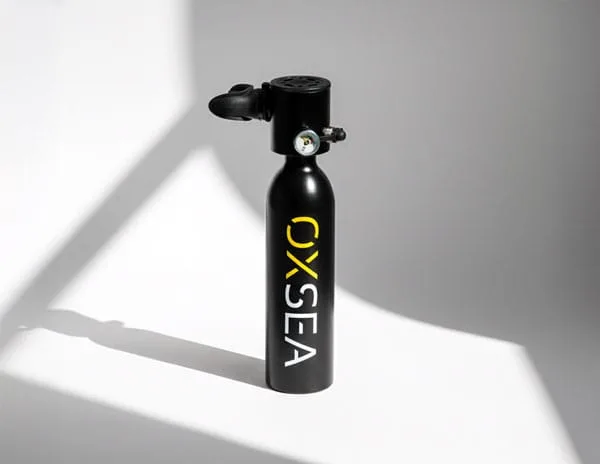
- OX500 (€199.99): 0.5 litres, up to 8 minutes. This is the model for quick jobs. A silicone mouthpiece lets you hold it in your mouth, and it weighs less than 1 kg underwater. The manual pump refills it in roughly 20 minutes, no electricity required.
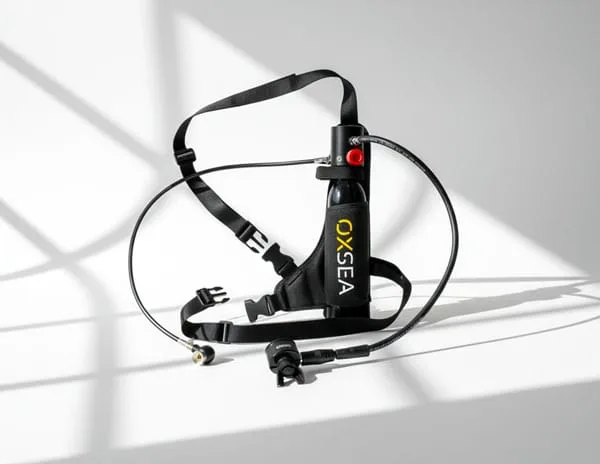
- OX500Plus (€289.99): 0.5 litres as well, so the same maximum air time. There are two ways to carry it: mouthpiece in your mouth, or tank on your back, fixed to a harness and connected to an external regulator. Its external pressure gauge is included.
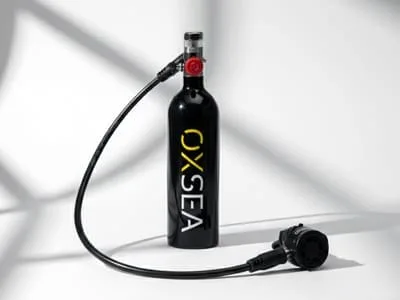
- OX1000 (€299.99): 1 litre, which means twice the air and around 15 minutes. It sits on your back, mounted on a harness, with an external regulator. Refilling takes about 20 minutes with the mini compressor, or about 1 minute using a transfer station connected to a full-size scuba tank. It is not compatible with the manual pump. Without a full-size tank to hand, you will need the 12V mini compressor, which runs off a car battery, a boat battery or the mains.
These times assume calm breathing, close to the surface. You may well use more: how fast you breathe that air is what sets the real time.
You also have to start with a full tank. The amount of air follows the product P × V (pressure multiplied by volume): filled to 100 bar, a tank holds roughly half of what it holds at 200 bar. A refill stopped too early cuts your air time by the same proportion.
If this equipment is new to you, you can see the whole range in our mini scuba tank shop.
Why every metre of depth costs you air
At the surface, the atmosphere puts roughly 1 bar of pressure on you. Below it, the weight of the water adds to that: 1 bar for every 10 metres you go down. Add the two together and you have what is called absolute pressure. It stands at 1.5 bar when you are 5 metres down and at 2 bar at 10 metres. So it climbs by 1 bar with every further ten metres, and does not double from one step to the next.
Boyle's law ties this to your tank. As long as the temperature does not change, a gas takes up a volume that varies inversely with the pressure applied to it (P × V = constant). Now, your regulator supplies air at the pressure that surrounds you. At 10 metres down, each breath therefore takes twice as much from the tank as it would at the surface. The FFESSM, the French underwater federation, illustrates this in one of its physics courses: a diver breathing 20 litres per minute at the surface gets through 40 at 10 metres.
With a mini tank there is no need to go that deep: the gap shows up within the first few metres.
| Depth | Air time compared with the surface | Extra air per breath | Absolute pressure |
|---|---|---|---|
| At the surface | 100% | baseline | 1 bar |
| 1 m | around 91% | +10% | 1.1 bar |
| 2 m | around 83% | +20% | 1.2 bar |
| 3 m | around 77% | +30% | 1.3 bar |
| 5 m | around 67% | +50% | 1.5 bar |
These figures come from a theoretical calculation that assumes steady breathing. In practice, effort, cold and stress come on top of depth.
The first of our two estimation methods follows from this table. Take the time stated for your model, the one that holds close to the surface when you breathe calmly. Then divide by the absolute pressure that applies at the depth you plan to stay at, in other words 1 + (depth in metres ÷ 10). For an OX500 used at 2 metres, the calculation is 8 ÷ 1.2, which comes to roughly 6 minutes 40 seconds. Treat that result as a maximum too. Take off the reserve described further down, and cut it again if the task is physical or the water is cool.
The second method, a reading taken from the pressure gauge, complements this one: use both.
Effort, cold, stress: what pushes your air consumption up
At the same depth, how much air you use can still vary a great deal.
Physical effort
Finning against a current, freeing a propeller: any muscular work makes you breathe faster. According to the Divers Alert Network (DAN), an organisation dedicated to diving safety, certain physical activities carried out underwater can use up air at five to ten times the normal rate. Weighting matters too: badly adjusted, it makes you work harder, and so use more air.
Cold
DAN Europe reports that water carries heat away 20 to 27 times as fast as air does, and the body cools quickly in it. In training material on cold and diving, the FFESSM lists increased air consumption among the effects of cold. The same document notes that compressed air, cool as you breathe it in, also plays a part in chilling you. So a wetsuit chosen for the water temperature helps preserve your air time.
Nerves
You may feel on edge the first time you use the tank, or when the water is murky. And anxiety quickens your breathing. In those situations, DAN recommends watching your air more closely. When you are starting out, pick calm water shallow enough to stand up in.
Your own breathing
Air consumption varies from person to person, and from one day to the next for the same person. Keep your breathing calm and even. Never hold your breath to make the tank last longer: it creates a real risk during the ascent, covered in detail further down.
Pressure gauge and reserve: knowing when to come up
You read the pressure remaining in the tank on the gauge, and that pressure tells you how much air is left. On the OX500 the gauge is built in. The OX500Plus is supplied with an external one.
Measure your consumption. This is the second estimation method. In calm, shallow water, note the starting pressure, then check the needle again after 2 minutes of ordinary activity. An example with made-up figures: a needle that drops from 200 bar to 150 bar in 2 minutes points to a consumption of 25 bar per minute. With a tank full at 200 bar and a 50 bar reserve, you have 150 bar you can use, which works out at around 6 minutes at that pace. Then do it again in your real conditions, while carrying out an actual task. The figure you record that day is the one that matters.
Watch the needle. Two things to do before entering the water: confirm that the gauge shows a full tank, and decide when you will come back up. Once you are under, stick to that decision and check the needle often. DAN regards running out of air as the most frequent trigger of diving accidents and recommends checking the gauge at regular intervals.
Keep a reserve. An FFESSM course on physics takes a full-size tank charged to 200 bar and works out how long it lasts with 50 bar set aside, which is a quarter of the initial pressure. We advise you to apply the same reasoning to the mini tank: when the needle nears 50 bar, begin a calm ascent. Going up uses air. So does the unexpected: a flooded mask, a snagged line.
On the way up, never hold your breath
Boyle's law applies to the return trip too. Pressure falls as you ascend, and the air in your lungs expands. If you hold your breath, that surplus has no way out and can damage your lungs: this is called lung overexpansion injury. According to the MSD Manual, a gas embolism can happen from a depth of roughly 1 metre when a person breathing compressed air ascends quickly while holding their breath.
So staying shallow does not protect you. DAN Europe gives an example: if you rose suddenly from a depth of 5 metres up to the surface, the gas would gain 50% in volume, whereas covering the same distance starting from 20 metres would add only 20%. Over an equal vertical distance, volume changes most close to the surface, which is the zone where a mini tank is used.
Four rules follow from this:
- do not hold your breath at any point, least of all during the ascent;
- return to the surface slowly, breathing as you normally would;
- keep to shallow depths;
- before you use the tank for the first time, have a qualified instructor introduce you to it. Training is recommended, even if you only use it occasionally.
To get familiar with the equipment, use our getting-started videos. They complement training and are no substitute for it.
Have a specific question about how you plan to use yours? Ask it on our support and FAQ page.
Frequently asked questions
Short answers to the questions this guide raises.
How long can you breathe from a mini scuba tank?
A 0.5 L tank (OX500, OX500Plus) gives up to 8 minutes, a 1 L tank (OX1000) around 15 minutes. Those figures hold close to the surface, with calm breathing. Plan for less as depth increases, when you are working hard or when the water is cold.
Will the tank last as long at 3 metres as it does at 1 metre?
No. Between those two depths, absolute pressure climbs from 1.1 bar to 1.3 bar. For the same effort, a breath taken at 3 metres needs roughly 18% more air than the same breath at 1 metre, and the tank lasts roughly 15% less time.
Why did my tank run out sooner than the stated time?
Most often, several causes combine: sustained physical effort, cold water, first-time nerves, a greater depth than planned, or an incomplete fill at the start. Read the pressure every time, before you enter the water.
Does holding your breath make the air last longer?
No, and the practice is dangerous. When you are breathing compressed air, holding your breath during the ascent puts you at risk of lung overexpansion injury, even at shallow depth. Keep breathing normally and come up as soon as the needle approaches your reserve.
Products mentioned in this guide
Prices include VAT; stock is live on each product page.
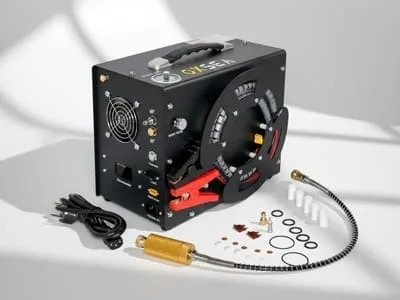
12 V / 220 V mini compressor
Refills 0.5 L and 1 L tanks from a battery or the mains
Last units
€549.99
Read next
Guides that build on this one.
Guide5 min read
Mini scuba tank comparison: OX500, OX500Plus or OX1000, which one should you get?
A mini scuba tank comparison of OXSEA's three models: refilling, time underwater, how you carry them and price, reviewed to help you find the one you need.
Tip8 min read
How to refill a mini scuba tank: time, budget and precautions
Refill a mini scuba tank with a manual pump, a mini compressor or from a full-size tank: fill times, budget for 20 refills, air quality, mistakes to avoid.
Guide9 min read
Mini scuba tank safety: where the danger lies and how to avoid it
Mini scuba tank safety: where is the danger? Ascent, refilling, upkeep, transport, contraindications. The real risks and the precautions, with sources.

Everything comes in the pack
Each pack bundles the tank, its refill system and the accessories. Still unsure? Email us and we'll point you to the right one.