
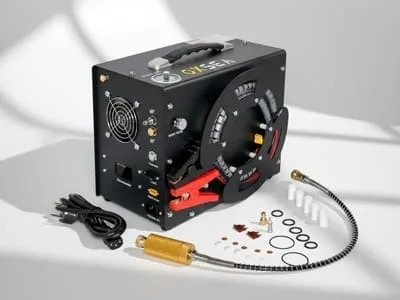
12 V / 220 V mini compressor
Refills 0.5 L and 1 L tanks from a battery or the mains
Last units
€549.99
Tip8 min read
Refill a mini scuba tank with a manual pump, a mini compressor or from a full-size tank: fill times, budget for 20 refills, air quality, mistakes to avoid.
Your OXSEA mini scuba tank is empty. Nothing odd about that: a 0.5 L model holds up to 8 minutes of air. It now has to be filled again, and how you do that depends on the tank you own and on what you have to hand: a mains socket, a battery, a dive club, or none of these.
To refill a mini scuba tank you can pump by hand, plug in a 12V/220V mini compressor or draw air from a full-size scuba tank. The time each one takes is different, and so is what you spend over a season. We compare the three, working from our catalogue prices as recorded on 1 October 2026 and from rates that dive clubs publish. You will know which one suits you before you place an order.
One pointer before the detail.
| Refill method | Quoted time | Models it fills | What it takes | OXSEA price |
|---|---|---|---|---|
| Transfer from a scuba tank | around 1 min (OX1000) | OX500, OX500Plus and OX1000 | a transfer station (yoke or DIN) and a filled scuba tank | the station, plus the fill for the scuba tank |
| 12V/220V mini compressor | around 12 min for 0.5 L, around 20 min for 1 L | OX500, OX500Plus and OX1000 | a 12 V battery or a 220 V mains socket | €549.99 |
| Manual pump | around 20 min | OX500 and OX500Plus (0.5 L) | no power supply, only your arms | €159.99 |
For an OX1000, nothing is as quick as transfer: our product page gives roughly 1 minute. A transfer station connects the mini tank to a filled scuba tank, with a DIN or a yoke fitting to suit the valve on the big tank. Air then leaves the large cylinder for the small one, and stops moving once the pressure is the same on both sides. To see the connection being made, watch the video “Refill station Yoke / DIN” in the OXSEA School.
A transfer compresses nothing: the pressure that is already there spreads across the two containers. The sums below are theoretical and assume the temperature stays constant. Take a 12 L tank filled to 200 bar and an empty 0.5 L mini tank: the two level out near 192 bar, and the big tank gives up about 4% of its pressure on the way. So each fill starts from a little lower down.
In practice, one 12 L tank supplies roughly five 0.5 L fills at more than 160 bar. Past that point the mini tank comes away less full, and you get that much less time underwater.
The 12V/220V mini compressor runs on either of two supplies: 220 V from the mains, or 12 V from the battery of a boat or a car. You do none of the work. A 0.5 L tank is full after about 12 minutes, a 1 L OX1000 tank after about 20. For the OX1000 it is in fact the only way to refill when you have no scuba tank to hand.
Two things count against it: the price, €549.99, and the fact that you must have power within reach. Run off a vehicle battery, it has to be set down in the right place. The section on air quality explains why.
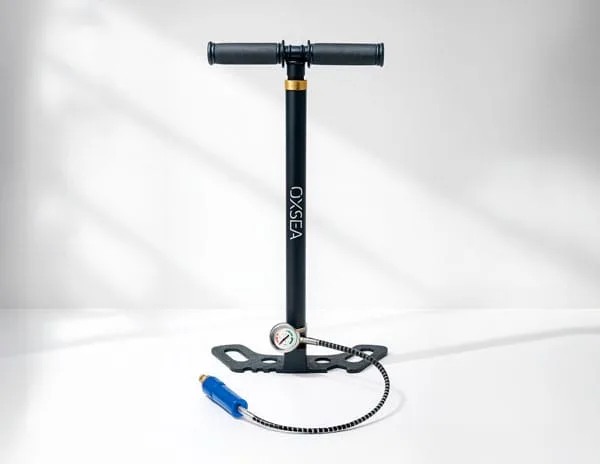
The OXSEA manual pump does without electricity, and therefore without a socket. You can take it to isolated places: a campsite, a small boat, a cove you reach by a footpath. Allow about 20 minutes for an OX500 or an OX500Plus.
You spend those 20 minutes pumping, all the way to 200 bar. The higher the pressure climbs inside the tank, the harder you have to push. One more limit: this pump cannot be used on the 1 L OX1000.
Our scenario: 20 refills of 0.5 L across the season, say ten outings with two tanks. For the price of a scuba tank fill, we take the published rate of two French dive clubs as a guide: €6 at both. At GPES in La Ciotat, that price is for a 12 L tank, according to the listing published by the town's tourist office (updated 23 July 2026). At CPTL, a Marseille club, it covers tanks of 12 or 15 L in the 2025 price list. Each club sets its own conditions.
| Refill method | Equipment to buy | Price of one refill | Total for 20 refills |
|---|---|---|---|
| Transfer, 12 L tank | a transfer station and a scuba tank | around €1.20 (€6 a fill, around 5 refills) | around €24 in fills (4 tanks), plus the station |
| 12V/220V mini compressor | €549.99 | electricity and filters | €549.99, plus electricity and filters |
| Manual pump | €159.99 | nothing, filters aside | €159.99, plus filters |
If you have a scuba tank and a club close by, transfer is far and away the cheapest to run. With no scuba tank, the manual pump has the lowest upfront cost, and after that its filters are all there is to maintain. The mini compressor is more expensive to buy, but in exchange it spares you 20 minutes of pumping per refill. With an OX1000 and no scuba tank, you cannot do without it.
Starting from scratch? Packs put the tank together with the means to fill it, such as the OX500 sold with its manual pump, at €359.99, or the OX1000 paired with the mini compressor, at €849.99.
This air ends up in your lungs, so it deserves some thought at filling time. DAN Europe, an organisation that works for the safety of divers, names several possible sources of contamination: the surrounding air and its impurities, exhaust gases and their carbon monoxide, compressor lubricants and their hydrocarbons. Carbon monoxide has neither taste nor smell: your senses will not sound the alarm.
Moisture comes next. A study published by INRS, France's occupational health and safety institute, and based on fifteen years of compressed-air analyses carried out at the French Navy's laboratory in Toulon, ranks it as the least well-controlled parameter. Very dry air is hard to obtain when ambient air is compressed directly. And excess moisture can encourage corrosion, if the container is metal, and regulator freezing, if the water is cold.
The air in a mini tank is compressed, just as it is in a full-size scuba tank. So the basic rule does not change: during the ascent, you never hold your breath. According to DAN Europe, ascending with your breath held from a depth of a single metre can be all it takes to cause a lung overexpansion injury. Stay shallow, breathe normally and get some training: an introductory session at a club or with an instructor builds the right reflexes.
Short answers to the questions this guide raises.
For 0.5 L, allow around 20 minutes with the manual pump and around 12 with the mini compressor. The 1 L OX1000 needs around 20 minutes on the mini compressor, but far less by transfer from a scuba tank: around 1 minute, going by our product page.
No, it is reserved for the 0.5 L tanks, the OX500 and the OX500Plus. An OX1000 is filled with the mini compressor, or by drawing air from a scuba tank.
On paper, the answer is about five 0.5 L refills at more than 160 bar, for a tank that starts out filled to 200 bar. From then on, each transfer leaves a lower pressure than the one before.
We checked the published rates of two clubs, and both ask €6 for a 12 L tank: GPES in La Ciotat (listing updated in July 2026) and CPTL in Marseille (2025 rates). Prices and conditions change from club to club, so ask the one nearest you.
The manual pump, if you have no scuba tank, a 0.5 L mini tank and only occasional outings. The mini compressor, if you own an OX1000 or refill often. Transfer, if a scuba tank and a club are already within your reach. Tank not chosen yet? Begin by comparing the OX500, the OX500Plus and the OX1000.
Prices include VAT; stock is live on each product page.
Refills 0.5 L and 1 L tanks from a battery or the mains
Last units
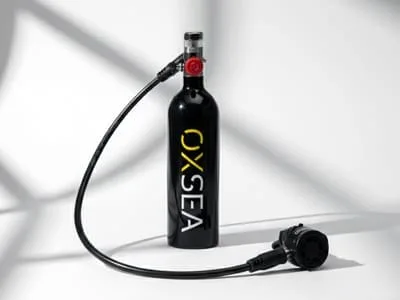
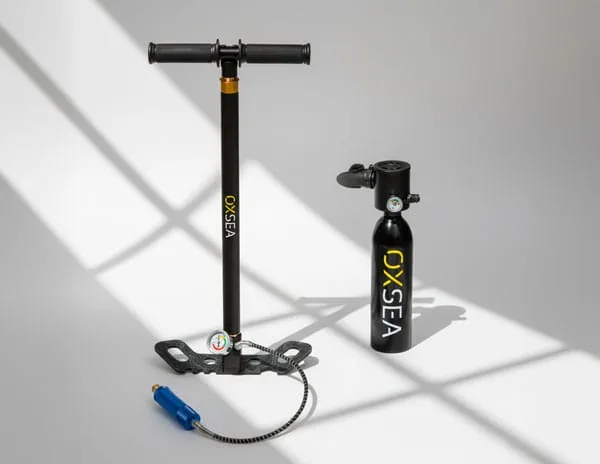
Guides that build on this one.
Tip8 min read
Mini scuba tank air time: up to 8 min from 0.5 L, about 15 min from 1 L, close to the surface. Two methods for estimating the time you will really have.
Guide5 min read
A mini scuba tank comparison of OXSEA's three models: refilling, time underwater, how you carry them and price, reviewed to help you find the one you need.
Tip3 min read
Fresh-water rinsing, seals, safety disc, refill filters, winter storage: the habits that keep an OXSEA mini tank in working order, and when to call after-sales.

Each pack bundles the tank, its refill system and the accessories. Still unsure? Email us and we'll point you to the right one.