
Tip8 min read
Scuba tank compressor: how to fill a tank to 200 bar and what to choose
How to fill a scuba tank to 200 bar (2,900 psi): hand pump, portable 12 V / 220 V compressor, dive shop or tank transfer. Fill times, clean air, upkeep.
- Written by
- The OXSEA team
- Published on
On this page
- Why a tire inflator or a shop compressor won't do
- Four ways to fill a scuba tank
- Fill time, power, tanks: the methods side by side
- Breathing air: what can contaminate your tank
- Upkeep: filters, drains and cooling
- Which gear for your tank and your setting
- Before you dive: the rules that don't change
- Frequently asked questions
A scuba tank is filled with a high-pressure compressor built for breathing air. It has to reach 200 bar (about 2,900 psi), the working pressure of our 0.5 L and 1 L tanks, and it has to filter the air it draws in. For a mini scuba tank, that job falls to a high-pressure hand pump or a portable 12 V / 220 V compressor. The third route is a transfer station, which takes air from a full-size scuba tank filled beforehand on a dive shop's fixed or gas-powered compressor.
Fill times run from about a minute by transfer to around twenty minutes by pump, and the right gear depends on your tank and where you fill it.
Why a tire inflator or a shop compressor won't do
A tire or dinghy inflator works at a few bar. A shop air compressor tops out around 10 bar (about 150 psi). Our 0.5 L and 1 L tanks are filled to 200 bar, twenty times that, and neither machine is built for anything close.
The air is the second problem. These machines have no filter meant for breathing, and what they push out can carry oil and water. You need a high-pressure unit designed for diving, with its filters, and a pressure gauge that tells you when to stop: at 200 bar for our 0.5 L and 1 L tanks, never above.
Four ways to fill a scuba tank
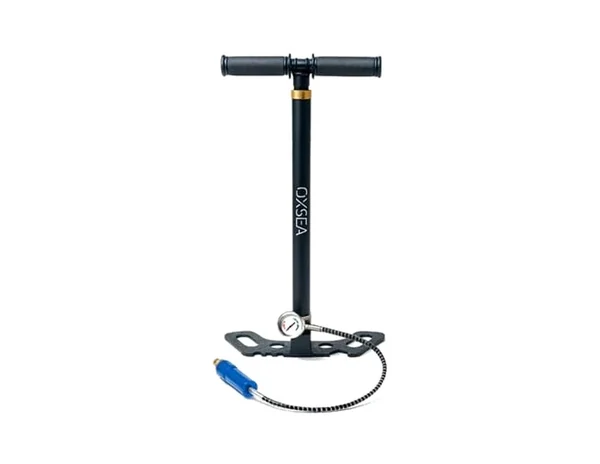
The high-pressure hand pump
No outlet, no battery. The OXSEA manual pump fills an OX500 or an OX500Plus (0.5 L) in about 20 minutes, and the pumping gets harder as the pressure climbs. It does not fill the OX1000 or the OX2000. It belongs wherever there is no power.
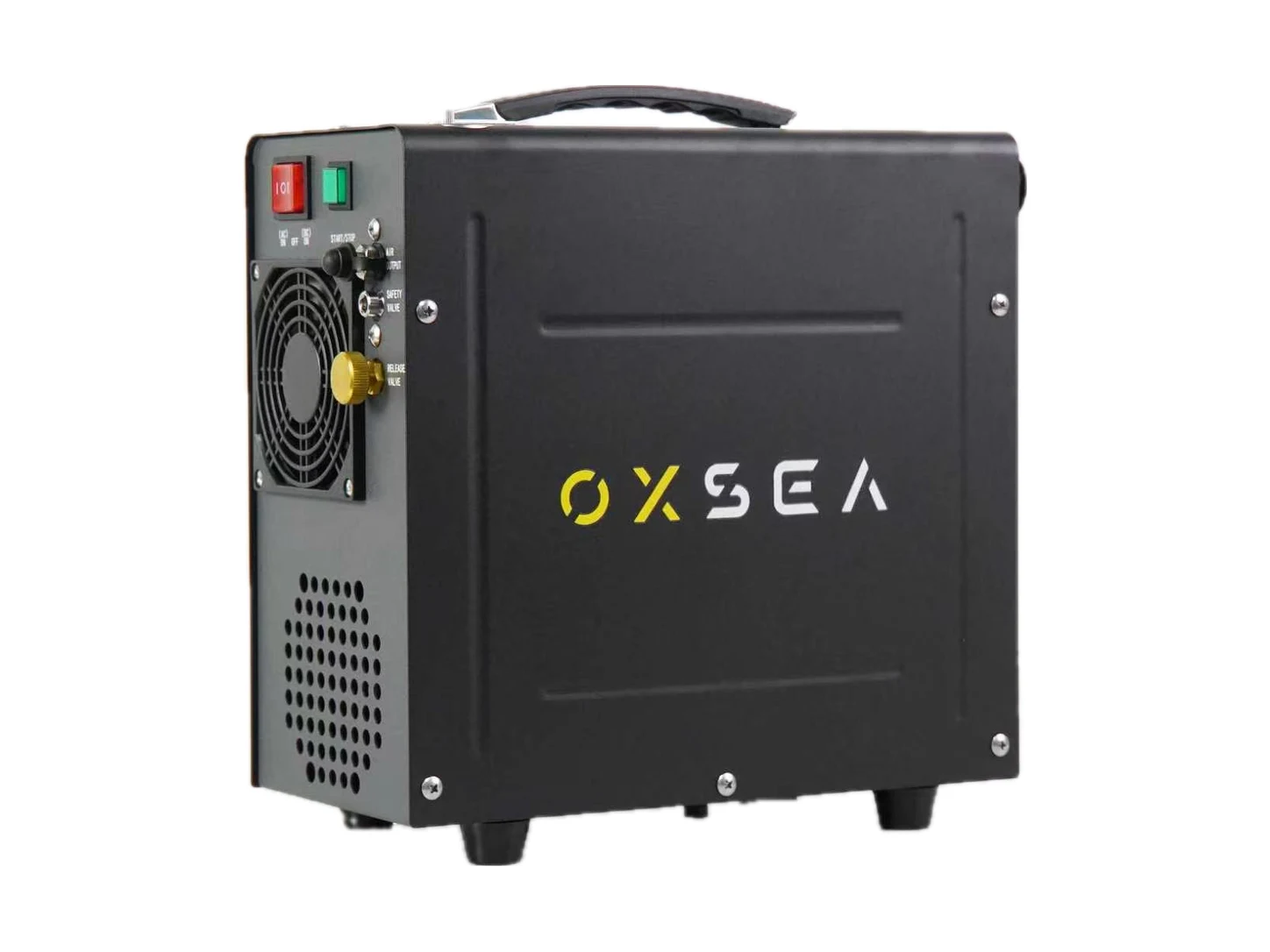
The portable 12 V / 220 V scuba compressor
This is the mini scuba tank compressor in the OXSEA range: an electric unit that runs off a 12 V battery, boat or car, or a 220 V outlet. The OXSEA 12 V / 220 V compressor fills a 0.5 L tank in about 12 minutes and the 1 L OX1000 in about 20, with no effort from you. It also refills the 2.3 L OX2000, which takes longer than 1 L; the exact time is still being measured. Without a full-size tank to draw from, it is the only unit in the range that fills those two larger tanks.
On a battery, two mistakes keep coming up: drawing on the starting battery, and running the engine during the fill. Our guide to the 12V scuba compressor on a boat battery covers the wiring and the amp-hours.
A dive shop compressor, fixed or gas-powered
Dive shops and clubs fill their tanks, standard cylinders of 10 to 15 L, on large compressors. Fixed units run on mains power. Gas-powered ones have their own engine, whose exhaust must stay well away from the intake. Keeping them in shape (filters, condensate drains, oil) is the operator's job.
Every shop sets its own fill rules. You may be asked for a certification card to rent a tank or have one filled, and the tank must be current on its inspections. A mini tank brought in on its own may be turned away: call first.
The DIN or yoke transfer station
With a full scuba tank at hand, this is the fastest route. The station connects the big tank to the mini tank, with a DIN or yoke fitting to match the tank valve, and the air moves across in about a minute for an OX1000, with no power and no effort. It works with all four OXSEA tanks; for the OX2000, the time has not been measured yet.
A transfer only evens out the pressure between the two. The mini tank therefore stops a little below the big tank's starting pressure, and each fill after that starts lower. Our guide on how to refill a mini scuba tank runs the numbers for a 12 L tank. If the big tank holds more than 200 bar (about 2,900 psi), watch the gauge and stop the transfer at 200 bar for a 0.5 L or 1 L tank.
Fill time, power, tanks: the methods side by side
| Method | Quoted fill time | Power | Compatible tanks |
|---|---|---|---|
| High-pressure hand pump | About 20 min for 0.5 L | None, just your arms | OX500 and OX500Plus (0.5 L) only |
| Portable 12 V / 220 V compressor | About 12 min for 0.5 L, 20 min for 1 L, longer for 2.3 L | 12 V battery or 220 V outlet | OX500, OX500Plus, OX1000 and OX2000 |
| DIN or yoke transfer station | About 1 min for the OX1000 | A filled scuba tank | OX500, OX500Plus, OX1000 and OX2000 |
| Dive shop compressor, fixed or gas-powered | Up to the shop | Mains or combustion engine | 10 to 15 L scuba tanks; a mini tank if the shop agrees |
| Tire inflator, shop air compressor | Not suitable | 12 V or mains | None |
Breathing air: what can contaminate your tank
A compressor sends the surrounding air into the tank, at about 21% oxygen, along with whatever is floating in it. Let a car idle near the intake and its exhaust goes underwater with you.
First hazard: carbon monoxide. DAN (Divers Alert Network), the international organization devoted to diver safety, lists engine exhaust and overheated compressor oil among the sources of breathing gas contamination. The gas has no smell and no taste, and contaminated air can impair your judgment to the point of passing out.
Moisture comes next. A study published by INRS (in French), France's occupational health and safety institute, covers fifteen years of testing at the French Navy laboratory in Toulon. Humidity was the worst controlled parameter: 59% of the moisture readings were out of compliance. Too much water can promote corrosion inside a metal tank and, in cold water, regulator icing.
Three habits keep these risks down.
- Fill outdoors, never in a closed garage or engine room.
- Keep the intake upwind of any exhaust (car, boat engine, generator, the compressor's own engine if it is gas-powered), and away from cigarette smoke and paint fumes.
- When in doubt, stop. An oily or chemical smell during the fill? DAN says to shut the compressor down at once and not to dive with that air. The absence of a smell proves nothing, since carbon monoxide has none.
Upkeep: filters, drains and cooling
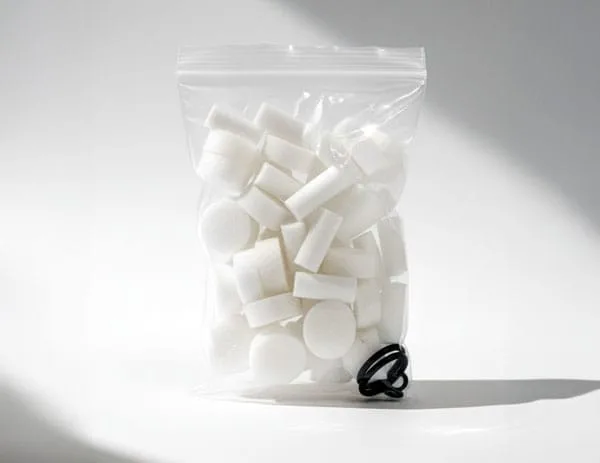
The filters on the OXSEA pump and compressor absorb moisture and trap particles and dust. They are consumables: change them regularly, and more often after use in damp or dusty air. The OX500, OX500Plus and OX1000 packs include a bag of them, and the pack of 25 replacement filters fits both the pump and the compressor. The "Change the filters" video in the OXSEA School shows how.
Draining mostly concerns large compressors, which pull water out of the air and must dump it regularly. The INRS study lists skipped drains and worn-out filters among the possible causes of overly humid air. For your own unit, follow its manual.
A compressor heats up as it works. Set it level, in the shade, where air can circulate, and never cover it: in an oil-lubricated unit, overheating can break the oil down and produce carbon monoxide. If the manual gives a rest time between two tanks, stick to it. Check the fitting seals before every fill, and rinse the tank in fresh water after sea use.
Which gear for your tank and your setting
Start with the tank.
- OX500 or OX500Plus (0.5 L): pump, compressor or transfer. The pump is enough for one or two refills per outing; beyond that, the compressor saves you the pumping.
- OX1000 (1 L): the compressor, or a full-size tank with the station. The pump can't fill it, hence the OX1000 pack with the 12 V / 220 V compressor.
- OX2000 (2.3 L): the same two options, with a longer compressor fill.
Then the setting.
- At home: the compressor on a 220 V outlet, outdoors and away from the street. Its page lists no 120 V input, the US and Canadian standard: there, run it from a 12 V battery or ask us first.
- On a boat: shore power in the marina. At anchor, the house battery, with engine and generator off. With no battery on board, the pump for 0.5 L tanks.
- Next to the car: the 12 V battery, engine off, compressor well away from the tailpipe. Restart the engine once the tank is disconnected, to recharge the battery.
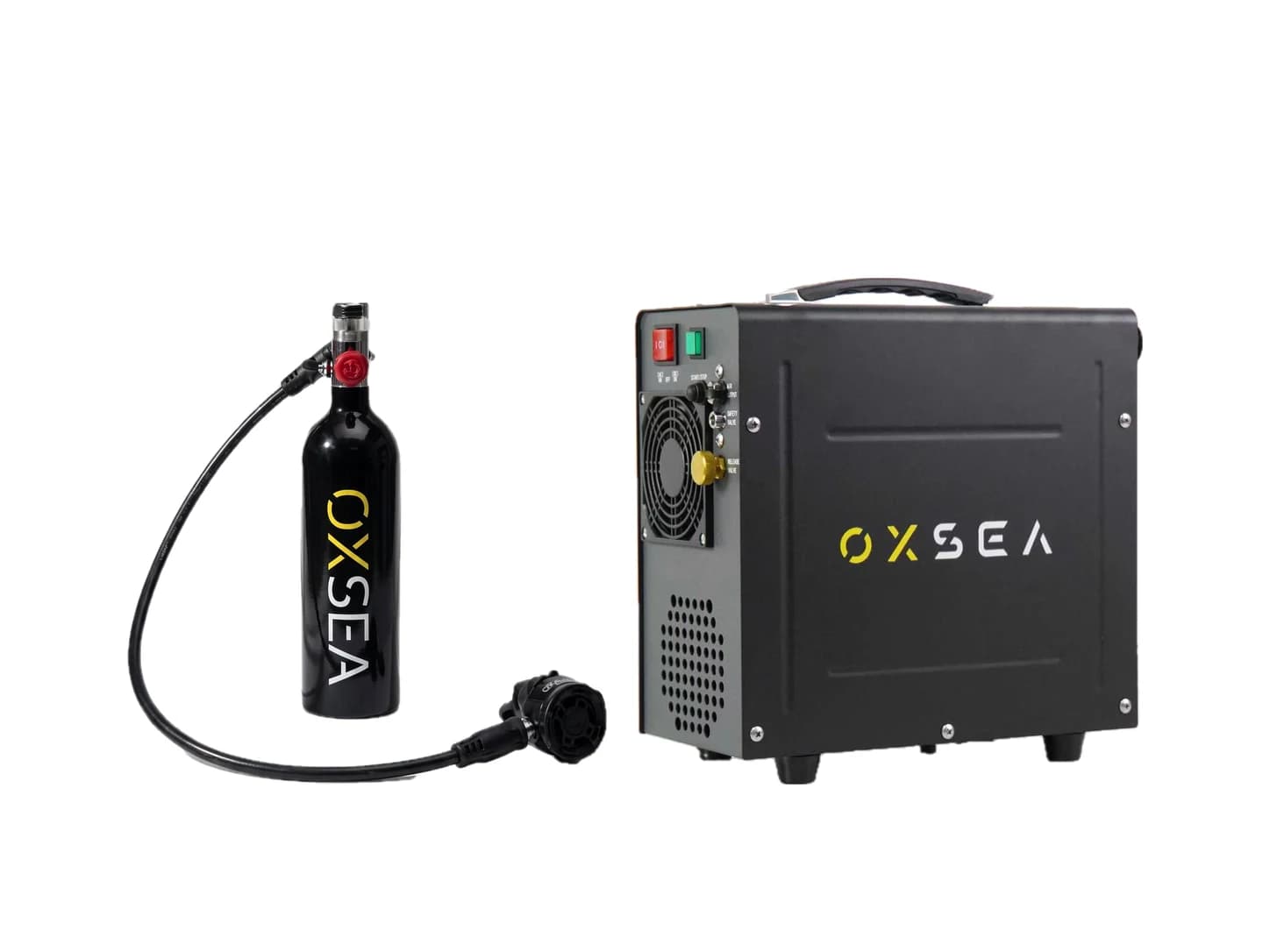
No tank yet? Our guide explains how a mini scuba tank works, model by model. Every OXSEA refillable mini scuba tank comes in a pack with its pump or its compressor.
Before you dive: the rules that don't change
- Never hold your breath on the way up. The air in your lungs expands as the pressure drops. According to DAN, an ascent of about 1.5 meters (5 feet) with your breath held can be enough to cause an arterial gas embolism.
- Stay shallow. A mini tank is meant for use near the surface.
- Never dive alone. France's ministry for the sea (in French) asks divers to always have a buddy, each one keeping an eye on the other.
- Head up while there is air left. Watch the gauge and decide on your ascent well before the tank runs low.
The mini scuba tank safety guide goes through these rules and the medical contraindications.
Frequently asked questions
Short answers to the questions this guide raises.
Can I fill a scuba tank with a regular air compressor?
No. A shop compressor tops out around 10 bar (about 150 psi) and doesn't filter air for breathing, while our 0.5 L and 1 L tanks are filled to 200 bar. Use a high-pressure dive compressor, the hand pump for 0.5 L tanks, or a transfer from a full scuba tank.
How long does it take to fill a mini scuba tank?
With the 12 V / 220 V compressor, about 12 minutes for 0.5 L and 20 minutes for 1 L, longer for the 2.3 L OX2000. With the hand pump, about 20 minutes for 0.5 L. By transfer from a full-size tank, about 1 minute for an OX1000.
Can I fill a scuba tank at home?
A mini tank, yes: with the hand pump for 0.5 L tanks, or with the compressor on a 12 V battery or a 220 V outlet. Work outdoors, keep the intake away from any exhaust, and watch the gauge from start to finish.
Can the OXSEA compressor fill a standard scuba tank?
Its stated use is OXSEA tanks, from 0.5 to 2.3 L, and we give no fill time for a full-size cylinder. For a 10 to 15 L tank, go to a dive shop. That tank can then refill your mini tanks through the transfer station.
How often should I change the compressor filters?
Regularly, and more often if you fill in damp or dusty air. A saturated filter lets moisture through into the tank. OXSEA filters fit both the pump and the compressor.
Sources
External documents this text relies on.
Tanks mentioned in this guide
Each tank has its own page; its packs include the refill system.
| Tank | Capacity | Air time | How you wear it | Refill | OXAIR mask | Packs |
|---|---|---|---|---|---|---|
| OX500 mini scuba tank | 0.5 L | up to 8 min | in the mouth | Manual pump, Compressor 12 V / 220 V, or from a dive cylinder | yes | OX500 packsLowest price: OX500 Pack + Manual pump |
| OX500Plus mini scuba tank | 0.5 L | up to 8 min | in the mouth or on the back | Manual pump, Compressor 12 V / 220 V, or from a dive cylinder | yes | OX500Plus packsLowest price: OX500Plus Pack + Manual pump |
| OX1000 mini scuba tank | 1 L | about 15 min | on the back | Compressor 12 V / 220 V, or from a dive cylinder | yes | OX1000 packsLowest price: OX1000 Pack + Compressor 12 V / 220 V |
| OX2000 mini scuba tank | 2.3 L | 20 to 25 min | on the back | Compressor 12 V / 220 V, or from a dive cylinder | yes | OX2000 packsLowest price: OX2000 Pack + Compressor 12 V / 220 V |
Air time depends on your breathing, the depth and the effort.
Full comparison of the four tanksProducts mentioned in this guide
Prices include VAT; stock is live on each product page.
Out of stock
Read next
Guides that build on this one.
Tip12 min read
12V scuba compressor on board: refilling a mini tank from your boat battery
Refill a mini scuba tank with a 12V compressor running off your boat battery: which battery to use, how many amp-hours per fill, the wiring, the air.
Tip9 min read
How to refill a mini scuba tank: time, budget and precautions
Refill a mini scuba tank with a manual pump, a 12 V / 220 V compressor or from a full-size tank: fill times, cost of 20 refills, air quality, mistakes to avoid.
Tip3 min read
Looking after your mini scuba tank
Fresh-water rinsing, seals, safety disc, refill filters, winter storage: the habits that keep an OXSEA mini tank in working order, and when to call after-sales.
Guide9 min read
Mini scuba tank safety: where the danger lies and how to avoid it
Mini scuba tank safety: where is the danger? Ascent, refilling, upkeep, transport, contraindications. The real risks and the precautions, with sources.

Everything comes in the pack
Each pack bundles the tank, its refill system and the accessories. Still unsure? Email us and we'll point you to the right one.