
Tip9 min read
How to choose a mini scuba tank: the questions to settle before you buy
Refilling, time underwater, mouthpiece or back harness, pressure gauge, spare parts: the questions to settle before you choose your mini scuba tank.
- Written by
- The OXSEA team
- Published on
- Updated on
On this page
- Start with the refill, not the tank
- How many minutes do you need underwater?
- Mouthpiece or back harness
- OX500, OX500Plus or OX1000: a table to help you decide
- Two parts to examine closely: regulator and pressure gauge
- Very low prices: the warning signs that should stop you
- A few years on: wear parts, tutorials and after-sales service
- Before your first dive: the safety rules
- Frequently asked questions
Clearing a propeller, checking the mooring, scraping the hull, taking a look at a shallow seabed: this is mini scuba tank territory. With no BCD and no full-size tank to carry, it supplies a few minutes of air underwater.
The next step is finding the right one. On paper that is not simple, because from one product listing to the next the models look much the same. The differences show up once the kit is in use, on points few buyers examine before they order, such as the refill method or whether a replacement seal can still be had several years later.
Two things decide which model you need: what you are going to do underwater, and the way you will fill the tank. This guide begins with the second. If the concept is new to you, take a look at our range of mini scuba tanks first.
Start with the refill, not the tank
Many people think about it last. Yet it is the refill that determines what you will do with your purchase. Before you compare models, work out where the tank is going to be filled, and with what: on the pontoon, on board, at a dive centre, or on holiday far from any power socket.
| Option | What it takes | OX1000 (1 L) | OX500 and OX500Plus (0.5 L) |
|---|---|---|---|
| Transfer station, DIN or yoke | A scuba tank that is already full. | Around 1 min | Compatible |
| 12V mini compressor, €549.99 | A 12 V battery (boat or vehicle) or a 220 V mains supply. | Around 20 min | Around 12 min |
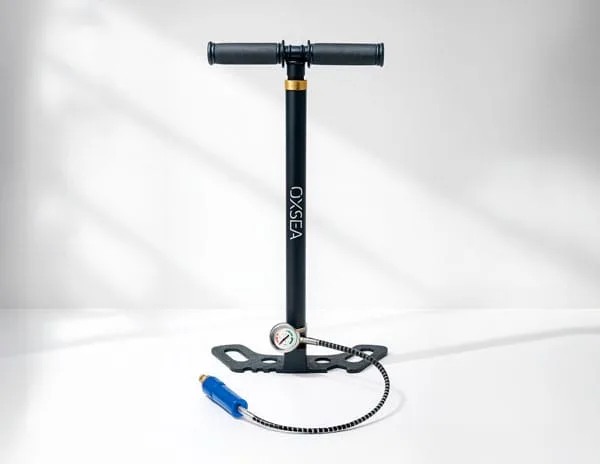
| Manual pump, €159.99 | Physical effort, but no electricity. | Not compatible | Around 20 min |
Where there is no power, nothing leaves you more independent than the OXSEA manual pump, although it only works with the 0.5 litre tanks. On board, the OXSEA 12V mini compressor, hooked up to the battery, is the more convenient option. If you go that way, position its air intake at a distance from the engine: whatever the machine draws in ends up in the tank, and DAN Europe, an organisation dedicated to diver safety, advises keeping the air intake of a compressor away from exhaust gases. With a full scuba tank within reach, it takes around 1 minute to fill an OX1000 through the transfer station.
The price to look at is the price of the whole setup, tank and refill method together. Sold as a pack, the OX500 and its manual pump cost €359.99. The OX1000 cannot do without a compressor or a full-size tank: paired with the mini compressor, it comes to €849.99.
How many minutes do you need underwater?
The OXSEA range comes in two tank sizes. The 0.5 litre gives up to 8 minutes of air, the 1 litre about 15 minutes. In both cases the tank is 6061 aluminium and its working pressure is 200 bar.
Take those minutes for what they are: approximate figures. The deeper you go, the more air you use, because the regulator feeds you air at the same pressure as the water around you. So each breath takes a little more out of the tank. Effort counts as well: you do not breathe at the same rate while scraping a hull against the current as you do while drifting above a seagrass meadow.
Match your choice to the longest job you expect to tackle. For a quick look at the mooring, 0.5 litres is often enough. If you have to stay beneath the hull for several minutes, 1 litre makes sense. Either way, the decision to surface is made long before the gauge comes close to zero.
Mouthpiece or back harness
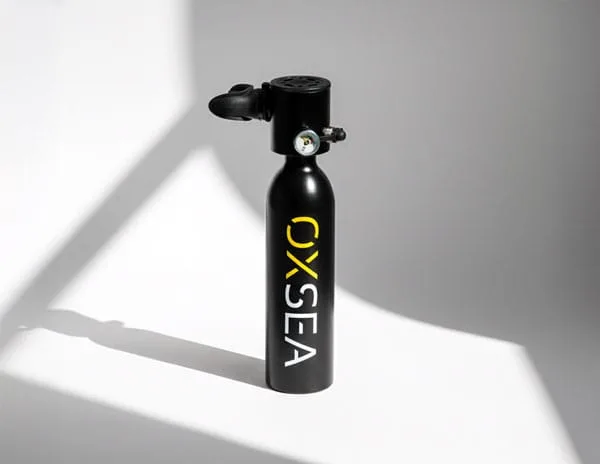
Held in the mouth, the tank is ready within a few seconds, and no format is more compact. That is how the OX500 tank works, with its silicone mouthpiece: once it is in the water, its weight drops below 1 kg.
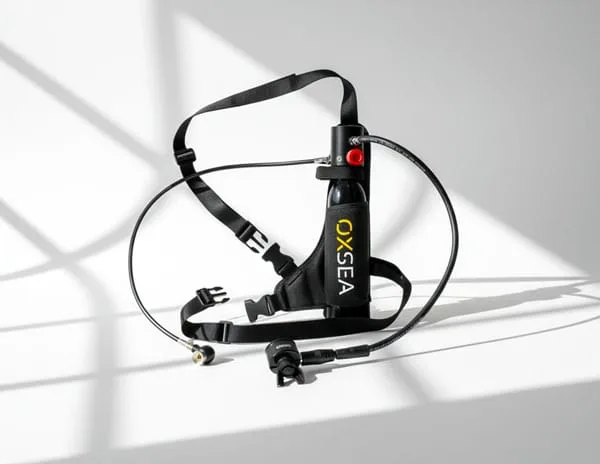
Worn on the back, the tank fastens to a harness and the air reaches you through an external regulator. Your jaw has nothing left to hold, and turning your head no longer drags the tank along. You feel the difference as soon as a dive runs long or there is work to be done. The OX1000 is designed to be worn this way only. The OX500Plus works either way: mouthpiece for a quick trip below the surface, harness when a longer session is planned.
OX500, OX500Plus or OX1000: a table to help you decide
| Criterion | OX500 | OX500Plus | OX1000 |
|---|---|---|---|
| Volume | 0.5 litre | 0.5 litre | 1 litre |
| Time underwater | Up to 8 minutes | Up to 8 minutes | About 15 minutes |
| How you carry it | Mouthpiece | Mouthpiece or on the back | On the back |
| Refilling by manual pump | Possible, around 20 min | Possible, around 20 min | Not compatible |
| Tank on its own | €199.99 | €289.99 | €299.99 |
| One possible pack | €359.99 with the pump | €449.99 with the pump | €849.99 with the mini compressor |
For a first purchase and short dives, the OX500 does the job. Teamed with the manual pump, it can be filled anywhere, including places with no electricity.
If some of your outings are getting longer and you would rather spare your jaw, the OX500Plus model is the natural next step. For the same capacity, it also goes on your back (harness and external regulator) and it is supplied with an external pressure gauge.
For jobs that take a while, the 1 litre OX1000 offers twice the capacity. It is worn on the back. Filling it requires the mini compressor or a scuba tank: the manual pump is not compatible.
The detail, criterion by criterion, is set out in our full comparison of the three tanks.
Two parts to examine closely: regulator and pressure gauge
Between the tank and your lungs, the regulator is the part that brings the stored air down to a breathable pressure. When it is set correctly, the air arrives smoothly, as soon as you begin to inhale. Two checks before buying: the airflow has to be adjustable, and a manual or a video has to show how it is done. Another sign of a reputable seller is a listing that states what the fittings and seals are made of.
The pressure gauge is just as important. Nothing else tells you how much air remains. Without that reading, there is no way of deciding when to head back up. On the OX500 the gauge is built in, and the OX500Plus is supplied with an external one.
Very low prices: the warning signs that should stop you
Mini scuba tanks sold for far less can be found online. Some of them serve their purpose. Others cause problems from the very first fill. Stay on your guard when a listing shows one of the following flaws:
- The seller displays neither an address nor a customer service you can identify. If the tank leaks, you could be left with nobody to talk to.
- The listing mentions neither the material the tank is made of nor its working pressure.
- The air time is quoted on its own, with no depth and no level of effort. A nice round figure tells you nothing.
- The pressure gauge is missing, or its dial is so small that you cannot read it underwater.
- Refilling is left vague: a pump presented as “compatible” without further detail, no adapter for filling from a scuba tank, no filter anywhere in the air line.
- The manual is poorly translated, there is no video, and not a single spare part is on sale.
When a tank is filled to 200 bar, it is better to know who manufactured it and who will look after it once the sale is made.
A few years on: wear parts, tutorials and after-sales service
Pump or compressor filters, safety disc, membrane, seals: several parts of a mini scuba tank wear out and need replacing. Sooner or later a seal will start to fail. When that day comes, you will have to find the part and know how to fit it. So before ordering, check that these parts can be obtained without difficulty, that instructions exist in English, and that the after-sales service can be contacted at an address you can identify.
OXSEA has gathered its video tutorials in the OXSEA School, sorted by product. They show you how to put the tank together, set the airflow, replace the regulator seal or the safety disc, change the filters and run a test to locate a leak. For after-sales service, write to us by email: the address is given on our contact page.
Before your first dive: the safety rules
With a mini tank you are breathing compressed air, as you would with conventional diving equipment. The ground rules therefore hold for you as they do for any diver, even in two metres of water.
On the way back up, never hold your breath. As the pressure falls, the air inside your lungs expands. DAN (Divers Alert Network) states that once you have breathed from a tank, surfacing with your breath held from a depth of only 4 feet, roughly 1.2 metres, may be all it takes to injure the lungs. The reason is that volume changes are greatest close to the surface. Ascend without hurrying, and never stop breathing normally.
Do not go deep, and always keep a reserve of air. A mini tank is designed for short dives, close to the surface.
Get proper training. Diving on a tank has to be learned, so turn to a dive centre and its qualified instructors. Beyond that, never dive on your own, have a doctor confirm that you are fit to dive, and use a buoy and a flag to show that you are in the water.
Frequently asked questions
Short answers to the questions this guide raises.
Which mini scuba tank should a beginner start with?
A 0.5 litre tank fitted with a pressure gauge and bought together with a means of refilling it meets most needs, as long as your dives stay short and close to the surface. In the OXSEA range, that role falls to the OX500. If you expect long jobs beneath the hull, go for the 1 litre version.
Can a mini scuba tank be filled without a compressor?
For the 0.5 litre tanks, yes. Allow about 20 minutes on the manual pump to fill an OX500 or an OX500Plus, with no electricity at all. Both models can also be filled from a scuba tank, through a transfer station. The OX1000 is filled with the mini compressor, or from a scuba tank.
How long does a 0.5 litre mini scuba tank last?
Up to 8 minutes when conditions are good. Going deeper or exerting yourself shortens that time. Keep an eye on the gauge and surface with air to spare.
Are you allowed to spearfish with a mini scuba tank?
Before anything else, check the rules that apply where you dive. France, for example, bans recreational spearfishing for anyone using scuba gear, in other words a tank. Other countries set their own regulations. Our advice is to use the mini tank for looking after the boat and for observing, not for fishing.
Is training required before using a mini scuba tank?
Training is recommended. For any diving on a tank, our advice is to learn at a dive centre, under qualified instructors. That is where the right habits are formed, the first being to breathe out as you ascend. The OXSEA School tutorials deal with the equipment and are no substitute for an instructor.
Products mentioned in this guide
Prices include VAT; stock is live on each product page.
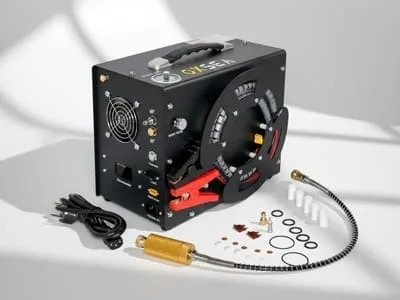
12 V / 220 V mini compressor
Refills 0.5 L and 1 L tanks from a battery or the mains
Last units
€549.99
Read next
Guides that build on this one.
Guide5 min read
Mini scuba tank comparison: OX500, OX500Plus or OX1000, which one should you get?
A mini scuba tank comparison of OXSEA's three models: refilling, time underwater, how you carry them and price, reviewed to help you find the one you need.
Tip8 min read
How to refill a mini scuba tank: time, budget and precautions
Refill a mini scuba tank with a manual pump, a mini compressor or from a full-size tank: fill times, budget for 20 refills, air quality, mistakes to avoid.
Guide9 min read
Mini scuba tank for boats: getting equipped to work under the hull
With or without a 12 V battery, which mini scuba tank for boats should you carry? Models, refill times, stowage on board and the safety rules to follow.

Everything comes in the pack
Each pack bundles the tank, its refill system and the accessories. Still unsure? Email us and we'll point you to the right one.