
Tip8 min read
Scuba tank: mini or full-size, which one do you need?
Scuba tank sizes compared: a full-size 10 to 15 liter tank or a 0.5 to 2.3 liter mini tank. Air carried, depth, refills, weight, training and upkeep.
- Written by
- The OXSEA team
- Published on
On this page
- Full-size scuba tanks: sizes and pressures
- Small scuba tanks: 0.5 to 2.3 liters, near the surface
- Full-size or mini scuba tank: the comparison table
- Refilling: a fill station or your own gear
- Weight and bulk
- Care and inspections
- Full-size or mini: it depends on the dive
- Which mini scuba tank for which job
- Safety rules, whatever the tank
- Frequently asked questions
It comes down to what you want to do underwater. To explore a reef or a wreck on a real dive, you need a full-size scuba tank of 10 to 15 liters, along with training and a dive shop to fill it. For a short job near the surface, under a hull or at anchor, a small scuba tank of 0.5 to 2.3 liters is enough: up to 8 minutes of air from 0.5 liters, 20 to 25 minutes from the largest, and you refill it yourself, at home or on board. One does not replace the other.
Both hold compressed air and both can be refilled. They differ in how much air they carry, how deep they belong, how you fill them and what training they call for.
Full-size scuba tanks: sizes and pressures
The tank a dive center hands you usually has an internal volume of 10 to 15 liters (US tanks are often named for their air capacity in cubic feet). Depending on the model, it is generally filled to 200 or 232 bar, about 2,900 to 3,400 psi. It rides on your back, strapped to a buoyancy compensator (BC), with a regulator and weights.
Air follows pressure times volume: in theory, a 12 liter tank at 200 bar holds about 2,400 liters of air at surface pressure, roughly 85 cubic feet. Enough for a full dive, which gets shorter the deeper you go, since each breath then draws more from the tank.
A full-size tank comes after training. An entry-level course such as the FFESSM's Level 1 (in French), recognized internationally as a CMAS one-star certification, is taught at a club, requires a medical certificate and then lets you dive to 20 meters (66 feet) under supervision. Dive shops set their own rules, and most ask to see a certification card before they rent you a tank or fill one.
Small scuba tanks: 0.5 to 2.3 liters, near the surface
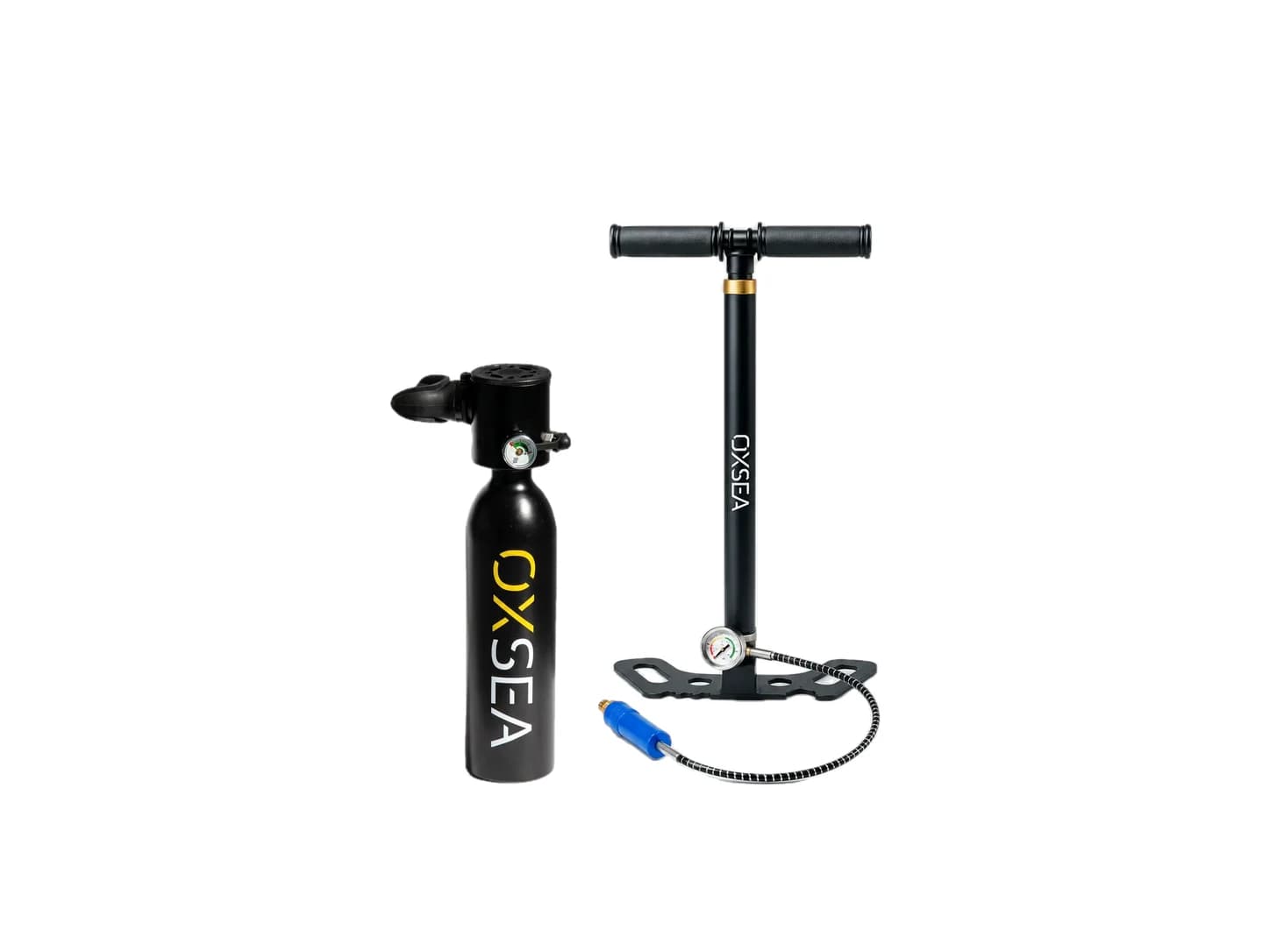
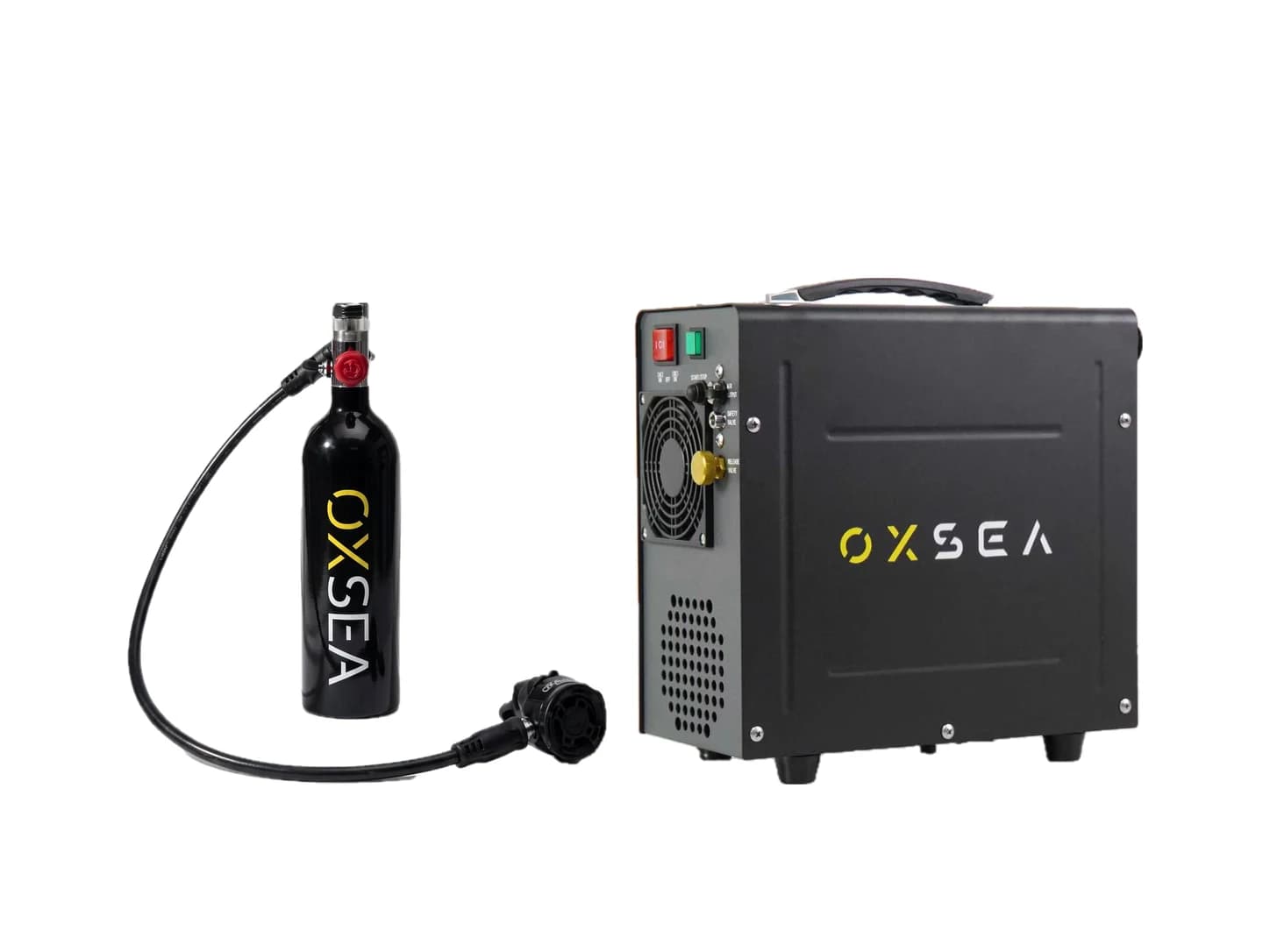
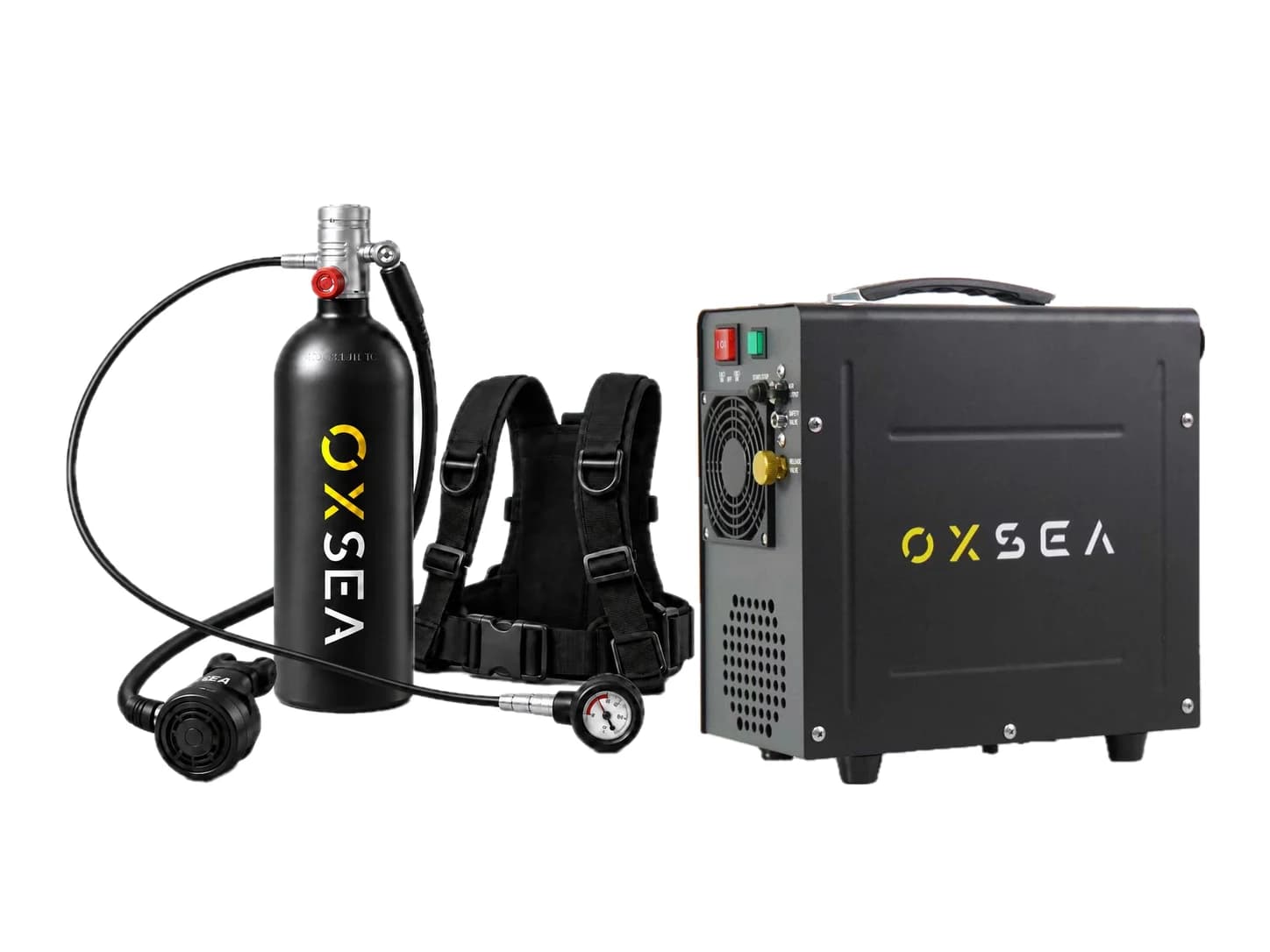
A refillable mini scuba tank, often called a small or portable scuba tank, carries far less air, for a different job. At OXSEA, the OX500 and OX500Plus hold 0.5 liters: the first is held in the mouth with a silicone mouthpiece, the second can be held in the mouth or worn on the back. The OX1000 (1 liter) and the OX2000 (2.3 liters) are worn on the back. The OX500, OX500Plus and OX1000 are filled to 200 bar, about 2,900 psi.
By the same math, a full OX500 holds about 100 liters of air and an OX1000 about 200. That gives you up to 8 minutes from 0.5 liters, about 15 minutes from the OX1000 and 20 to 25 minutes from the OX2000, near the surface with calm breathing. Depth, effort and cold all cut those times.
It is the tool for short jobs in shallow water: cutting a line off the prop, checking a zinc, freeing an anchor in a shallow anchorage, recovering something dropped overboard. It also works for snorkeling, or in a pool to get used to breathing underwater. No certification is required to buy one, but an introductory session is still recommended. Our main guide explains how a mini scuba tank works.
Full-size or mini scuba tank: the comparison table
| Criterion | Full-size scuba tank | OXSEA mini tank |
|---|---|---|
| Internal volume | 10 to 15 liters, most often | 0.5, 1 or 2.3 liters |
| Pressure | Generally 200 or 232 bar (about 2,900 to 3,400 psi) | 200 bar (OX500, OX500Plus, OX1000) |
| Air carried (theoretical) | About 2,400 liters (12 liters at 200 bar) | About 100 liters (0.5 liter), 200 liters (1 liter) |
| Time underwater | A full dive, shorter at depth | Up to 8 min (0.5 L), about 15 min (1 L), 20 to 25 min (2.3 L) |
| Depth | Within the limits of your certification | Shallow, close to the surface |
| Training | A certification, usually asked for to rent a tank or get it filled | None required to buy, introductory session recommended |
| Refilling | A dive shop or club fill station | Manual pump, 12 V / 220 V compressor or transfer from a full-size tank |
| Tank weight | More than 10 kg (22 lb) for 12 liters, before the rest of the gear | 1.55 kg (OX500), 3.15 kg (OX1000) |
| Inspections | Periodic inspections set by regulations | Your own check at every refill, periodic professional check advised |
Refilling: a fill station or your own gear
Every scuba tank can be refilled. What changes is where.
A full-size tank is filled at a dive shop or club, on a high-pressure compressor, provided its inspections are current. DAN, the reference organization for diver safety, warns in its Alert Diver magazine that a fill station may turn away a cylinder that is out of date, and advises using only authorized fill stations that test their air regularly.
A mini tank is refilled wherever you are.
- Manual pump: about 20 minutes for 0.5 liters, no power needed. It fills the OX500 and OX500Plus, not the OX1000 or OX2000.
- 12 V / 220 V compressor: on a 12 V boat or car battery, or on 220 V mains power, about 12 minutes for 0.5 liters and 20 minutes for 1 liter. The OX2000 takes longer.
- Transfer from a full-size tank: a DIN or yoke transfer station fills the mini tank from a full scuba tank, in about a minute for the OX1000.
The air you compress is the air you will breathe: refill outdoors, away from any engine or generator exhaust, and replace the filters, which wear out. Our guide on how to refill a mini scuba tank compares the three methods, with times and budgets.
Weight and bulk
A 12 liter tank weighs more than 10 kg (22 lb) on its own. Add the BC, the regulator and the weights, and the kit fills a dive bag.
A mini tank fits in a boat locker: the OX500 weighs 1.55 kg (3.4 lb) out of the water, the OX1000 3.15 kg (6.9 lb). The pump or compressor goes wherever the tank goes, on board or ashore, so you no longer depend on a fill station.
Care and inspections
The basics are the same for both. After a day at sea, rinse the tank and regulator with fresh water, let them dry in the shade, then store them away from heat and knocks. Before every fill, look for dents, corrosion, a damaged thread or a split seal.
A full-size tank also needs periodic professional inspections (visual and hydrostatic), on a schedule set by each country's rules. For a mini tank, we advise a periodic check by a professional, as often as your use calls for. Seals, the safety disc and the filters wear and get replaced: the OXSEA School videos show each step.
Full-size or mini: it depends on the dive
A full-size tank is the right call if you want to explore the bottom and stay down for a long time. You work your way up through certification levels and plan each dive. For going deep, no mini tank replaces it.
A mini tank makes sense when the work is near the surface and short. It also helps when no dive shop is nearby, since you refill it yourself. Already a certified diver? You can fill it from your own tank and keep it on board for quick jobs.
Which mini scuba tank for which job
- A look at the prop, something to fish out, a boat with no power: the OX500, held in the mouth, and the manual pump, sold together in the OX500 and manual pump pack.
- A line to cut, both hands busy: the OX500Plus, worn on the back, sold in packs with the pump or the compressor.
- A lap around the hull, a zinc to check: the OX1000 and its quarter hour or so of air, in the OX1000 and 12 V / 220 V compressor pack.
- Sessions longer than a quarter hour: the OX2000 and its 2.3 liters, sold with the compressor in the OX2000 pack.
- Learning to breathe underwater in a pool: 0.5 liters is enough.
The comparison of the four mini tanks sets them side by side, criterion by criterion, and each product page shows the pack price. Tanks and refill systems come with a 24-month warranty and 30 days to change your mind.
Safety rules, whatever the tank
A mini tank holds the same compressed air as a full-size one. The basic rules are the same, from the very first meter.
- Never hold your breath on the way up. The air in your lungs expands as the pressure drops. According to DAN's Alert Diver, an ascent of about 1.5 meters (5 feet) with your breath held can be enough to cause an arterial gas embolism, and a lung overexpansion injury can happen even in a swimming pool.
- Stay close to the surface. A mini tank is made for shallow water, not for going deep.
- Never dive alone. In diving the basic unit is the pair, as France's ministry for the sea (in French) puts it. Keep someone at the surface watching you.
- Head up while there is still air. Watch the gauge and decide to surface well before your last breath.
The mini scuba tank safety guide goes through these rules one by one, along with the medical contraindications.
Frequently asked questions
Short answers to the questions this guide raises.
Is a scuba tank filled with oxygen?
No. It holds compressed air, about 21% oxygen. Calling it an oxygen tank is a misnomer: pure oxygen is dangerous for diving. OXSEA mini tanks are filled with air, like most recreational scuba tanks.
Can you refill a scuba tank at home?
A mini tank, yes: about 20 minutes with the manual pump for 0.5 liters, or with the 12 V / 220 V compressor about 12 minutes for 0.5 liters and 20 minutes for 1 liter. A full-size tank is generally filled at a dive shop or club.
How much does a scuba tank cost?
For a full-size tank, the cylinder is only part of the bill: add the regulator, the BC, the weights, the training and every fill. For an OXSEA mini tank, each pack's price, tank and refill system included, is on its product page. After that, a refill costs only the filters, plus electricity with the compressor.
What size scuba tank do I need?
For recreational dives at depth, a full-size tank of 10 to 15 liters. For short jobs near the surface, a mini tank: up to 8 minutes from 0.5 liters, about 15 from 1 liter, 20 to 25 from 2.3 liters, less with effort or cold.
Sources
External documents this text relies on.
Tanks mentioned in this guide
Each tank has its own page; its packs include the refill system.
| Tank | Capacity | Air time | How you wear it | Refill | OXAIR mask | Packs |
|---|---|---|---|---|---|---|
| OX500 mini scuba tank | 0.5 L | up to 8 min | in the mouth | Manual pump, Compressor 12 V / 220 V, or from a dive cylinder | yes | OX500 packsLowest price: OX500 Pack + Manual pump |
| OX500Plus mini scuba tank | 0.5 L | up to 8 min | in the mouth or on the back | Manual pump, Compressor 12 V / 220 V, or from a dive cylinder | yes | OX500Plus packsLowest price: OX500Plus Pack + Manual pump |
| OX1000 mini scuba tank | 1 L | about 15 min | on the back | Compressor 12 V / 220 V, or from a dive cylinder | yes | OX1000 packsLowest price: OX1000 Pack + Compressor 12 V / 220 V |
| OX2000 mini scuba tank | 2.3 L | 20 to 25 min | on the back | Compressor 12 V / 220 V, or from a dive cylinder | yes | OX2000 packsLowest price: OX2000 Pack + Compressor 12 V / 220 V |
Air time depends on your breathing, the depth and the effort.
Full comparison of the four tanksProducts mentioned in this guide
Prices include VAT; stock is live on each product page.
Read next
Guides that build on this one.
Guide5 min read
Mini scuba tank comparison: OX500, OX500Plus, OX1000 or OX2000, which one should you get?
A mini scuba tank comparison of OXSEA's four models: refilling, time underwater, how you carry them and price, reviewed to help you find the one you need.
Tip11 min read
Mini scuba tank buying guide: price, air time, refill, shipping
What a complete mini scuba tank setup includes, how long the air lasts, refilling on 120 V outlets or at a dive shop, and US shipping and returns.
Tip8 min read
Oxygen tank for diving: what you really breathe underwater
Oxygen tank for diving? Divers actually breathe compressed air, about 21% oxygen. Why pure oxygen is dangerous underwater and what a mini scuba tank offers.
Guide9 min read
Mini scuba tank safety: where the danger lies and how to avoid it
Mini scuba tank safety: where is the danger? Ascent, refilling, upkeep, transport, contraindications. The real risks and the precautions, with sources.

Everything comes in the pack
Each pack bundles the tank, its refill system and the accessories. Still unsure? Email us and we'll point you to the right one.