
Tip8 min read
Oxygen tank for diving: what you really breathe underwater
Oxygen tank for diving? Divers actually breathe compressed air, about 21% oxygen. Why pure oxygen is dangerous underwater and what a mini scuba tank offers.
- Written by
- The OXSEA team
- Published on
On this page
Recreational scuba tanks don't hold pure oxygen. They hold compressed air, the same air you are breathing right now, with about 21% oxygen. Pure oxygen becomes toxic as pressure rises, and underwater the pressure rises fast: a few meters down is enough to reach the danger threshold. That is why an OXSEA mini scuba tank is filled with ambient air, filtered and then compressed by the manual pump or the compressor, to 200 bar (about 2,900 psi) for the OX500, OX500Plus and OX1000.
Calling it an “oxygen tank” comes from a sound idea: underwater as anywhere else, oxygen is what your body needs. It gets it from air, in a dose it can handle. The trouble starts with pure oxygen, as soon as you go down.
Air, nitrox or pure oxygen: what is inside a dive tank
The air around you is about 21% oxygen, and nearly all the rest is nitrogen. A standard scuba tank holds that same air, compressed to high pressure. So the underwater oxygen tank people picture on a recreational diver's back is, in most cases, a tank of air.
Nitrox, or enriched air, is a mix with more than 21% oxygen, such as 32% or 36%. According to DAN (Divers Alert Network), the international organization devoted to diver safety, nitrox requires special training to be used properly and safely, and every mix has its own maximum operating depth.
| Gas | Composition | Who can use it | What it is used for |
|---|---|---|---|
| Compressed air | About 21% oxygen, the rest mostly nitrogen | Any diver, mini tank users included, following the safety rules | Recreational scuba diving, OXSEA mini tanks |
| Nitrox (enriched air) | More than 21% oxygen, such as 32% or 36% | Divers trained and certified for that mix | Scuba diving within the maximum operating depth of the mix |
| Pure oxygen | Close to 100% oxygen | At the surface, patients and certified first aid providers; in the water, technical divers trained to use it | Medical care, first aid after a diving accident, decompression stops on technical dives |
Why pure oxygen becomes dangerous underwater
Below the surface, the weight of the water adds to the weight of the atmosphere: pressure goes up by about 1 bar every 10 meters (33 feet). Your regulator delivers gas at the pressure around you. For each gas in the mix, what counts is then its partial pressure: its share of the mix multiplied by that pressure.
The oxygen in air sits at 0.21 bar at the surface and a little over 0.3 bar at 5 meters (16 feet). Breathed pure, oxygen is already at 1 bar at the surface and 1.5 bar at 5 meters. The MSD Manual says oxygen toxicity occurs in most people once the partial pressure of oxygen reaches 1.4 atmospheres. With 100% oxygen, that level is reached at a depth of 4 meters (13 feet). With air, that level is only reached far beyond recreational diving depths. A mini tank, for its part, is used close to the surface.
The most serious form affects the brain. DAN lists the signs of oxygen toxicity: visual disturbances, ringing in the ears, nausea, lip twitching and, in some cases, a convulsion. The convulsion itself is not what harms you, DAN points out. The danger is losing your mouthpiece underwater and drowning. DAN also notes that divers have had convulsions at shallow depths.
Those first few meters are exactly where a mini scuba tank is used. That is why it is filled with air: at those depths, the oxygen in air stays far below the toxicity threshold.
Medical or welding oxygen: never for diving
The thought does come up: fit a mouthpiece to a relative's medical oxygen cylinder, or to the oxygen cylinder of a welding torch. Never do it.
- The gas. It is pure or nearly pure oxygen, with the convulsion risk described above starting a few meters down. Welding oxygen is also sold as an industrial gas, not as a gas to breathe.
- The regulator. A medical regulator sets a flow rate to a mask or a nasal cannula. A welding regulator feeds a torch. Neither one delivers gas on demand at the pressure of the surrounding water, the way a scuba regulator does.
- Fire. Pure oxygen feeds combustion. DAN Europe warns that exposure to oil and grease increases the risk of fire with oxygen equipment.
Pure oxygen does have a place around diving, at the surface. The same DAN Europe article calls it the primary first aid for scuba diving injuries, breathed at 100% and delivered by a certified oxygen provider. On a boat, its cylinder belongs with the first aid kit.
A mini scuba tank: the same air, in a smaller amount
What many people call a mini oxygen tank for diving is really a small tank of air. Refillable mini scuba tanks from OXSEA carry the same air as a full-size tank, in a much smaller amount: 0.5 to 2.3 liters depending on the model, where a standard scuba tank has a capacity of 10 to 15 liters. That is enough for a few minutes close to the surface.
- OX500: 0.5 L, held in the mouth, up to 8 minutes of air.
- OX500Plus: 0.5 L, in the mouth or on your back with a harness and external regulator, up to 8 minutes.
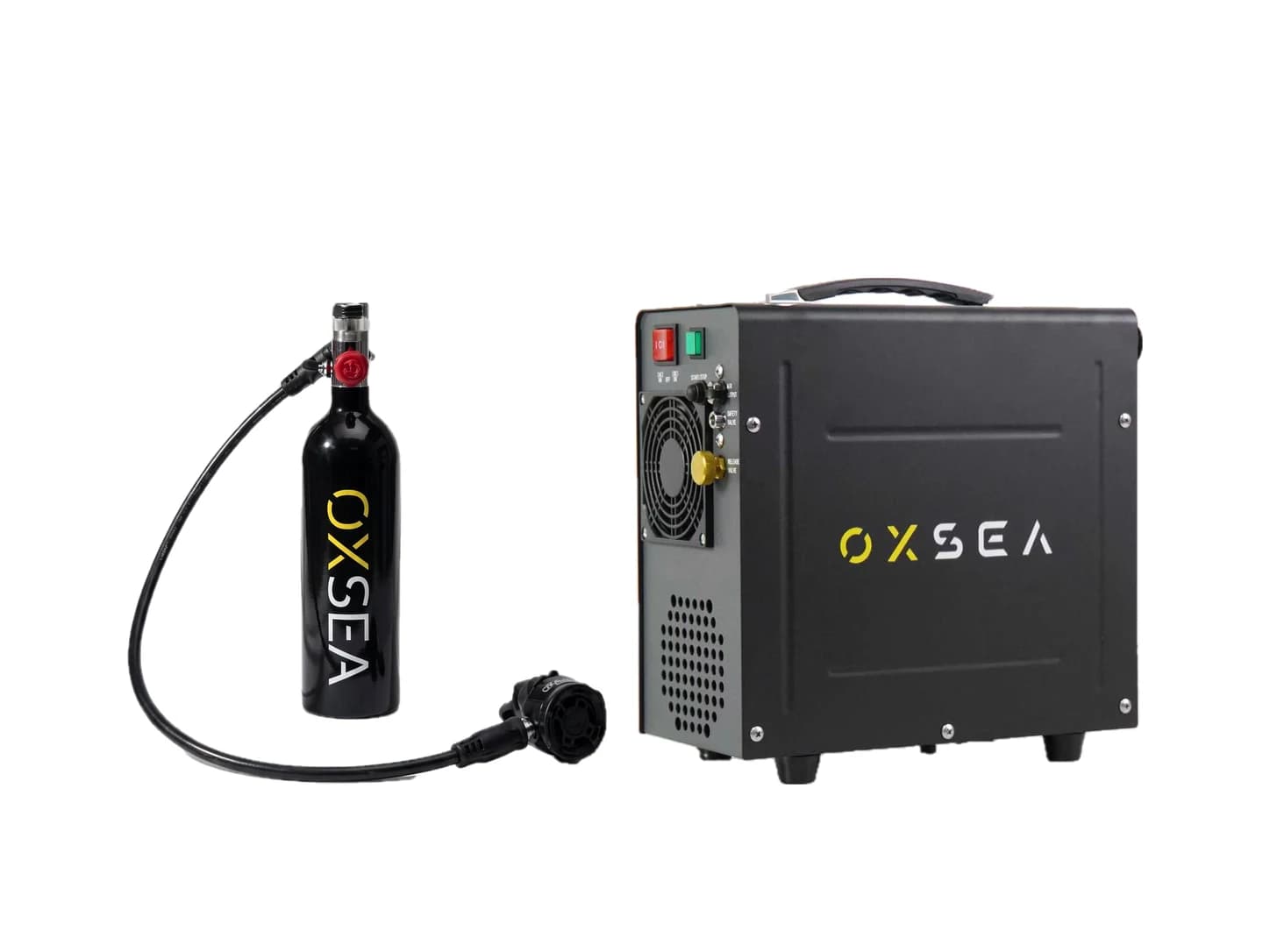
- OX1000: 1 L, worn on the back, about 15 minutes. It comes as an OX1000 pack with the 12 V / 220 V compressor.
- OX2000: 2.3 L, worn on the back, 20 to 25 minutes.
Those times apply close to the surface, breathing calmly. Depth, effort and cold water shorten them: the guide to mini scuba tank air time shows how to estimate yours.
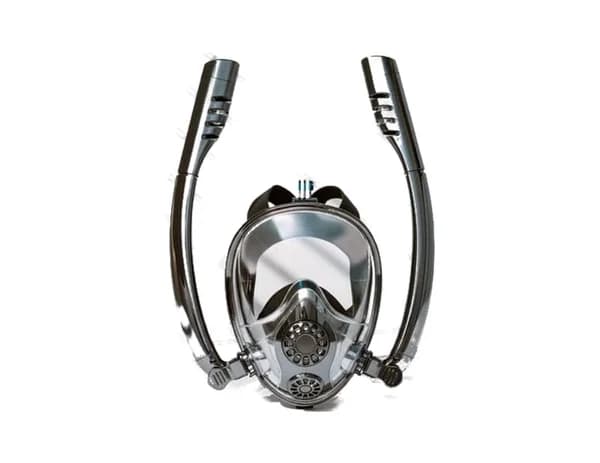
A few minutes cover a lot of jobs. Under a boat, you can check the hull, clear a line wrapped around the prop, inspect an anode or recover something dropped at anchor. For snorkeling, the “oxygen mask” people sometimes mention is a full-face mask connected to a tank of air: the OXAIR mask switches from the snorkel to the tank's air when you go down. In a pool, a 0.5 L tank held in the mouth is enough to learn to breathe underwater in calm conditions. Our mini scuba tank guide compares the four models and what each one is for.
How a mini tank is filled with air
You refill it yourself, at home, on board or at the dock. The pump or compressor draws in the surrounding air, passes it through its filters and compresses it into the tank. The gauge shows when the working pressure is reached: 200 bar for the OX500, OX500Plus and OX1000. Never go past it.
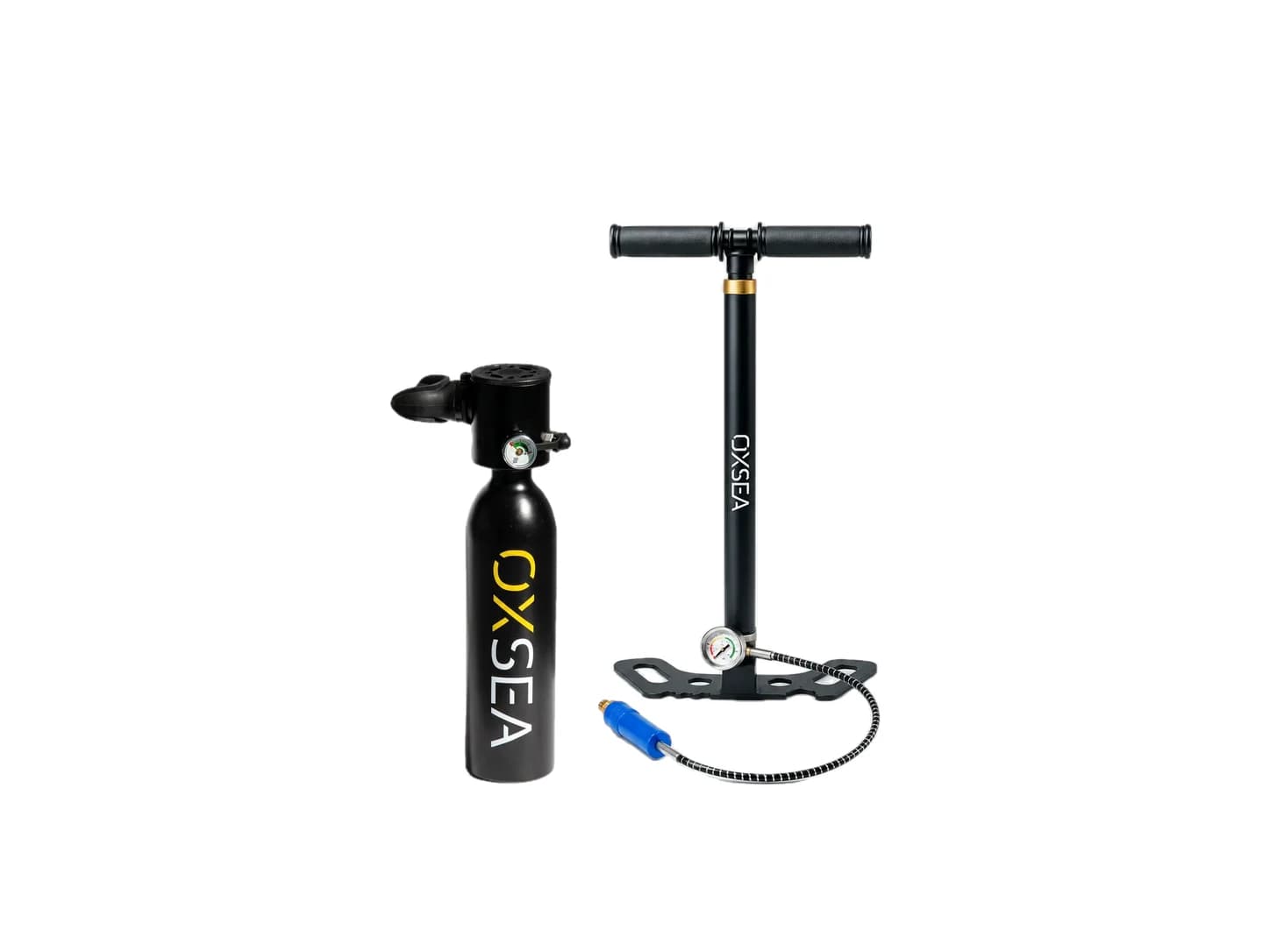
- Manual pump: about 20 minutes for 0.5 L, with no electricity. It does not fill the OX1000 or the OX2000. The OX500 pack with the manual pump puts the tank and its refill method in one order.
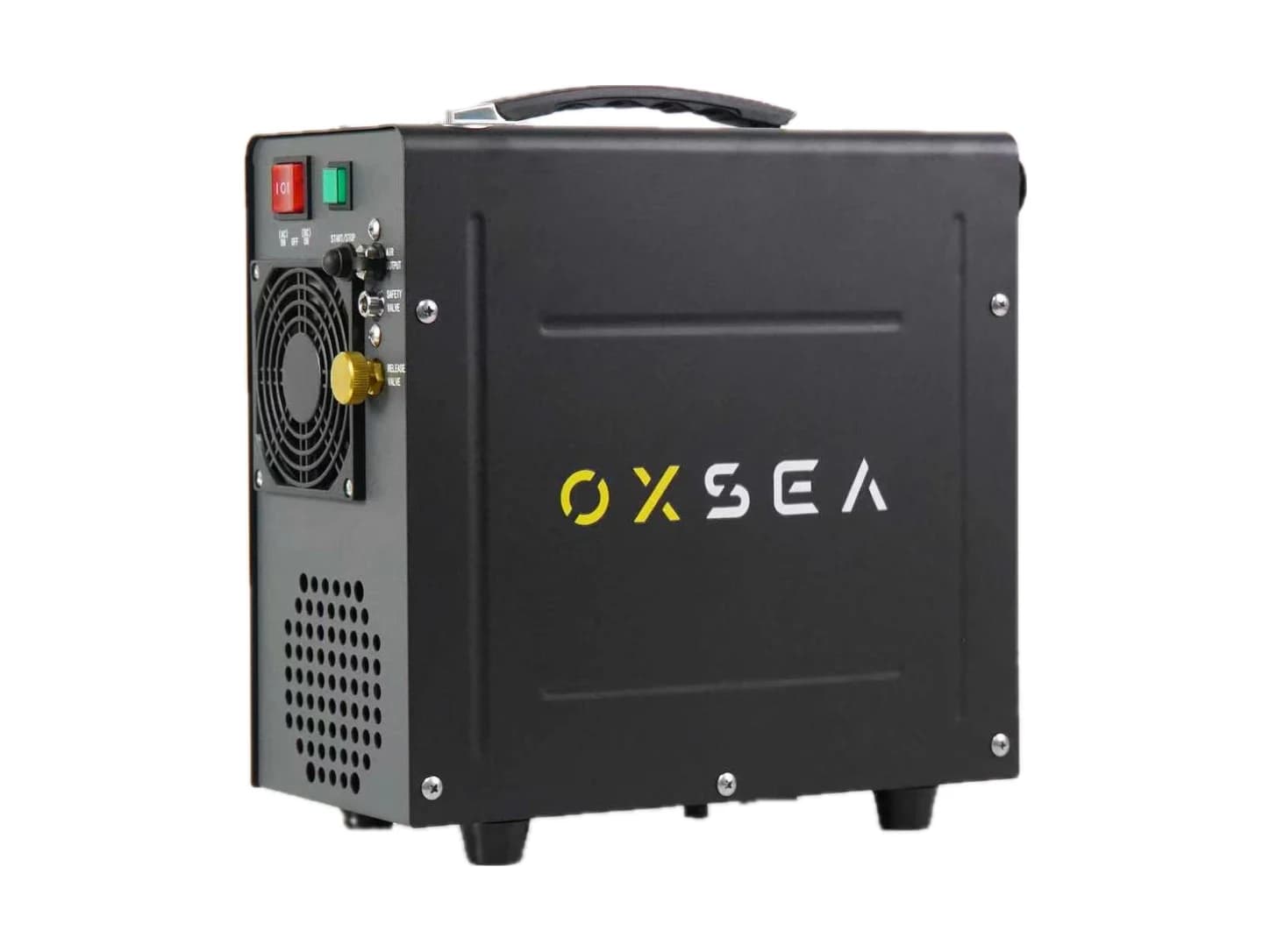
- Compressor: the 12 V / 220 V compressor fills 0.5 L in about 12 minutes and 1 L in about 20, the OX2000 in longer, from the boat battery or a power outlet.
- From a scuba tank: the DIN or yoke transfer station moves air from a full-size tank filled with air into the mini tank, in about a minute.
- Power Compressor 220 V: 20 to 25 minutes for the OX2000, on mains power.
The air around you is what goes into the tank, so the spot matters. Refill outdoors, away from any engine or generator exhaust. DAN lists engine exhaust among the sources of breathing gas contamination, and the carbon monoxide it contains has no smell and no taste. Filters are consumables: replace them regularly. And never fill a mini tank with oxygen. The guide on how to refill a mini scuba tank compares the methods, with times and budgets.
Safety: the rules of compressed air
Breathing air takes the pure oxygen risk off the table. The compressed air risk remains, and it mostly shows up on the way up.
- Never hold your breath on the way up. The air in your lungs expands as the pressure drops. According to DAN's Alert Diver magazine, an ascent of about 1.5 meters (5 feet) with your breath held can be enough to cause an arterial gas embolism.
- Stay shallow. A mini tank is meant for use close to the surface, under a hull or while snorkeling.
- Never dive alone. Keep someone at the surface who can see you and knows how to raise the alarm.
- Head up while there is still air. Decide when you will surface before you go down, then keep an eye on the gauge.
The mini scuba tank safety guide covers these rules in detail, along with medical contraindications and refilling precautions.
Frequently asked questions
Short answers to the questions this guide raises.
Do scuba divers breathe pure oxygen?
No. In recreational diving, the tank holds compressed air with about 21% oxygen, like the air at the surface. Nitrox, which contains more oxygen, and the pure oxygen used at decompression stops are for divers trained to use them.
Can you dive with a medical oxygen tank?
No. According to the MSD Manual, pure oxygen reaches its toxic level at a depth of 4 meters (13 feet), with a risk of convulsions and therefore of drowning. A medical regulator is not built for breathing underwater, and pure oxygen raises the fire risk around oil and grease. Medical oxygen is meant to be breathed at the surface.
How long does a mini scuba tank last?
Up to 8 minutes with 0.5 L (OX500, OX500Plus), about 15 minutes with 1 L (OX1000) and 20 to 25 minutes with 2.3 L (OX2000). Those times apply close to the surface, breathing calmly. They drop as depth, effort or cold increase.
Can a mini tank be filled with oxygen or nitrox?
No. An OXSEA mini tank is filled with air, from the pump, the compressor or a scuba tank filled with air. Pure oxygen is dangerous underwater, and nitrox is reserved for divers trained to use it.
Do you need a certification to use a small dive tank?
Not to buy one or to use it close to the surface. At a dive shop, renting a tank or getting one filled usually requires a certification card, while a mini tank is refilled at home. The safety rules always apply, and a try-dive with an instructor is a good way to learn to breathe underwater. Rules vary by country: check what applies where you dive.
Sources
External documents this text relies on.
Tanks mentioned in this guide
Each tank has its own page; its packs include the refill system.
| Tank | Capacity | Air time | How you wear it | Refill | OXAIR mask | Packs |
|---|---|---|---|---|---|---|
| OX500 mini scuba tank | 0.5 L | up to 8 min | in the mouth | Manual pump, Compressor 12 V / 220 V, or from a dive cylinder | yes | OX500 packsLowest price: OX500 Pack + Manual pump |
| OX500Plus mini scuba tank | 0.5 L | up to 8 min | in the mouth or on the back | Manual pump, Compressor 12 V / 220 V, or from a dive cylinder | yes | OX500Plus packsLowest price: OX500Plus Pack + Manual pump |
| OX1000 mini scuba tank | 1 L | about 15 min | on the back | Compressor 12 V / 220 V, or from a dive cylinder | yes | OX1000 packsLowest price: OX1000 Pack + Compressor 12 V / 220 V |
| OX2000 mini scuba tank | 2.3 L | 20 to 25 min | on the back | Compressor 12 V / 220 V, or from a dive cylinder | yes | OX2000 packsLowest price: OX2000 Pack + Compressor 12 V / 220 V |
Air time depends on your breathing, the depth and the effort.
Full comparison of the four tanksProducts mentioned in this guide
Prices include VAT; stock is live on each product page.
Read next
Guides that build on this one.
Guide9 min read
Mini scuba tank safety: where the danger lies and how to avoid it
Mini scuba tank safety: where is the danger? Ascent, refilling, upkeep, transport, contraindications. The real risks and the precautions, with sources.
Tip8 min read
Scuba tank: mini or full-size, which one do you need?
Scuba tank sizes compared: a full-size 10 to 15 liter tank or a 0.5 to 2.3 liter mini tank. Air carried, depth, refills, weight, training and upkeep.
Tip9 min read
How to refill a mini scuba tank: time, budget and precautions
Refill a mini scuba tank with a manual pump, a 12 V / 220 V compressor or from a full-size tank: fill times, budget for 20 refills, air quality, mistakes to avoid.
Tip10 min read
First time scuba diving with a mini tank: how deep, how long, what gear
First time scuba diving with a mini tank: how deep to go, how many minutes of air you get, what gear to bring, and the habits that prevent accidents.

Everything comes in the pack
Each pack bundles the tank, its refill system and the accessories. Still unsure? Email us and we'll point you to the right one.