
Tip10 min read
How to equalize your ears when scuba diving in shallow water: methods that work from your first descent
How to equalize your ears scuba diving, starting at the surface: Valsalva, Toynbee, Frenzel, a step-by-step descent, colds, a blocked ear and when to stop.
- Written by
- The OXSEA team
- Published on
On this page
- Why it all happens in the first few meters
- How to equalize your ears when diving: the techniques
- The descent, step by step
- When your ears won't equalize: a cold, one ear, a child, a full face mask
- After the dive: the signs that mean you stop
- Under the hull, the other rules stay the same
- Frequently asked questions
To equalize your ears when scuba diving, you let air into the middle ear through the Eustachian tubes, and you do it before it hurts. Start at the surface, then do it again roughly every 60 centimeters (2 feet) through the first few meters. Three moves are enough to get started: the gentle Valsalva (pinch your nose, blow softly), the Toynbee (pinch your nose, swallow) and the Frenzel (pinch your nose, say “K”). If an ear refuses to clear, stop descending, go up 1 meter (about 3 feet) and try again. If it still refuses, the dive ends there.
These rules hold with a dive center tank as much as with an OX500 mini scuba tank. Ears suffer first near the surface, which is exactly where first descents take place.
Why it all happens in the first few meters
The middle ear is a small air-filled cavity, closed off on the outside by the eardrum. Its only opening is to the back of the throat, through the Eustachian tube. That tube stays shut at rest and opens for an instant when you swallow, explains the Divers Alert Network (DAN), the international organization devoted to diver safety.
Underwater, pressure rises by about 0.1 bar per meter (roughly half a psi per foot), according to DAN's medical guide to ears and diving. The water pushes on the eardrum while the air in the middle ear stays at surface pressure. The eardrum bows inward. The same guide says a difference of 0.35 bar (5 psi) can rupture it in some divers. DAN spells out what someone goes through when they descend without equalizing.
| Depth reached without equalizing | Pressure difference on the eardrum | What happens |
|---|---|---|
| 30 cm (1 ft) | 0.03 bar (0.45 psi) | The eardrums flex inward. You feel pressure. |
| 1.2 m (4 ft) | 0.12 bar (1.78 psi) | The eardrum stretches: pain sets in. |
| 1.8 m (6 ft) | 0.18 bar (2.67 psi) | The eardrum starts to tear. Pressure locks the tubes shut, and equalizing becomes impossible. |
| 2.4 m (8 ft) | 0.25 bar (3.56 psi) | Blood and mucus fill the middle ear: this is barotrauma. |
| 3 m (10 ft) | 0.31 bar (4.45 psi) | On a fast descent, the eardrum can rupture. |
Sensitivity varies from one person to another, but the order of magnitude holds. DAN Europe notes that these injuries happen mostly on descent, and from as shallow as 2 meters (6.5 feet) when the tube is blocked or the diver forces it.
Boyle's law is behind it. According to DAN's page on equalizing methods, going down about 1.8 meters (6 feet) from the surface squeezes the middle ear by a fifth. From 9 meters (30 feet), you have to go another 3.8 meters (12.5 feet) deeper for the same effect. Close to the surface, you equalize almost nonstop.
How to equalize your ears when diving: the techniques
Every method tries to open the lower end of the tubes so that air can travel from the throat to the ear. You learn them on dry land, in front of a mirror. DAN also suggests a test before you get on the boat: when you swallow, you should hear a small “pop” in both ears.
Valsalva: pinch your nose and blow gently
This is the method most divers learn first. Pinch your nostrils, keep your mouth closed and blow gently through your nose. DAN finds two flaws in it. It does not use the muscles that open the tubes, so it fails once pressure has locked them. And it is easy to blow too hard: the pressure travels to the inner ear and can rupture the round window, a very thin membrane. Blow gently, and never for more than five seconds.
Toynbee: pinch your nose and swallow
With your nostrils pinched, swallow. Swallowing opens the tubes while your tongue pushes air against them. DAN's medical guide also recommends it on the way up.
Frenzel: pinch your nose and say “K”
With your nostrils pinched, close off the back of your throat as if you were about to lift something heavy, then make the sound of the letter “K”. The back of your tongue rises and drives air toward the openings of the tubes, with no breath from the lungs.
Hands-free: voluntary tubal opening
Tense your soft palate and throat while pushing your jaw forward and down, as if you were starting a yawn. Those muscles pull the tubes open. According to DAN, up to 30% of divers manage to master it, after a lot of practice. Yawning or working your jaw is the simple version, useful when your mask keeps you from pinching your nose.
| Method | The move | Nose pinched | When |
|---|---|---|---|
| Valsalva | Blow gently, five seconds at most | Yes | Descent |
| Toynbee | Swallow | Yes | Descent and ascent |
| Frenzel | Throat closed, say “K” | Yes | Descent |
| Voluntary tubal opening | Start of a yawn, jaw forward | No | Descent, continuously once mastered |
DAN advises divers who have trouble equalizing to get comfortable with several of them.
The descent, step by step
The right move is no use if it comes too late. These steps draw on DAN's ten tips for easier equalizing and on its medical guide.
- A clear nose. A cold, an allergy, blocked sinuses: you stay out of the water. Skip tobacco and alcohol before the trip, since both encourage mucus.
- A first equalization at the surface. Gently, before you go under, if it helps you. That small head start covers the first few meters, while you are still settling your mask and your breathing.
- Feet first. Air rises up the tubes and mucus drains down. DAN cites studies in which a Valsalva takes 50% more force when you are head-down.
- Down a line. A mooring line or an anchor chain controls your speed and lets you stop on the spot. Without a reference, the descent picks up speed more than you expect.
- About every 60 centimeters (2 feet). That is the rhythm most references recommend, DAN writes, especially over the first 3 to 4.5 meters (10 to 15 feet). Stay slightly ahead instead of waiting until it feels uncomfortable.
- Look up. Stretching your neck helps the tubes open.
- Once more at the bottom. A slight deficit you cannot feel can still injure the ear if it lasts several minutes.
The stop rule. Pain is never normal. If an ear hurts or stays closed, stop going down. Rise a meter or two (3 to 6 feet) until the pain fades, then try again gently, without bouncing up and down. If nothing clears, call off the dive: DAN Europe considers it safer to leave it for another day. Forcing will not unlock a tube that pressure has shut, and it puts the inner ear at risk.
DAN reports the case of a diver who forced an equalization at around 3 meters (10 feet). A “pop”, sharp pain, then dizziness, vomiting and reduced hearing: an inner ear injury, which healed with rest.
When your ears won't equalize: a cold, one ear, a child, a full face mask
With a cold or an allergy
DAN is clear that you never dive with a stuffy nose, a cold or allergy symptoms. Mucus blocks the tubes on the way down, and sometimes on the way up: that is a reverse block. A decongestant can wear off underwater, and repeated use of a nasal spray can make congestion worse through a rebound effect. DAN's medical guide only allows them when a doctor agrees, and never as a first try right before a dive.
Only one ear won't clear
Stop and turn the blocked ear toward the surface, DAN advises: air rises into it more easily. If your two ears do not equalize at the same rate, a gap of about 66 centimeters (2 feet) of water can cause brief vertigo. Hold on to the line, and head back up if the ear does not open.
On the way up
Normally, the extra air escapes by itself through the tubes. If an ear feels pressure as you rise, slow down, try the Toynbee and this time turn the sore ear toward the bottom, says DAN. Come up as slowly as your air supply allows, breathing normally.
Going slowly means having air in reserve. A 0.5-liter tank gives you up to 8 minutes underwater, a 1-liter tank about 15 minutes, and those times change with your breathing, the depth and how hard you work. Decide to head up early. The guide to mini scuba tank air time goes through these numbers.
A child
In its discovery pack (in French), the FFESSM, the French underwater sports federation, sets a minimum age of 8 for scuba diving and limits the first dive to 2 meters (6.5 feet) for children aged 8 to 10, and 3 meters (10 feet) for those aged 10 to 14. With a mini tank, a child only dives with a trained adult right beside them. Agree on a signal that means “my ears hurt”, and head up the first time you see it. A child with a cold stays out of the water.
With a full face mask like the OXAIR
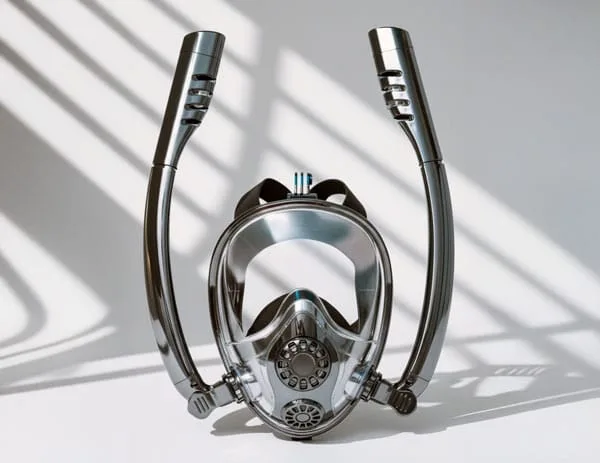
The OXAIR mask is a full face mask: the lens also covers your nose and mouth. With a standard mask, you pinch your nose through the soft skirt, as DAN describes. Under the lens of a full face mask, your fingers cannot reach your nose directly. That leaves the hands-free moves.
Try it where you can stand: mask on, sink slowly to about 1 meter (3 feet) while swallowing or pushing your jaw forward. If your ears open, keep going at the same pace. If they only open when you pinch your nose, keep the OXAIR for the surface and go down with a standard mask and the tank's mouthpiece. The OXSEA School video on the OXAIR shows how to connect it to the tank.
After the dive: the signs that mean you stop
DAN lists the signs of middle ear barotrauma: a full feeling in the ear, muffled sounds, a faint ringing, light-headedness. Diving again with these symptoms, even mild ones, exposes you to a more serious injury of the inner ear.
- Pain, vertigo or a sudden drop in hearing underwater. End the dive. If it does not pass, do not dive again and see a doctor.
- Deafness, ringing, vertigo with nausea. These signs point to the inner ear. According to DAN, you should see an ENT (ear, nose and throat) specialist who knows diving as soon as possible. Hearing loss sometimes only becomes noticeable after a few hours.
- Vertigo underwater. Watch the water in your mask to find which way is up, and follow your bubbles, slowly, to the surface.
After barotrauma, all the medical advice says to stay out of the water until it has healed, DAN sums up. The mini scuba tank safety guide goes back over the contraindications you need to know.
Under the hull, the other rules stay the same
- You keep breathing. Ear pain sometimes makes people hold their breath and shoot to the surface. Alert Diver, DAN's magazine, points out that rising about 1.5 meters (5 feet) with your breath held can be enough to cause a gas embolism.
- Someone is watching you. “Never dive alone” is the heading of the underwater leisure leaflet from France's Ministry of the Sea (in French). Under a boat, keep at least one person at the surface who can call for help.
- The Alpha flag is up. The same French leaflet requires it on dive support boats, kayaks included.
- The engine is off and the key is out when you work near the propeller. The key stays with the person on board.
Frequently asked questions
Short answers to the questions this guide raises.
At what depth should you start equalizing your ears?
At the surface. According to DAN, pain begins at around 1.2 meters (4 feet) if you have not equalized, and pressure can lock the tubes at around 1.8 meters (6 feet). Equalize gently before you go under, then about every 60 centimeters (2 feet).
Which method should you use on a first dive?
A very gentle Valsalva, five seconds at most, which is what most divers learn first. Learn the Toynbee as well, since it works on the way up, and practice both on land.
Can you wear earplugs underwater?
Not ordinary earplugs. DAN explains that a non-vented earplug, a hood that is too tight or a plug of earwax traps air in the ear canal, which can then no longer equalize on descent. The symptoms look like those of middle ear barotrauma.
My ear feels blocked after diving. What should I do?
Do not dive again while the feeling lasts, and do not force a Valsalva to clear it: DAN Europe describes a diver in whom this triggered tinnitus and vertigo. If the discomfort does not go away, see a doctor, ideally an ENT specialist.
Can you equalize your ears with the OXAIR mask?
Your nose is under the lens and your fingers cannot reach it directly. Count on the hands-free moves: swallowing, pushing your jaw forward, voluntary tubal opening. Check where you can stand that these moves are enough for you. If they are not, keep the OXAIR for the surface.
Sources
External documents this text relies on.
- Divers Alert Network (DAN) (dan.org)
- DAN's medical guide to ears and diving (dan.org)
- DAN Europe (alertdiver.eu)
- DAN's page on equalizing methods (dan.org)
- DAN's ten tips for easier equalizing (dan.org)
- case of a diver (dan.org)
- DAN (dan.org)
- discovery pack (plongee.ffessm.fr)
- Alert Diver, DAN's magazine (dan.org)
- underwater leisure leaflet from France's Ministry of the Sea (mer.gouv.fr)
Products mentioned in this guide
Prices include VAT; stock is live on each product page.
Read next
Guides that build on this one.
Guide5 min read
Mini scuba tank comparison: OX500, OX500Plus or OX1000, which one should you get?
A mini scuba tank comparison of OXSEA's three models: refilling, time underwater, how you carry them and price, reviewed to help you find the one you need.
Guide9 min read
Mini scuba tank safety: where the danger lies and how to avoid it
Mini scuba tank safety: where is the danger? Ascent, refilling, upkeep, transport, contraindications. The real risks and the precautions, with sources.
Guide9 min read
Mini scuba tank for boats: getting equipped to work under the hull
With or without a 12 V battery, which mini scuba tank for boats should you carry? Models, refill times, stowage on board and the safety rules to follow.

Everything comes in the pack
Each pack bundles the tank, its refill system and the accessories. Still unsure? Email us and we'll point you to the right one.