
Tip11 min read
Rope around the propeller: how to free your boat yourself, safely
Rope around your boat's propeller? Engine off, key out, boat secured: clear it from the deck, dive only as a last resort, and know when to call for help.
- Written by
- The OXSEA team
- Published on
On this page
- How to tell the propeller is fouled
- The first few minutes: get the boat under control
- Clearing it from the deck, without going in the water
- Diving under the hull: under what conditions
- Before you head off again: the checks
- Calling the CROSS in France, and what a tow costs
- Avoiding the next one
- Frequently asked questions
When a rope gets wrapped around your boat's propeller, deal with it in this order: shift into neutral, stop the engine, pull the key, get the boat under control. Then try to clear it from the deck, either by unwinding the line or by cutting it with a knife lashed to a boathook. Getting into the water under the hull comes last, on a flat sea, with someone on board who watches you and holds the key. If the boat is drifting toward danger or the sea is building, leave the propeller alone and call for help on VHF channel 16 (in French waters, the call goes to the CROSS, France's maritime rescue coordination center).
It is far from a rare event. In 2025, CROSS Étel, the French rescue center responsible for the coast from Penmarc'h Point in Brittany down to the Spanish border, opened 107 operations for a fouled propeller, all types of vessels combined, according to its 2025 activity report (in French). The report notes that most of the breakdowns reported by recreational boaters come down to poor maintenance or inadequate preparation.
How to tell the propeller is fouled
The engine suddenly slows, knocks or stalls. Sometimes the signs are subtler: an unusual vibration, a boat that pulls to one side, an engine running hot. The British magazine Yachting Monthly lists all of them and points out an awkward truth: the line that gets sucked in is often your own. A trailing sheet, a fender line, the dinghy painter. Failing that, it is the buoy line of a lobster pot or a shred of fishing net.
The right reflex is neutral first, then engine off. Keep driving and the rope only cinches tighter on the shaft. Polypropylene, cheap and widely used by fishermen, can even melt from the friction and fuse into a hard ball that sometimes has to be attacked with a hacksaw, the magazine warns.
The first few minutes: get the boat under control
The boat comes before the propeller. Without propulsion you drift, and the drift sets how much time you have.
- Take the key out. Give it to a crew member, or switch off the starting battery. Nobody should restart the engine out of habit.
- Get everyone into life jackets. That is the first piece of advice in the leaflet on rescue, towing and assistance at sea (in French) published by the French Ministry for the Sea.
- Read your drift. Where are the wind and current pushing you? Toward a shore, rocks, a channel? Is the weather turning, is night coming on?
- Anchor if the bottom allows. In a harbor, grab a mooring buoy or a dock while you can still steer.
- Raise the alarm early. At the slightest doubt about how things will go, call the rescue services before the situation gets worse.
One special case: the boat is held by a pot line, as if it were anchored by the stern. Yachting Monthly advises taking the strain off the trapped section: pull the line up with a boathook or a small grapnel and make it fast on a cleat. Do not cut it until you are sure you will get your steering and propulsion back, or the boat starts drifting.
Clearing it from the deck, without going in the water
Staying on board is by far the best option. BoatUS, the Boat Owners Association of the United States, describes two methods that work from the deck. In both cases, the engine is off and the key is out.
Outboard or sterndrive: tilt the engine up
Tilt the outboard or sterndrive all the way up. The propeller comes out of the water, or close to it, and a jammed line can often be pulled off by hand. BoatUS wants a second person on board watching while you work. If the prop is still out of reach, try the boathook, then a knife fixed to its end.
Inboard engine: unwind it by turning the shaft
Hook the free end of the line with the boathook. One crew member at the stern keeps it under tension. Another goes below and turns the propeller shaft by hand, ignition off. The person at the stern calls out whether the free length is growing or shrinking. If it is shrinking, the rope is winding on further: turn the other way while the stern crew takes up the slack. If nothing moves, alternate directions to work a knot loose.
A knife on the end of a boathook
Fix a serrated knife to the end of a boathook with duct tape and zip ties, and mark the handle on the side of the cutting edge. The rudder is your landmark: the propeller sits just ahead of it. Slide the pole in as flat as you can and cut downward with a sawing motion, Yachting Monthly advises. While you lean over the swim platform, keep your life jacket and tether on, with a crew member watching you. The magazine admits the setup has its limits: on a very tight wrap, a blade on a pole often lacks the stiffness to bite.
A burst of engine, with care
The last method Yachting Monthly mentions: restart in neutral, shift into reverse for one second, back to neutral, then try forward. Only if the boat is drifting freely, never if the rope is holding it in place. The safe boating guidelines from DAN, the Divers Alert Network, a dive safety organization, say no one should stay on the swim platform while the engine is in gear. If the engine stalls again, stop there: the problem is serious.
Diving under the hull: under what conditions
Yachting Monthly treats it as the last resort. Under a boat, you can cut yourself on the hull or on your own knife, get tangled in the rope, get chilled. Worst of all, the stern of a pitching boat can strike the swimmer's head, which is why the magazine keeps the job for sheltered water. BoatUS sets its own conditions: calm sea, no wakes, clear water that is not too cold, and a fit person who knows what they are doing. And never alone.
| What you see | Decision |
|---|---|
| Flat sea, sheltered anchorage, clear water, a crew member on board | Going in is possible if working from the deck got nowhere |
| Waves or swell, even slight | Nobody in the water: a stern dropping back down can cause serious injury |
| Drifting toward a shore, rocks or a channel | Anchor if you can and call for help on channel 16 |
| Night, cold water and no wetsuit, fatigue | Work from the deck only, or get a tow |
| Net caught around the propeller, rudder and keel | Call for assistance: this is no longer a job for a knife |
| Nobody to stay on board | Nobody goes in |
Before you go in
- Engine off, key in the crew member's pocket. Everyone knows a diver is under the hull. DAN points out that a propeller that is not turning can still injure you.
- Alpha flag hoisted. Under the French rules set out in the Ministry for the Sea's recreational diving leaflet (in French), a boat supporting a diver flies this blue-and-white flag for as long as the diver is in the water.
- Swim ladder down before you get in. You climb back out without having to look for it.
- A line run tight along the hull, fitted with a float, to hold on to. A body shop suction cup also helps you stay pressed against the hull.
- The right knife. Serrated blade, blunt tip, a wrist lanyard loose enough to let go of it if the blade jams. A bread knife or a hacksaw often does better than a multi-tool.
- Wetsuit and gloves, against cold and cuts.
Breath-hold or mini scuba tank
For a couple of loose turns, one breath-hold may be enough. On a rope crushed against the shaft, each breath-hold buys you a few seconds of work, and each trip back to the surface leaves you more out of breath. With a mini scuba tank, you stay face to face with the propeller and cut through the turns one at a time.
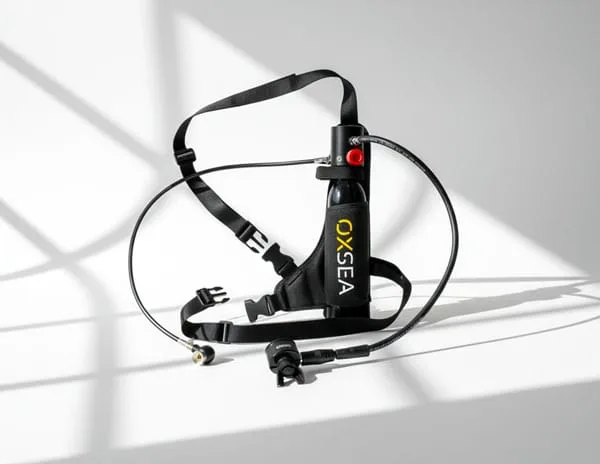
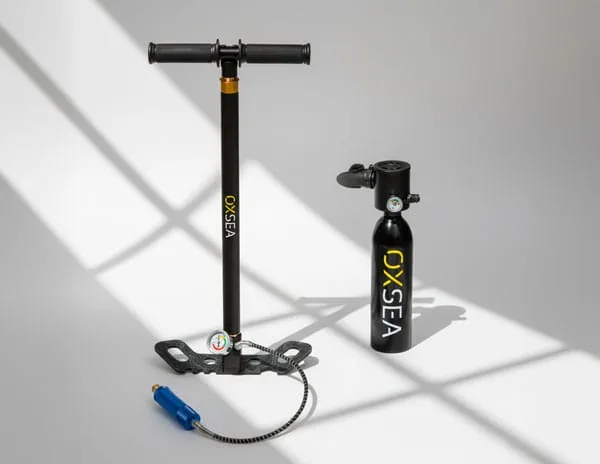
The OX500 is held in the mouth and contains 0.5 liter (17 fl oz) of air at 200 bar (2,900 PSI), enough for up to 8 minutes. The OX500Plus has the same volume but can also be worn on the back: one hand holds the shaft, the other cuts. Those times are maximums, reached breathing calmly near the surface. Sawing through rope is hard work and drains the tank faster: watch the pressure gauge and come up with air in reserve. Between two dives, allow for refilling a 0.5 liter tank: about 20 minutes with the manual pump, about 12 minutes with the mini compressor. The OX500 and manual pump pack fits in a locker and needs no power at all.
One word of caution. Yachting Monthly warns that any breathing apparatus calls for training so you understand the risks, and the French Ministry for the Sea reminds readers that scuba diving is something you learn. The day the prop is fouled is not the day for your first try: get familiar with the tank in the harbor, or better still, with an instructor.
Under the water
Hold on to the hull or the shaft, never the blades. Cut in sections and bring the pieces back aboard. Before you leave the propeller, make sure nothing is left: according to BoatUS, even a small piece of forgotten line can damage the drivetrain when you restart. On the way up, keep breathing without pause. DAN's Alert Diver magazine explains that in shallow water, rising about 1.5 meters (5 feet) while holding your breath can already cause an arterial gas embolism. Our mini scuba tank safety guide goes through these rules in detail.
Before you head off again: the checks
A freed propeller does not guarantee an undamaged boat. A fouled prop can damage the gearbox, or even rip the engine off its mounts, Yachting Monthly points out.
- Look for water coming in around the stuffing box. The magazine recommends keeping a softwood plug sized to the shaft opening, tied on close by.
- Inspect the cutless bearing and the shaft seal. BoatUS notes that a line can work its way in there and compromise the seal.
- On an outboard, keep an eye on the lower unit oil. According to Yamaha, fishing line wound around the propeller shaft can nick the seals and let water into the gearcase. Milky oil means water: have the seals checked.
- Restart gradually, at idle, listening for vibration. If it persists, head back slowly or ask for a tow.
Back in port, have a professional inspect the propeller, shaft, strut and bearings. A haul-out can be worth the money, in the magazine's view.
Calling the CROSS in France, and what a tow costs
At sea in French waters, the CROSS is your one and only contact. The ministry's leaflet asks you to use VHF channel 16 first, with a PAN PAN call, and to dial 196, the French maritime emergency number, only if something is wrong with the radio. At a minimum, give:
- your position, from GPS or relative to a landmark;
- the name and description of the boat;
- the number of people on board and their condition;
- the nature of the problem, here a fouled propeller;
- the help you need and what you have already done, for example anchoring to limit the drift.
After that, report any change, for better or for worse. On the money side, rescuing people is free in France. Towing and assistance to the vessel are paid services: towing is done under a contract at a negotiated flat rate, and assistance can cost more. Check now whether your insurance covers towing.
Avoiding the next one
- Look over the side before starting up. No line end should be trailing in the water, especially when leaving the dock or with the dinghy in tow, Yachting Monthly insists.
- Bring in fenders and dock lines as soon as you clear the harbor, and coil down the sheets.
- Slow down in pot fields, with a crew member at the bow to spot the buoys.
- Think about a rope cutter. The magazine describes three families: disc, scissor and fixed-blade cutters. It is fitted with the boat out of the water.
- Put the kit together: serrated knife, boathook, small grapnel, mask, fins, wetsuit and a tank that is already full. Our guide to the mini scuba tank for boats helps you choose the model and stow it.
Frequently asked questions
Short answers to the questions this guide raises.
Can I motor back to port with rope still caught in the propeller?
It is a gamble. BoatUS warns that leftover line can cut into the cutless bearing or the shaft seal if the engine is running. A sailboat whose rudder is still free can sail home, even trailing a bit of light line, Yachting Monthly notes. Otherwise, weigh that risk against the price of a tow.
Should I alert the CROSS about a fouled propeller in France?
Yes, as soon as the boat is drifting toward danger, getting in the way of other traffic or the weather is deteriorating: on channel 16, with a PAN PAN call. Yachting Monthly advises letting the rescue services know even before you need help, so they already know the situation if it turns bad.
How long can I stay under the hull with a mini scuba tank?
Up to 8 minutes with a 0.5 liter tank (OX500 or OX500Plus), about 15 minutes with the 1 liter (34 fl oz) OX1000, breathing calmly near the surface. The effort of cutting shortens those times: our guide to mini scuba tank air time explains why, and the pressure gauge remains your reference.
Can I dive under my boat with nobody on board if the sea is calm?
No. The French Ministry for the Sea points out that in diving, the basic unit is the pair. Under a hull, keep at least one person on board who watches you, holds the engine key and knows how to call for help.
What about recovering something that fell overboard?
An object dropped over the side at anchor is searched for under the same rules: engine off, Alpha flag up, someone on board. The search only makes sense if the bottom is close and the water is clear. Beyond that, give up or leave it to a professional.
Sources
External documents this text relies on.
- 2025 activity report (dirm.nord-atlantique-manche-ouest.developpement-durable.gouv.fr)
- Yachting Monthly (yachtingmonthly.com)
- rescue, towing and assistance at sea (mer.gouv.fr)
- BoatUS (boatus.com)
- safe boating guidelines from DAN (dan.org)
- recreational diving leaflet (mer.gouv.fr)
- Alert Diver (dan.org)
- Yamaha (yamahaoutboards.com)
Products mentioned in this guide
Prices include VAT; stock is live on each product page.
Read next
Guides that build on this one.
Guide5 min read
Mini scuba tank comparison: OX500, OX500Plus or OX1000, which one should you get?
A mini scuba tank comparison of OXSEA's three models: refilling, time underwater, how you carry them and price, reviewed to help you find the one you need.
Guide9 min read
Mini scuba tank safety: where the danger lies and how to avoid it
Mini scuba tank safety: where is the danger? Ascent, refilling, upkeep, transport, contraindications. The real risks and the precautions, with sources.
Guide9 min read
Mini scuba tank for boats: getting equipped to work under the hull
With or without a 12 V battery, which mini scuba tank for boats should you carry? Models, refill times, stowage on board and the safety rules to follow.

Everything comes in the pack
Each pack bundles the tank, its refill system and the accessories. Still unsure? Email us and we'll point you to the right one.