

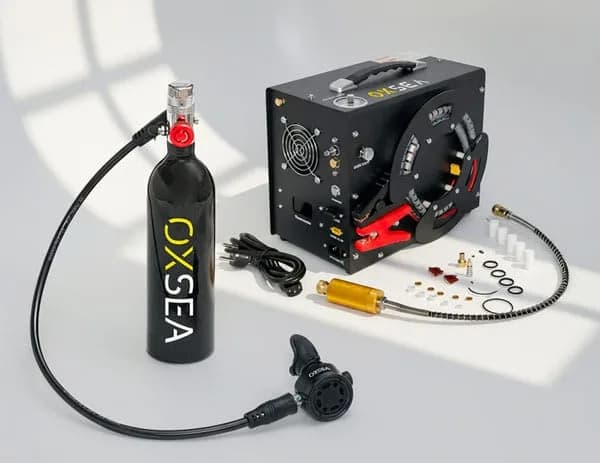
12 V / 220 V mini compressor
Refills 0.5 L and 1 L tanks from a battery or the mains
Last units
€549.99
Tip10 min read
Clean your boat hull in the water with no haul-out: what comes off afloat, which tools to use, time under the hull and the marina rules to check first.
Yes, you can clean a boat hull in the water, with no haul-out and no trip to the yard. The method works on the slippery film and short weed that build up between two bottom jobs, as long as you remove them gently and leave the antifouling paint where it is. Before you go down, check two things: the marina rules, which may ban diving at the dock, and that someone stays on board to keep an eye on you.
A bottom job, strictly speaking, means stripping the hull and repainting it, and it is done out of the water. Between two bottom jobs, cleaning the hull afloat keeps it smooth while the paint is still in good shape.
The International Maritime Organization (IMO) has published guidance for recreational craft on hull fouling. It considers in-water cleaning suitable for light fouling, such as the slime layer of microalgae, using gentle techniques. The caution has two reasons behind it: limiting the biocide the paint releases, and keeping the paint from wearing out before its time.
The same document advises against scrubbing off hard or bulky growth attached to antifouling while the boat is afloat: barnacles, tubeworms, long fronds of weed. Tearing them off scatters debris and a pulse of biocide into the water, and the depleted paint then fouls again faster. The IMO also recommends hauling the boat out at least once a year to clean it on land, where the waste is captured.
| What you see | Afloat? | What to do |
|---|---|---|
| Brown or green film, slippery to the touch | Yes | Sponge or soft brush, light strokes |
| Short weed near the waterline | Yes | Soft brush, no pressure |
| Colonies of barnacles, tubeworms, long weed on the paint | No | Haul-out at a properly equipped yard |
| Barnacles on a bare-metal propeller | Yes, engine off | Scraper, without nicking the blades |
| Corroded anode | Inspect only | Note its condition and plan to replace it |
Why bother when the hull has only turned a little green? Because a thin film already slows you down. For commercial ships, a study published by the IMO estimates that a slime layer 0.5 mm thick (about 0.02 in) covering up to half the hull can raise greenhouse gas emissions by 20 to 25%, depending on the ship and its speed. On a pleasure boat the logic holds: a clean bottom moves through the water more easily.
In France, every port applies its own set of port regulations, which you can consult at the harbormaster's office. Read them before you pull on your wetsuit, because they may rule out cleaning at the dock. The rules adopted in 2023 for Villefranche-Darse and Villefranche-Santé, two département-run harbors in Villefranche-sur-Mer, are a clear example. There, in-water maintenance of the underwater hull is reserved for a specialist contractor, with the port authority's approval. And diving, whether freediving or on scuba, is banned within the port limits.
Other ports are more flexible, but the substance stays the same. The good-practice guide to hull maintenance from the Iroise Marine Natural Park, in Brittany, points out that France's Environmental Code penalizes letting substances harmful to wildlife and plants run into the water. It specifies that this provision targets hull work done outside the designated areas and slipways, and that some towns, such as Douarnenez, ban unauthorized hull cleaning by municipal order. A brush that lifts antifouling and spreads it around the basin produces the same kind of discharge. The IMO guidance points the same way: check with the local authorities before any in-water cleaning.
Some regions even give guidance on frequency. In California, the boater's guide to using hull paint from the state's Division of Boating and Waterways recommends waiting at least 90 days after applying a copper paint before cleaning it. After that, clean it only when needed, no more than once every 30 days. For a biocide-free paint, the document suggests a cleaning every two to four weeks, adding that the right frequency depends on the product and local conditions.
Four questions to ask at the harbormaster's office:
Aim for a calm day: little wind, little current, and water clear enough to see the hull at arm's length. If the rules allow it, a sheltered anchorage sometimes has clearer water than the marina basin.
Take the age of the paint into account as well. Freshly applied antifouling should not be brushed, and each manufacturer explains on the product data sheet how to maintain it. The IMO asks boaters to follow those instructions.
On a breath-hold, a good share of each dive goes into getting down and back up. With a mini scuba tank, you stay in one spot long enough to finish a whole section. At OXSEA, a 0.5-liter tank filled to 200 bar (about 2,900 psi) gives up to 8 minutes of air, and a 1-liter tank about 15 minutes. Those times assume calm breathing. They drop with effort and depth, and scrubbing a hull is real effort.
| Tank | Air available | Refill | How it is carried |
|---|---|---|---|
| OX500, 0.5 L | Up to 8 min | Hand pump, about 20 min. Mini compressor, about 12 min. | Held in the mouth |
| OX500Plus, 0.5 L | Up to 8 min | Hand pump, about 20 min. Mini compressor, about 12 min. | In the mouth or on the back |
| OX1000, 1 L | About 15 min | Mini compressor, about 20 min. No hand pump. | On the back |
How many tanks for the whole bottom? Don't start from a number you read on a forum. Split the hull into sections: port waterline, starboard waterline, bottom, keel, rudder, propeller and shaft. Do one section per dive and time the first one. You will know your real pace, on your own boat, with the growth it has right now.
Refilling then sets the rhythm. The 12 V / 220 V mini compressor runs off the boat's battery or shore power. With two tanks, one fills while you use the other, and the break gives you time to warm up. The guide on how to refill a mini scuba tank compares the hand pump, the compressor and the transfer station.
Brushing takes two hands: one to hold on, the other for the brush. A tank strapped to your back suits the job better than a mouthpiece clenched between your teeth. The OX500Plus can be worn that way thanks to its harness and external regulator, and so can the OX1000, with twice the air. The OX1000 and mini compressor pack puts the tank and the means to fill it on board in one box.
The ministry's sheet also advises seeing a doctor to rule out any reason you should not dive. The mini scuba tank safety guide goes through each point, and the guide to mini scuba tanks for boats helps you pick a model based on how your boat is equipped.
Short answers to the questions this guide raises.
Yes, for light fouling: slippery film, microalgae, short weed. Use a soft brush or a sponge in light strokes, and first check that your marina's rules allow diving at the dock. Colonies of barnacles and long weed call for a haul-out and cleaning on land, at a properly equipped yard.
There is no single number. The right frequency depends on the paint, the water and how the boat is used. As a reference point, California's hull paint guide recommends cleaning a copper paint no more than once every 30 days, and waiting 90 days after it is applied. Follow your antifouling's data sheet first.
No. It maintains paint that is still in good condition. The IMO recommends hauling the boat out at least once a year to clean it on land, where the waste is captured, and advises against stretching worn paint with in-water scrubbing.
A soft-bristle brush or a non-abrasive sponge on the paint, and a scraper on a bare-metal propeller. Keep metal tools off the antifouling, and bring a suction-cup handle so you can stay against the hull.
It depends on that port's own regulations. In France, some ports ban all diving within their limits and reserve in-water maintenance for specialist contractors, as in Villefranche-sur-Mer. Ask at the harbormaster's office before you get in the water.
An OX500 or OX500Plus (0.5 L) gives up to 8 minutes, and an OX1000 (1 L) about 15 minutes, with calm breathing. Brushing speeds up your breathing, so expect less. Time your first dive to find out how many sections you can do per tank.
External documents this text relies on.
Prices include VAT; stock is live on each product page.
Refills 0.5 L and 1 L tanks from a battery or the mains
Last units

Guides that build on this one.
Guide5 min read
A mini scuba tank comparison of OXSEA's three models: refilling, time underwater, how you carry them and price, reviewed to help you find the one you need.
Guide9 min read
Mini scuba tank safety: where is the danger? Ascent, refilling, upkeep, transport, contraindications. The real risks and the precautions, with sources.
Guide9 min read
With or without a 12 V battery, which mini scuba tank for boats should you carry? Models, refill times, stowage on board and the safety rules to follow.

Each pack bundles the tank, its refill system and the accessories. Still unsure? Email us and we'll point you to the right one.