
Tip10 min read
How often to change the anodes on a boat, and how to check or replace them in the water
Half-worn anodes, zinc, aluminum or magnesium, checks under the hull: how often to change boat anodes and how to replace one safely in the water.
- Written by
- The OXSEA team
- Published on
On this page
- What an anode does, and where to find it under the hull
- When to change an anode: the signs to look for
- Zinc, aluminum or magnesium: picking the alloy for your water
- Checking the anode without hauling the boat out
- Replacing a shaft anode in the water, step by step
- How long under the hull, and with which tank
- Safety rules when working under a boat
- Frequently asked questions
How often should you change the anodes on a boat? Whenever one has lost roughly half of its original size. That is the threshold Volvo Penta gives on its anodes page, and BoatUS, the American boat owners' association, adds that most anodes get there in about a year. In salt water, most outboard and sterndrive manufacturers go further and recommend a change every six months, according to the same source. You can inspect the anodes without hauling the boat out. You can replace a shaft anode that way too, with the engine off, the key out of the ignition, and someone keeping an eye on you from the deck the whole time.
The harder part is reading what you see. An anode that still looks intact after a year is a warning sign, not a reassurance. So is one that has been eaten away in a few weeks.
What an anode does, and where to find it under the hull
Two different metals, electrically connected and immersed in seawater, form a battery. The less noble of the two slowly dissolves: that is galvanic corrosion. BoatUS gives the example of a stainless steel propeller on an aluminum outdrive. Without protection, the outdrive is what gets eaten.
An anode, made of zinc, aluminum or magnesium, is even less noble. Connected to the parts it protects, it dissolves in their place. Once it is gone, a far more expensive part takes over that role.
According to a second BoatUS article, anodes are fitted to hulls, propeller shafts, rudders, trim tabs, outboards and sterndrives, and inside the cooling system of most inboard engines.
- Propeller shaft: a collar made of two half shells clamped together with screws. This is the usual setup on a fiberglass sailboat.
- Saildrive: a ring anode around the hub. Some folding propellers carry their own as well, as the Volvo Penta parts catalog shows.
- Outboard and sterndrive: several anodes on the lower unit, sometimes on the transom bracket as well. Your owner's manual lists them.
- Inboard engine: pencil anodes in the heat exchanger, checked from the engine compartment.
Next time the boat is on the hard, take a photo of each anode and note its part number. Once underwater, you will know exactly what you are looking for.
When to change an anode: the signs to look for
Replace an anode once it has lost about half of its original size or weight: Volvo Penta and BoatUS give the same threshold. Waiting any longer is a bet that it will hold out until your next check.
Volvo Penta names water flow, salinity, temperature, pollution and stray currents among the factors that affect how long an anode lasts.
| What you see | What it means | What to do |
|---|---|---|
| Anode partly worn, less than half gone | It is working normally | Check it again in a few weeks or before you leave the boat for a long time. |
| Anode worn down to about half | Replacement threshold reached | Change it now, in the water, or at haul-out if that is coming up soon. |
| Anode almost intact after a year | Poor contact, impure metal, a painted anode, or an alloy that does not suit the water | Check how tight it is, look for paint, confirm the alloy, then replace it. |
| Anode wearing away much faster than usual | Possible stray current on board or in the marina, or magnesium in salt water | Have the electrical system checked by a marine electrician. |
| Collar turning on the shaft | Electrical contact is no longer reliable | Tighten or replace it right away. |
These signs come from BoatUS, which also points out that an anode must be tightened down hard on a clean, unpainted surface, or current cannot flow through it.
To judge "half" underwater, hold an identical new anode next to the one in place. Weigh every new anode before you fit it, too: when it comes off, the scale will tell you how much it lost.
Never paint an anode. BoatUS says paint puts it out of action and leaves the expensive parts to corrode instead. The same article asks for extra care if your through-hulls are electrically bonded to the underwater gear: once the anodes give out, the through-hulls are the ones at risk.
Zinc, aluminum or magnesium: picking the alloy for your water
The shape of an anode depends on the part it protects. Its metal depends on the water your boat lives in.
| Water the boat is kept in | Alloy recommended by Volvo Penta | Avoid |
|---|---|---|
| Salt water | Aluminum, or zinc if no aluminum version exists for your part | Magnesium |
| Brackish water: estuary, lagoon, river mouth | Aluminum, or zinc as a fallback | Magnesium |
| Fresh water: lake, river, canal | Magnesium | Zinc and aluminum |
Zinc is still the best known anode metal, so much so that many boaters call every anode a "zinc". Volvo Penta nonetheless recommends aluminum in salt and brackish water: according to the manufacturer, it lasts up to 40% longer in salt water than a zinc anode of the same size. BoatUS also takes the view that most boats should be running aluminum.
Fresh water conducts current far less well. Volvo Penta advises against zinc and aluminum there, because they build up a coating that stops them from working, and recommends magnesium. That magnesium never goes into salt or brackish water: it overprotects and burns away very fast. BoatUS adds that overprotection can blister paint, but rates aluminum as effective in fresh water too. Where the two disagree, your engine manual has the final word. If your boat moves between fresh and salt water with the seasons, ask your dealer.
An anode left out in the air for months, while the boat is stored ashore for the winter, can build up the same coating. The Volvo Penta catalog advises bringing it back with emery cloth before launch, never with a wire brush or a steel tool.
Checking the anode without hauling the boat out
A shaft or saildrive anode sits close to the surface. Sometimes a mask and a single breath are enough for a quick look. To compare sizes, test whether the collar is tight and work your way around the other anodes, a small air supply keeps you steady under the hull.
- On deck, stop the engine, pull the key and hand it to the crew member who stays aboard. Hoist the Alpha flag.
- Go down with the new anode you will compare against, tied to your wrist with a thin line.
- Compare the size of the installed anode with the new one.
- Grip the collar with your whole hand and try to turn it. It should not move.
- Look for any trace of paint and count the screws.
- Move on to the other anodes, then surface before the pressure gauge gets close to reserve.
- Log the date and the condition of each anode so you can follow wear from one season to the next.
Replacing a shaft anode in the water, step by step
The shaft anode is the easiest one to swap afloat: two half shells, a few screws, one wrench. Everything depends on preparation, because underwater a screw that slips from your fingers goes straight to the bottom.
Gear to lay out on deck
- The new anode, matched to your shaft diameter and in the right alloy. Dry-fit it first to make sure the screws go in without forcing.
- The right wrench, plus a spare, both tethered to your wrist. BoatUS recommends hex socket screws, which are easier to handle underwater than slotted heads, used with a T-handle wrench.
- A small mesh bag for the screws and the old anode.
- An abrasive pad to clean the shaft where the collar will sit.
The job, in order
- Engine off, key out, Alpha flag up, crew member in position.
- First dive: unscrew the old anode, put everything in the bag, come back up.
- Second dive: scrub the shaft where the collar goes until you reach bright, clean metal with no paint or deposits left.
- Position the half shells exactly where the old anode was. Start every screw by hand.
- Tighten them in turn, a little on each screw, so the two halves close evenly. Finish firmly, then check that the collar no longer turns.
- Surface with air still in reserve. Weigh the old anode and log the date.
The other anodes call for more caution. Depending on the model, a saildrive anode comes off with or without removing the propeller: read the manual before you get in the water. A hull anode held on by through-bolts should not be removed afloat unless you know exactly how it is mounted. When in doubt, wait for haul-out or call a professional.
How long under the hull, and with which tank
The work is done near the surface, but it takes time and both hands. The volume of air you carry sets the length of each dive.
| OXSEA tank | Air available underwater | Refill time |
|---|---|---|
| OX500 or OX500Plus (0.5 L, 200 bar / 2,900 psi) | Up to 8 minutes | About 20 min with the manual pump, about 12 min with the 12 V / 220 V mini compressor |
| OX1000 (1 L, 200 bar / 2,900 psi) | About 15 minutes | About 20 min with the 12 V / 220 V mini compressor |
| OX2000 (2.3 L) | 20 to 25 minutes | 20 to 25 min with the Power Compressor 220 V |
These times are upper limits, reached near the surface with calm breathing. Effort, cold and depth all cut them down, and fighting a seized screw counts as effort. Our guide to mini scuba tank air time explains what makes them vary.
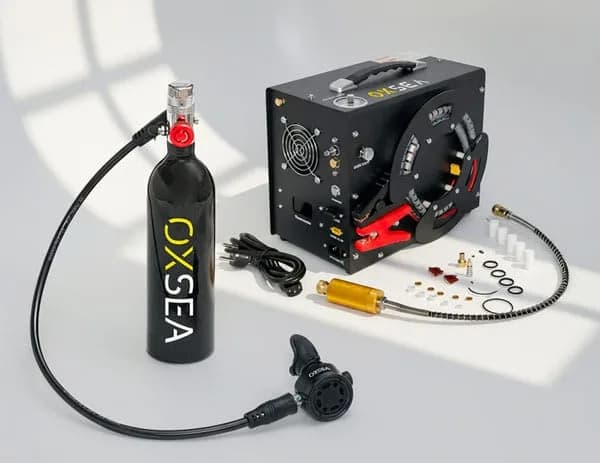
The OX1000 is worn on your back with a harness and an external regulator, which leaves one hand for the collar and the other for the wrench. The OX500Plus can be carried the same way, with 0.5 L of air. With a 0.5 L tank, plan for a refill or a second tank between taking the old anode off and fitting the new one. The OX1000 and mini compressor pack refills on board from the boat's 12 V battery. Our guide on how to refill a mini scuba tank compares the other options, and the mini scuba tank for boats page helps you pick a model.
Safety rules when working under a boat
- Engine off, key out. A propeller put in gear by mistake while you are holding the shaft can cause serious injury.
- Never alone. The recreational diving fact sheet published by France's Ministry for the Sea says never to dive alone. Under a hull, keep at least one person on the surface who can see you and raise the alarm.
- Alpha flag. The same French fact sheet requires dive support boats to fly this blue and white flag for as long as divers are in the water.
- Keep breathing. Never hold your breath on the way up. According to DAN's Alert Diver magazine, an arterial gas embolism can happen after an ascent of barely 1.5 meters (5 feet) with the breath held.
- Fresh water and shore power. Current leaking from a dock or from a boat plugged into shore power can paralyze a swimmer, who then drowns. The Tennessee State Fire Marshal's Office recommends never swimming within 100 yards (about 90 meters) of a freshwater marina. On a lake, do the job at anchor, well away from any dock.
- Marina rules. They may ban swimming and diving inside the harbor. Ask at the harbor office before you go in.
Our mini scuba tank safety guide goes through these rules one by one.
Frequently asked questions
Short answers to the questions this guide raises.
How often should you change a boat's anodes?
When they have lost about half of their size, which BoatUS says usually takes about a year. In salt water, most outboard and sterndrive manufacturers recommend a change every six months. The half-worn threshold matters more than the calendar, so check several times a season.
Can you change an anode without hauling the boat out?
Yes, for a shaft collar anode: two dives, tools tethered to your wrist, engine off, key out, crew on the surface. For a saildrive that requires removing the propeller, or a hull anode with a mounting you do not know, you are better off waiting for haul-out.
Zinc or aluminum anodes: which should you use in salt water?
Both work in salt water. Volvo Penta now recommends aluminum in salt and brackish water, and keeps zinc for parts that have no aluminum version. Stick with the alloy specified in your engine manual.
Which anode should you use on a boat kept in fresh water?
Magnesium, according to Volvo Penta, because zinc and aluminum build up a coating in fresh water that leaves them inactive. Never take a magnesium anode into salt water: it overprotects the parts and disappears very quickly.
Can you paint over an anode with antifouling?
No. Paint insulates the anode from the water, and the corrosion moves to the parts it was supposed to protect. Tape over the anodes when you paint the bottom, and keep the surface they sit on clean.
Sources
External documents this text relies on.
Products mentioned in this guide
Prices include VAT; stock is live on each product page.
Read next
Guides that build on this one.
Guide5 min read
Mini scuba tank comparison: OX500, OX500Plus or OX1000, which one should you get?
A mini scuba tank comparison of OXSEA's three models: refilling, time underwater, how you carry them and price, reviewed to help you find the one you need.
Guide9 min read
Mini scuba tank safety: where the danger lies and how to avoid it
Mini scuba tank safety: where is the danger? Ascent, refilling, upkeep, transport, contraindications. The real risks and the precautions, with sources.
Guide9 min read
Mini scuba tank for boats: getting equipped to work under the hull
With or without a 12 V battery, which mini scuba tank for boats should you carry? Models, refill times, stowage on board and the safety rules to follow.

Everything comes in the pack
Each pack bundles the tank, its refill system and the accessories. Still unsure? Email us and we'll point you to the right one.